Updated Surplus Numbers

Updated Surplus Numbers
Updated Surplus Numbers: Actual surplus 2018 per audit was $85,163.
Boards 2011-2018 implemented policies and procedures with specific goals:
stabilize owner fees, achieve maintenance objectives and achieve annual budget surpluses.
Any surplus was retained by the association.
The board elected in fall 2018 decided to increase owner fees, even in view of a large potential surplus

Average fees prior to 2019

Average fees prior to 2019
Average fees per owner prior to 2019:
RED indicates the consequences had boards continued the fee policies prior to 2010,
BLUE indicates actual fees. These moderated when better policies and financial controls were put in place by boards

Better budgeting could have resulted in lower fees

Better budgeting could have resulted in lower fees
Better budgeting could have resulted in lower fees:
RED line = actual fees enacted by boards,
BLUE line = alternate, fees, ultimately lower with same association income lower had
boards used better financial controls and focused on long term fee stability

Monday, May 18, 2026

Most Recent Unit Sale

0 comments

View from the Balcony


Our former unit was sold, according to Zillow.  The price was $296,000.  This is an appreciation of 29% since December 2022.  The most recent owner did make some improvements to one of the bathrooms, replaced appliances, etc. 

Real estate taxes have increased about 60% in the last 8 years.  According to Zillow the HOA fees are $439 per month. That's an increase of 22% since December 2022. That's a sizeable fee increase, compared to what we (the board I was a member of) was able to achieve.

Fees and real estate taxes now total about $814 per month.  I projected these increases would occur and they are the financial reason we sold several years ago.  I had low confidence in the board's ability to both maintain the property and hold the line on fee increases.  The State of Illinois has been reducing revenue sharing to communities such as Wheaton.  As a consequence, these communities have no choice but to raise taxes.  Illinois is in a fiscal tailspin. 

We moved to a state that has seen an influx of New Yorkers, Californians, Illinois and so on. Some bring their bad ideas with them.


(c) 2026 N. Retzke


Sunday, July 6, 2025

The Owl and the Bomb

0 comments


Albuquerque, New Mexico

We are on our 2025 trek and so we have gone 3,100 miles.  Many stops along the way. More to come.  Currently in Michigan for the 4th of July.

One of our stops was Albuquerque, New Mexico and this time we visited two new places.  The National Museum of Nuclear Science and History, and the Owl Cafe.

The museum was very interesting with both indoor and outdoor exhibits.  About 6 acres of walking space.  

The Owl Cafe is somewhat of a local legend and serves really delicious malts and ice cream shakes.  Many calories!


Here's the Owl Cafe:


(C) N. Retzke 2025


Tuesday, April 22, 2025

Replacing 2012 Chevy 3500 Hood Latch

0 comments

 Moved to RT blog

Hood Latch Spring
Things break from time to time.  A couple of winters ago the hood latch for the engine compartment would not latch while during a trek.  This was very inconvenient and was a potentially dangerous situation.  If the hood is not properly latched it can open unexpectedly while the vehicle is moving, obstructing the driver's vision and an accident. I used a locking cable to hold the hood closed until I could get it repaired.

My 2013 Roadtrek 210P is built on a 2012  Chevrolet 3500 Chassis. I have sufficient mechanical skill to do this type of repair, but doing so takes on certain risk.  Caution: An improper repair may result in a latch failure and that in turn can result in opening of the hood while the vehicle is in motion. That can cause a serious accident with injury or death.   Vehicle repairs are not something everyone can or should do.

For the curious, this post shows what your mechanic would do were he or she to replace the latch.

I accepted responsibility and purchased a new latch part from Tom Auto Parts, Inc. Tolleson AZ. The cost with tax + shipping was $31.88.

Now, I could have gone to a Chevy dealer or a local mechanic, but decided this was something I could do and save a few dollars.  Collecting the tools, doing the repair and cleanup took about an hour and a half.

The most difficult thing was figuring out how to get to the old latch.  I could see a spring was loose, but I couldn't get it to stretch and attach to the catch point.  That's when I decided to order a part and replace the latch. 

To do this required removing two bolts holding the plastic grill against the frame.  I was then able to pull the grill out about an inch, sufficient to get a 3/8 socket to the three bolts holding the latch in place. With the bolts removed I was able to swing the old latch up and out of position.  I was then able to squeeze the clamp holding the release cable in position on the latch. I removed the old latch, and using the new latch I reversed the process, sliding the release cable through the opening in the new latch and pushing the clamp into the hole on the latch. I cleaned the frame and bolts with silicone spray. Then put it all together and using the pull under the dash I released the hood, then closed it and released it again, etc. This to determine it was working correctly.

Here's a few step-by-step photos. I Began by opening the hood and then did the following:


Using a 3/8 socket I removed the left bolt holding the plastic grill in place, 
then did the same for the bolt on the right

I pulled on the left of the plastic grill, releasing it from the frame

I did the same where the grill attaches on the right


I then pulled along the grill to release it from the frame


While pulling on the grill, I inserted a 3/8 socket and
removed the 3 bolts holding the latch in place

I then flipped the hood latch up so that the release cable could be removed


I made note of the routing of the release cable so it would be installed
 in the same manner with the new latch .
I was able to release the cable from the latch by squeezing it
with a needle nose pliers where it enters the latch, and then pulling the cable free.


This photo is after I removed the cable.
The old latch is now free and can be removed.


I then laid the new latch above the location to be installed, aligned as shown. 
I slid the release cable through the hole in the latch and into position.
I then pushed the retainer into the hole in the latch.

I was then ready to dop the latch into position, as shown.
I took care to route the release cable 
so it was behind the plastic grill.
The new latch had 3 rectangular holes.
I installed 3 bolts through the center of the holes.


Close-up of one of the hood latch bolts 


I then went to the driver's seat and pulled several times on the hood latch release lever, to ensure that the cable is free.  Then returned to the hood latch and applied silicone lube to the springs, etc.

I closed the hood, and checked to see that it caught properly, and the hood was snug to the frame.

Returning to the driver's seat I again pulled the hood release lever. I then exited the vehicle and released  the latch completely.  I then raised the hood.  It was important to be able to raise the hood.  At this point I decided that the replacement was complete.

Note: If the hood isn't snug when closed, it would have been necessary to slightly loosen the three bolts holding the latch in place and adjust the position of the latch, then I would have retightened the three bolts.  I would then have rechecked the latching mechanism by closing the hood ensuring was snug, etc.

N. Retzke accepts no liability for anyone else doing any repairs to their vehicle after reading this blog.  Do any and all repairs and modifications at your own risk!

(c) N. Retzke 2025


Saturday, March 29, 2025

Wheaton continues to improve

0 comments

Link to City of Wheaton Website

One thing we do miss after selling our condo in December 2022 is the city of Wheaton.   There are a number of really nice western suburban cities and villages in DuPage County and Wheaton is one of them.  The City continues to invest wisely in the infrastructure and amenities. However, as far as we were concerned it is in the wrong state, and too close to dysfunctional Cook County and Chicago. 

At one time I lived in Chicago.  I left it because of the dysfunction, taxes and crappy public schools. Wheaton too has changed.  The severe problems in Chicago have come to Wheaton as Chicagoans leave that city.  That is another reason why we left Wheaton.  The Democrats destroyed Chicago, making it a divisive city with horrible public schools. It is a matter of time before Wheaton is destroyed, too.   For some idea of what this is like, just look to California.

We do visit the Midwest frequently.  My spouse did get to Wheaton in 2024, but I did not.  She was there on personal business.  I haven't visited for several years.  I am curious about how BLMH has changed.  The boards in place after our departure shut down the HOA website and it seems the only information available to the general public is via the realtors.   Attending a HOA meeting is limited to owners.  In other words, to find out about BLMH requires making a serious attempt to purchase.   When I first came to BLMH it seemed that problems were hidden from potential buyers. I attended many monthly HOA meetings and from time to time there were angry owners.  This reached a crescendo in 2007.  Some felt that they had been misled.  For example, regular financial data was provided to owners and there were short lists of reserve funds for capital projects.  What was not provided to owners were the projected costs of these capital projects.  Nor were there any reserve studies conducted by professional firms whose sole business was providing these services.  One board member ran on a simple plank: I'll keep fees as low as possible.  However, that's a subjective term and in fact, fees increased at rates of 5% or higher each and every year. 

When studies were made it became apparent there were some serious financial short-falls.  This was exacerbated by the fact that the HOA owned infrastructure including water mains, streets, curbs and street lighting.  At one time there was no budget allocation to deal with water main failures, etc.  

In 2010 things came to a head.  The streams were in disrepair and leaking expensive city water, causing damage on the property.  The streets were failing prematurely and water main failures were occurring with regularity.  There was a major roofing project barely begun.  It was a mess. 

It has been said that all things can be resolved in communication. That was one of the reasons I expanded the Newsletter. Copies were hand delivered to every on-site owner.  The others received a copy via US Mail. The newsletters were also posted on the HOA website.  This provided all owners and potential buyers with significant information about the association, its direction and future plans. Annual meetings included lots of slides and charts, etc.  Later boards phased out these types of open to the public communications, and the HOA website, too.  

When combined, the changes at BLMH, the loss of critical board members, the continuous board delays in turning the water system over to the city and the influx of Chicagoans with their very bad ideas prompted us to sell and move on. 

When we relocated we had the opportunity to purchase in a HOA and we said "No, thank you!"

Here's a link to a blog post containing older newsletters and other information.  When I left all updates ceased:

https://briarcliffelakes.blogspot.com/2021/09/blmh-newsletters.html


(c) 2025 N. Retzke


Monday, March 3, 2025

How RVing extended my life and made it better

0 comments


Accepting the keys to our new Roadtrek 210P, December 2013

Our RVing journey began in October 2013 when we rented a Class B in Las Vegas and used it to tour Utah's National Parks.  This led to treks of about 6,000 miles each year and the establishment of two "lily pads" for longer stays; one at the eastern shore of Lake Michigan and the other in Tucson, Arizona.  I've approached each trek, short or long, as possibly the only time in my life I will do it and the one opportunity I have to visit each location.  As a consequence, I make the most of each.

One of the things about life is finding things that fulfill us, make us stretch, find companions, have a purpose and make a difference.  I like new experiences, too. RVing did that and more for me.  I'm one of those people who likes to leave things in better condition than when I found them.  Think of it as applying "no trace camping" to one's entire life. I also like to tinker and take on projects.  RVing is a perfect fit. 

RVing took care of all of the above and more.  After purchasing the Roadtrek, which has been our primary exploration vehicle, we purchased a 30 ft. travel trailer for a Michigan location and a 41 ft. 5th wheel for the Arizona location.  The Roadtrek allowed us to find the campground and resort with a lot of additional exploration.  I took apart much of the systems of the Roadtrek and have become very proficient.  The Roadtrek gave me multiple purposes and what I've learned I applied to our RVs in Michigan and Arizona. 

Summer in Michigan

Our "lily pad" in Michigan, ready for winter


Assembling the deck in Michigan

Our Arizona "lily pad"

We had reached a kind of equilibrium and were comfortable with our Michigan and Arizona "lily pads".  One was in a mega-resort with all kinds of activities.  Tucson has a lot to offer, too.  After covid fear receded we decided to resume our travel plans of about 6,000 miles each year.  Each year from 2013 to 2019 I reduced my working hours.  By 2022 I was remote working for about one month a year.  

However, things came to a halt in 2022 when I became gravely ill. I was diagnosed with an unusual, rare tumor.  It was an inoperable, deadly cancer with at best a 15% survival rate.  In the fall of 2022 we began planning how to deal with this, became permanent residents of Arizona and I sought medical treatment.  It didn't look good. 

When I was diagnosed with a serious illness, it became a new hobby (just kidding). My life's work and dealing with adversity had prepared me for this fight.  I was mentally ready to take it on, had the financial resources to relocate permanently and we knew where it was that we would domicile. That location would provide better medical care with less stress on my spouse.  Overall, I was in poor shape. In early 2023 my urologist suggested that “It might be best if Norm goes into hospice”. But I didn’t and decided to work my way back to a more “normal” life. At one point my radiologist marveled “You are made of stern stuff”.  It took more than two years and with the grace of God, here I am. Stable. That’s better than the alternative.

While undergoing treatment I did my best to live a normal life.  It was difficult. My weight had fallen from 170 lbs. to 135. At first, I needed a walker to get around. But I continued to do RV maintenance. As time went on, I progressed to a cane and finally was able to get around without such support. I frequented the gym at the resort to use the stationary bicycle, beginning with 5 mile trips.  As time went on, I increased the exertion level. 

While treatment continued G and I discussed future travel plans.  However, there needed to be some changes.  On change was our 5th wheel. I could not maneuver inside, and we spent a month in an ADA compliant room at the resort hotel.  The resort has RV areas and park models, affectionately called "candominiums".  It also has a section with manufactured homes and a section of condominiums.   Friends had been assisting us in finding a "home" on the property.  It isn't unusual for manufactured homes to be sold before the listing goes up. Location, condition and floor plan plays a part in this.  G look at several but was dissatisfied. Friends gave her a heads up about another.  She went to the real estate office and toured that home the day it was to be listed.  Excited, she and I talked about this, I hobbled over on my walker and viewed the place.  We talked for a couple of hours; it would be a financial stretch, but we tendered an offer, it was accepted and voila' we were soon to be homeowners. We put the site of the 5th wheel up for sale and did the same for the RV.

We were now down to two RV's!  

Arizona site ready for sale!

As I progressed from radiation therapy through chemotherapy, I began scheming about how to get back into the Roadtrek.  This wasn't possible in 2023.  However, by the time I was in immunotherapy and my stamina improved, this began to look like a real possibility. However, I did have two nephrostomy tubes and a compromised immune system to contend with.  I continued to take on more difficult chores, assembling furniture for the new house, taking on certain repairs and so on. It was a slow, difficult process.  There were setbacks, far too many to list here. Certain physical issues made it imperative that I be within a short distance of a bathroom!

Radiation Therapy Graduation Board - I had made it!

Chemo access prior to the installation of the port

In March 2024 we attended the FMCA RV expo at the Pima County Fairgrounds near Tucson.  We were with the AZ Roadtrek Chapter. This was local and we decided to do a short RV trek.  It was a trial; it was a success and got us out of the cobwebs.

March 20, 2024 - Pima County Fairgrounds

After months of immunotherapy and several nephrostomy tube exchanges I discussed travel with my oncologist.  I told him I wanted to live as near a normal life as possible.  Let's call it "a new normal".  He agreed that I could skip a session.  That opened the window for a 3+ weeklong trek.  At the appointed time we were off in the Roadtrek! It was a press because time constraints wouldn't allow a leisurely trip.  I did most of the driving, too.   We had been away from Michigan for nearly two years.  On arrival I nervously opened the trailer, half expecting to interrupt a menagerie of critters that had moved in during our absence.  But our trailer was pristine!  We did see a small problem with the roof and I contracted to have that fixed. 

2,000 miles one-way, August 2024

The trek was a success! Upon return to Arizona G and I immediately began planning a second trip.  In September we returned to Michigan.  I wanted to inspect the repairs and prepare it for winter. We had our final campfire on September 16, 2024.

Final 2024 Michigan campfire September 16

Today, I'm "stable" and we are planning our 2025 adventures.  I’d say working longer and RVing altered my life for the better, in many ways.  My twin died of medical issues 20 years ago, a younger sibling also passed of illness at 50.  My parents both died of illness at 70-71.  I’ve lived the life they didn’t have the opportunity to.  Perhaps I’m the outlier. Working and dealing with adversity may have prepared me for this fight.  Having the purpose of again RVing and everyone's prayers definitely spurred me onward. I don't know how long I'll be in this sweet spot, but I am enjoying it!


(C) 2025 N. Retzke

Monday, December 30, 2024

Corporate Transparency Act (CTA)

0 comments


The Corporate Transparency Act (CTA) was passed in 2024.  Under the CTA, corporations were to file a Beneficial Owner Information Report (BOIR) on or before January 1, 2025. BLMH is a Not-For-Profit Corporation and so it is mandated to file these reports.

However, this has been going through the courts and there was a stay order. As of December 26, 2024 the 5th Circuit Court of Appeals reimposed the stay “… in order to preserve the constitutional status quo while the merits panel considers the parties’ weighty substantive arguments…

It is unknown of BLMH has filed the necessary documents.  The association's attorney has stated "For some associations, filing the BOIR now may be advantageous to avoid the uncertainty of evolving requirements and deadlines, as well as to maintain Board member engagement on the issue. For others, there may be value in waiting for the appeals process to conclude. It ultimately depends on whether your association prefers to step off the rollercoaster of CTA uncertainty and hedge its bets."

I'm no longer involved in the operation of BLMH.  However, I think owners would want to know where the board stands on this.  Failure to comply with such mandates usually involves fines, legal action and otherwise unnecessary legal fees.  These all raise owner's Fees.  

Happy New Year!

(c) 2024 N. Retzke


Saturday, December 3, 2022

Final Post - We sold our condo

0 comments


Our condo

Bookmark and Share

Several years ago we decided to sell our condo.  We had two options:  Rent it or Sell it.  BLMH by-laws permit rentals.  However, we decided we didn't want to do that.  Furthermore, we didn't want to sell it to an investor.

Circumstances intervened, including the CCP Covid-19 pandemic. So our plans were delayed several years.  We had established places to live in two other states because we are RVers.  So, the condo sat fallow most of the year.

In 2020 I decided it was time to permanently close my business, and I went through the office furniture, etc. and cleared it out.  In the fall of 2020 we spent some time on the east coast.  That delayed preparing the condo for sale. Then winter set in and we headed to the Southwest. In June 2021 we rented a U-Haul and took some choice pieces of furniture to our winter location.   Upon return to Wheaton we helped a neighbor move. Then winter set in and we headed to the Southwest.

Finally, in spring 2022 we began prepping the condo for sale.  Residuals from my business were disposed of. 

In June and July I emptied the home office.  I scanned old documents and photos and tossed the originals.  A professional service shredded documents and hard drives. 

There were a number of minor repairs to do, and these were completed in July, August and September, while we pared our belongings. 

We gave a lot away to Amvets and Goodwill.  The condo was ready for staging in early October and the condo was placed on the market on October 6.  We immediately got several offers from investors, but we noted issues with the contracts.   

A short time later an individual buyer made an offer and we accepted.

The closing was scheduled for late November, early December and has been sold.

Good-Bye to Illinois. 


Monday, December 27, 2021

Projects reports to Boards and to owners

0 comments


Project costs of 2018,
presented to owners during the 2018 Annual Meeting

Bookmark and Share

Project reports to the HOA owners and the board are useful.  It is important to track expenditures but in my experience, boards at BLMH didn't do a good job of tracking the actual long term project costs.  There are a variety of reasons to do so, including the building of better budgets and the preparation of owners for positions on the board.

Of course, this information must also be responsibly communicated.

I prepared a variety of spreadsheets and charts as a member of the board 2010-2018.  This is one in a continuing series on the benefits of doing this.  Owners get better insights, and the board can make better decisions, if they choose to do so.  See Notes 1, 2, 3 and 4 as an example.

The chart above was presented to owners during the September 2018 annual meeting.  That was my final meeting as a board member. (Note 1).

When I was a board member, I created spreadsheets as condition reports and surveys to present to the board so the board could properly perform its fiduciary duties and maintain the property. I also created spreadsheets to track project expenditures as the board voted to perform that maintenance.  To be clear about this, Management did provide this information in a different form and presentation to the board each month via the monthly "Information Packet".  However, my goal was improved communications and better board decisions.  The board's decision to replace management effective January 1 means I can't say anything about the future.

In 2018 I made a sheet and presented it during the annual meeting, so owners could see where the board was spending the reserves.  I did similar sheets for a variety of projects completed or undertaken during previous years.  I was on the board for eight years and millions of dollars were spent on roofs, drainage, streets, water mains & fire hydrants, driveways, garage floors, streams, common decks, unit patios & property bridges & decks, tree removal and replacements, and so on.  

I do have a very good idea of how much was spent and where.   How is that?  Because I paid attention and kept notes and made spreadsheets.  The chart below is an indicator.  I held a variety of positions over an eight year period, including Maintenance, Architecture directors, and president. I made it a point that that these financial insights were all thoroughly discussed.  Owners, who are the shareholders of this not-for-profit corporation, were informed during meetings and via the newsletters. 

There is no requirement that owners attend association meetings, although I also made it a point as a board member to promote that they do, and I rewarded those who did with informative meetings. 

As an example, I included the chart above as part of presentations to the board and to the owners during a regularly scheduled meeting and I telegraphed it via the newsletter.  I would have included more and at times I even expended the pages in the newsletter to provide additional information.  

Not all board members agreed, and some remain on the board to this very day. Since 2019 that has been reflected in the newsletter and in the termination of the BLMH.org website by the board in 2021.

Even the "Welcome Packet" was allowed to wither by non-supportive board members. It hasn't been updated, nor is it available online.

(C) N. Retzke 2021


Saturday, December 18, 2021

Creating Budget Surpluses through better Processes

0 comments


Budget status August 31, 2018, prior to annual budget meeting

Bookmark and Share

This post will compare two budgets. The 2018 annual budget included a zero percent fee increase.  This was not an accident, nor was it a financial gamble.  This was the last budget I participated in at BLMH and it was one of a series that created a surplus.  In other words, the board ran the association in such a manner that all work per the Operations & Maintenance (O&M) budget was completed, the Replacement Fund (reserves) were fully funded, but not all owner fees were spent to accomplish this.

2018 was the culmination of 8 years of hard work and planning. 

Creating annual budgets was a challenge during my board tenure, from September 2010 until September 2018.  This period included the "Great Recession" and fallout from the 2008 banking crises. We experienced owner fee delinquencies that exceeded $80,000 in one year. Yet, we stabilized fees and avoided the 3 to 7% annual fee increases of earlier boards, and we simultaneously eliminated an extensive maintenance and repair backlog.

During this period Homeowners Associations (HOAs) experienced severe financial difficulties. Some owners found that they could not afford to pay the mortgages and HOA fees. Dealing with this was a challenge for boards.  To do so responsibly as a board member required that owners be held accountable for their agreements. In other words, all owners were equally and fairly required to pay their fees.  The budgets were constructed with that understanding, even though some owners did not, and some foreclosed.  As a consequence, annual "bad debt", which is uncollectable fees reached a peak in 2013 and 2014 of about $30,000.

Commencing in 2011 significant changes were made to better monitor and control the fallout of delinquencies and foreclosures, and in so doing, shield other owners from the consequences of their neighbor's misfortune or financial mistakes.  Earlier boards had never considered such problems and so there were limited financial controls in place.  I saw the handwriting on the wall in December 2006 and so I began preparing.  Few would listen at the time.  By fall of 2008 owners elected a new board with no prior HOA board experience, and very limited business experience.  Some said "We have enough money" but I attributed that to denial.  It wasn't until September 2010 that things had become so ugly that desperation set in among owners and some board members.  So, I got a seat on the board but it was solely because of an earlier treasurer who created a vacancy for me.  "You can lead them to water, but you can't make them drink" is an old expression.  

From the period 2011-2018 the board was diligent in collecting fees.  I've written about that in other posts.  Even so, there were significant delinquencies and "bad debt" which is owner fees and related legal collection expenses which were owed the association and never collected.

Delinquencies and "Bad Debt" 2009-2018

As a responsible fiduciary I worked to construct budgets which would balance, keep fees to a minimum, maintain the association and a balance. It isn't possible to create a "perfect" budget in which expenses match the forecast made in the prior year. As a consequence, budgets were designed to create a small surplus each year.  Of course, that might or might not occur.  The budget could balance, but it was paramount not to overcharge owners, or create a shortfall which would be an issue for the next year's board to deal with. So, I led boards in creating budgets which could include a small surplus.

That small, anticipated surplus was to be a cushion.  If such a surplus did occur, it was a contribution to the Replacement Fund (reserves).  This was important because there were failing roofs at end of anticipated life as well as failing streets and failing water mains that had to be dealt with.


Sunday, December 12, 2021

Patio Condition Survey

0 comments


Patio Survey - My Spreadsheet September 2012
Survey by our Manager and I.
Presented to the board in September 2012

Bookmark and Share

After I joined the board in September 2010, I initiated a lot of onsite surveys.  These were a necessity because the board was unaware of the condition of much of the infrastructure.  The earlier board had left in September 2010 but did not turn over condition reports to the new board; I suspected there were none.  Management provided whatever they had and that became the beginning of regular, annual surveys from 2011-2018.

I did the survey, for some of them management joined me, and for others another board member joined me.  

The need for these surveys became apparent when several owners approached the board in September 2010 and reported issues with garage floors. The board considered a repair, but I asked if we had a list of the condition of the 84 garage floors on the property.  We didn't.  I asked the board to delay a replacement until a proper survey could be made.  The board agreed.  

The garage floor condition survey was conducted in early 2011 and was reported to owners in the May-June 2011 Newsletter.  That survey revealed eleven garage floors in "poor" condition. The article is available by clicking here:

May-June 2011 Newsletter - Garage Floor Survey

To avoid any confrontations, I would never do garage or patio surveys unless accompanied.  

Patio Survey

The garage floor survey was the first of many, regularly scheduled annual surveys. 

The patio survey in the image above was submitted to the board in September, 2012.  One board member, who had been on boards for a couple of decades contested my findings.  It was her position that earlier boards believed that they had repaired all of the patios.  The facts and owner statements disproved that.

I conducted a formal survey because I observed some patio issues during my normal walk-arounds on the association property.

All of these surveys had the intention of best directing maintenance resources and avoiding breakdowns.  All resources were paid for by owner fees, and breakdowns would be at a minimum an inconvenience for owners, and at worst, require higher repair costs.  Higher costs result in higher fees.


(c) N. Retzke 2021

Sunday, November 28, 2021

Streams Project

0 comments


Waterfall #2, new walk and bridge - partially completed status in 2014

Bookmark and Share

In 2010 the HOA Board decided that the streams at this condo association were to be maintained, reversing two decades of decline.  The streams are an important architectural feature of this homeowners association. This video indicates project highlights, which required 6 years and included decks, bridges, 3-manmade streams, pump pits, pressurized water lines, and the installation of retaining walls and numerous concrete repairs. I led this long term project, and the replacement of 500 feet of water mains, a major street, replacement of 26 large roofs 2011-2014, 60 driveways and numerous garage floors as well as drainage and lawn improvements 2011-2018.

The decision made in 2010 was made at a time that owners were struggling with the consequences of the banking disaster of 2008, and the recession of 2007.  There were foreclosures and delinquencies.  The board had to answer the question "Do we need to implement a cost reduction program?" and "How to go about reducing costs?"

One item discussed was the streams.  These are man-made, two were in poor condition and all use city water at HOA expense.  Shutting them down would reduce maintenance and utility costs. On the other hand, they couldn't simply be abandoned.  The board would have to come up with a plan to remove them.

Here's the owner delinquency situation.  At the time of these discussions the delinquent amounts were spiking:

Delinquency Amounts 2008-2018

The board in fall of 2010 decided to maintain the streams and replace a failed pump. At the time, I told the board this decision would have long term consequences and as a board member I set about designing a program to restore the streams and reduce water consumption.

The program needed to wait until the roofing project was completed.  We also needed to address serious problems with Lakecliffe, a street which was failing.  Most driveways needed to be replaced and numerous garage floors had issues.

It took a number of years to complete the project envisioned in 2011, and the significant steps were completed in 2018.


A 15 minute YouTube video:

https://youtu.be/6-hM55JWLzs

Notes:

  1. The man-made streams consist of an elevated waterfall and concrete bowl.  Water flows downhill from the bowl, via manmade streams to a crushed stone pond.  At the pond a pump, buried in a pit, pushes the water back to the waterfall via a buried pipe.  The elevated, concrete bowl is built above a layer of clay.  Cracks in the bowl allow water to escape into the soil, below.  The water migrates through the soil, flowing downward until it reaches clay, which is a barrier impervious to water. Upon reaching the layer of buried clay, the water continues to flow downhill along the surface of the clay.  At Stream #3 that flow is toward Lake #4. Decades ago, a wall was constructed adjacent to a building and drain tiles and crushed stone installed to divert water around the building, with limited success. Additional work on that drainage system was included as part of the streams project.
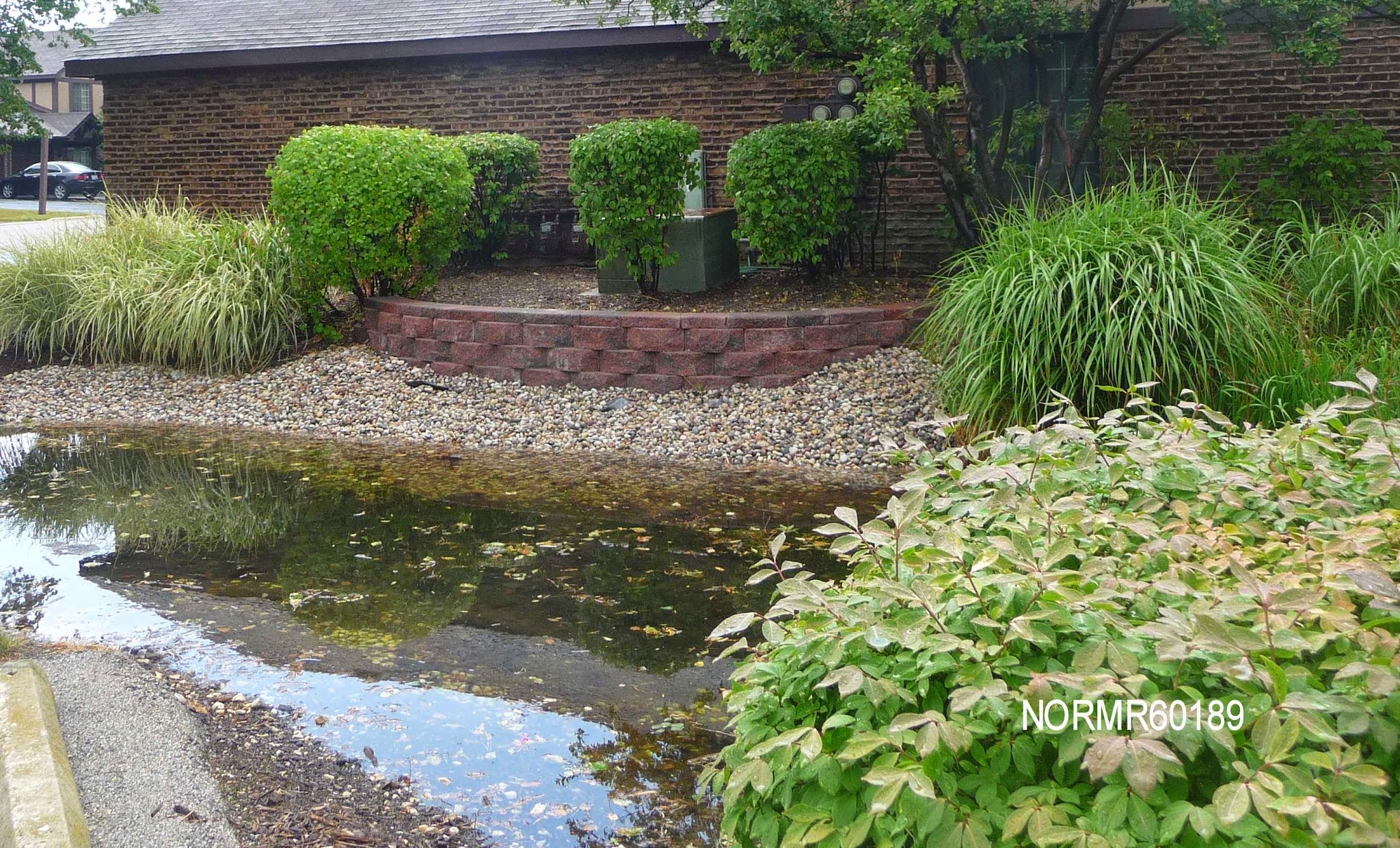
  2. Actual annual operating costs include water and electricity for the pumps. Water is required to initially fill the streams and water replenishes that lost via leaks.  The ponds can and do overflow particularly during rainfall.  The property is not level and has about 15 acres of turf. Rain water and snow melt flows from roofs and will find its way to some of the streams. This can exceed the capacity of the ponds. (See photos, Note 15).
  3. During warm weather the waterfall pumps must operate continuously.  If the pumps stop, the streams will empty.  They must then be recharged with costly city water.
  4. The stream water pumping systems are maintenance items and can failure. Because the pumps run continuously for about 6 months each year, a pump will wear and will require maintenance after 3-4 years.  The water lines to the waterfall are under pressure and these can and do fail.  The line for Stream #1 did and a major section was replaced in 2018. The pump pits were installed in 1978. These were galvanized steel.  These rusted and failed, allowing water and mud to fill the pits, burying the pumps and making pump maintenance costly and difficult.  During the stream project all of the pump pits were replaced with heavy duty plastic double walled cylinders suitable for direct burial. Other mechanical improvements were made to reduce the labor required to maintain the pumps and pits.
  5. During the work on the streams, waterfalls and ponds, a lot of grading occurred to direct the flow of seeping water away from buildings.  Such water can undermine concrete patios and building foundations. Additional direct burial piping was installed to direct such flow to storm sewers and to streams.
  6. The bowl for Waterfall #1 was replaced.  Repairs were made to the bowl for Waterfall #2.  It is likely additional work will be necessary on the waterfall bowls, in particular at Waterfall #3 if the seeping of water through cracks is to be further reduced. 
  7. The streams project was delayed by other, more urgent and expensive projects. The overall state of association infrastructure was "disrepair" as of 2010.  The stream project required detailed cost analysis.  The reserve studies of 2010, 2011 and 2015 were helpful. G& D Management and the contractor who did the work were essential, as were the maintenance company.  It was necessary to identify issues, determine solutions and costs. Concrete technology has advanced and we used a concrete for parts of the project that included strong fibers dispersed throughout the mix. The additional cost of this advanced concrete was minor. 
  8. It was a goal to reduce operating costs.  These costs include labor to maintain and repair, water consumed and electricity. This project is not complete.  My plans and notes are included in seven boxes of documents, drawings, sketches and notes I accumulated 2011-2018.  Some board members had little interest in this information. It will be shredded and will vanish, as did the years of Newsletters the boards of 2019-2021 deleted from the official association website.
  9. Some board members have preferred splashy, expensive landscaping projects at the ponds, rather than maintaining the system. Such eye candy should only be done after the maintenance is done. For years it wasn't.  The Landscaper promoted these expensive and profitable projects, the owners appreciated the eye candy and re-elected those boards. Shrewd board members, interested in re-election accommodated.  However, this deferred needed maintenance, ultimately contributing to the demise of the stream system and higher costs and owner fees.
  10. The waterfall and pond of Stream #3 was found to be in the best condition. A large deck had been installed earlier (in the 1990s?). However, thereafter the other stream systems were ignored, or maintenance suspended and relegated to patching small problems.
  11. The stream project began in 2013 with the identification of sub-projects and phases of the work.  Actual concrete work began in 2014. A portion of stream #1 between Thames and Lakecliffe was repaired. That section, from the gazebo to the pond was muck.  It was dug out, a layer of clay placed, then a liner and crushed stone above.  The gazebo which was rotting was removed. It was planned to install solar shales, but one board member wanted wood.  So nothing happened. 
    Commercial quality solar sails
    Photo from Newsletter July-August 2017

  12. In 2014 an engineering study of the streets provided sufficient information to determine a course for action in dealing with the failing streets.  The street project would occur 2014-2022 if the boards agreed. Lakecliffe, Salisbury were replaced 2014-2018 with patching of Dover, Harrow, etc.  Significant work remained for 2019-2022. In the spring of 2015, an updated survey of the streams was conducted with management. The completion of Lakecliffe and Salisbury streets were anticipated and in 2015 a schedule was created for completing or patching the remaining streets.
  13. I videotaped the stream survey and presented it to the board. We discussed the scope of the work and I proceeded with detailed planning.  That videotape is incorporated in the YouTube video and in included in its entirety.
  14. During the period 2013-2018 significant repairs were made to the water mains on the property.  Several fire hydrants were replaced, several B-valve shutoffs were replaced, and about 500 lineal feet of water mains were replaced.  This too had to be balanced with all of the other maintenance projects.
  15. Not all board members were supportive of these efforts.  Special thanks to the President 2012-2015, and the Treasurer and Maintenance Director who departed the board in the fall of 2018.  They were the prime motive force to accomplish many of the projects at BLMH.
  16.      


    One year after I had this retaining wall put in,
    the board voted to hire a landscaper to replace it with large slabs at great cost!


(c) N. Retzke 2021