Updated Surplus Numbers

Updated Surplus Numbers
Updated Surplus Numbers: Actual surplus 2018 per audit was $85,163.
Boards 2011-2018 implemented policies and procedures with specific goals:
stabilize owner fees, achieve maintenance objectives and achieve annual budget surpluses.
Any surplus was retained by the association.
The board elected in fall 2018 decided to increase owner fees, even in view of a large potential surplus

Average fees prior to 2019

Average fees prior to 2019
Average fees per owner prior to 2019:
RED indicates the consequences had boards continued the fee policies prior to 2010,
BLUE indicates actual fees. These moderated when better policies and financial controls were put in place by boards

Better budgeting could have resulted in lower fees

Better budgeting could have resulted in lower fees
Better budgeting could have resulted in lower fees:
RED line = actual fees enacted by boards,
BLUE line = alternate, fees, ultimately lower with same association income lower had
boards used better financial controls and focused on long term fee stability
Showing posts with label Observations at Meetings. Show all posts

Wednesday, February 24, 2010

Board Operation, Some Examples and Fiduciary Duties revisited - Part IIa

2 comments
"In successfully run homeowners associations, members of the board of directors possess good communication skills, carefully plan in advance, make good judgments based on sound decision making practices, delegate work to qualified committees or advisors, exercise initiative and independent thinking, and work well together as a team. In contrast, political or fiscal failures often result from the acts or omissions of boards of directors lacking good communication skills, procrastinating necessary work, making bad judgments without seeking input from committees or advisors, stagnating for lack of initiative, or political stalemates caused by dysfunctional personal relationships among the board members. From this perspective, the exercise of fiduciary duty flows naturally from effective business management, and it is the breakdown of good management practices, and the lack of skilled leadership, that breeds claims for breach of fiduciary duty."(6)

This is the second post on this subject and the first half of Part II of a multi-part post. In these posts I'll reference and quote a few sites and professionals, and provide a few "real world" examples. This will illuminate some of the issues faced by our board (or any HOA board) and a few of the issues when performing one's fiduciary duties. The next post will go into this a bit further.
I suggest the reader take the time to visit the links at the end of this series of posts, for further information. 
I am of the opinion that our board has been operating at a "technical" level. There are more than a few reasons for this. There have been and continues to be loosely defined responsibilities and accountabilities among members of the board. I think there is a perception that they must keep a "majority" of the unit owners happy and contented and at other times also cater to the whims and complaints of other groups. They may see their principal job as overseeing the maintenance, landscaping and other firms which support this organization. They may perceive their "duty" as bending the rules by reducing the enforcement of the rules, so that no one is offended and no one is compromised. Of course, in such a situation we are all compromised. If they are, in fact, attempting to operate for the majority of us, rather than for all of us, is it any surprise this association is sinking into divisiveness and petty complaints?
The irony is, the group that initiated this was all about a shift from a business model to a social model.  They seem to have become that which they most abhorred! Isn’t there an expression that "What you resist, persists"? Perhaps this is why our HOA is becoming a field for power plays, resentment and passive-aggressive behavior? I'll let the board and our great thinkers answer that one,  because whether they know it or not, they do, in fact, "lead by example".
I have recommended, in writing, that our current board attend a session with attorney and workshops to improve their understanding of the meaning of their "fiduciary duties".  This would be a mandatory assignment for all board members. Failure to attend would require resignation. In this small, intensive and "hands on" workshop, there are numerous questions to be asked, and answered. What are the issues and the practical application in an HOA? How to run an association for the benefit of “all” and avoid catering to the majority or other groups? How to balance the business aspects with the social aspects and properly enforce the rules and regulations? How to deal with dissension among unit owners and divisiveness among board members and successfully complete and uphold our duties? What is the proper conduct for a member of the board?
Here is the first of several examples, to illuminate the question "what are fiduciary duties". Sometimes it is useful to determine what something "is" by determining what it "is not". Or, what actions "are" consistent with fiduciary duties, by studying actions that "are not". Here is a list of recommended actions:
(1) "What actions can community association boards take to limit claims that they have breached their fiduciary duties?
In general, we offer the following advice to community association board members:
1.     Understand the association and its operations.
2.    Devote time to association business and actively participate in decision-making.
3.    Select and support good management.
4.   Seek the advice of professionals and listen to the advice those professionals give.
5.    Avoid making decisions solely based on popularity or to quiet dissension among neighbors.
6.   Serve the association altruistically, without compensation or special treatment.
7.    Conduct business at arm's length and for the association's benefit, not your own.
8.   Document the decision-making process in the association’s minutes, including professional advice received, for all major decisions."

I suggest the reader re-read the above. I’ll use some of the above in a few “real world” examples.
Let’s start with Number 3. Last year, there was open hostility toward existing board members, management and our professional maintenance company. It seems that the position was taken that one doesn't have to support management if they truly believe that management isn't "good". Really? REALLY? Certainly FUPM's communication methods with unit owners were under par; there were sufficient unit owner complaints about that. But it went further; why, ”we all knew” that management isn't good, didn’t we?  Question: Who is the "we" and how do we know what we know?  Well, I take another view. I think that it is the role of the board to support management, to guide management in correcting their inadequacies as part of the "partnership" that exists in running this HOA. And vice-versa. Instead, it became very clear that our management firm was in the crosshairs of a few. But the storm seemed to “blow over” and nothing happened! Actually, something did happen, and management now appears to be far more compliant to the wishes of the board, including the board's position on "hot button" items such as unit owner fees.
Current or recently elected board members have chosen to listen to management when it serves the purpose and position of some of the members of the board, and management seems more compliant, sometimes defending the position of certain board members during association meetings, etc. This year, management made an about face at the budget meeting of the association and made a statement which was something like "management does not believe a fee increase is necessary at this time." This was immediately seized upon by most of the board and has been used to justify their vote, to hold fees constant. How is it that members of the board can have it both ways? Management is “good” if the information it provides suits and supports the position of the board, and yet management is also “bad”. How can that be? Our treasurer, an experienced board member, stood his ground and did not cater to the "will of the majority". Good for him.
Number 5 seems to be a reoccurring and very difficult one. Is the goal to please people or keep them happy and thereby seek re-election? At times members of recent boards have seemed to promote and favor the wishes of groups, including the ever changing and nebulous "majority". Our current board may be accelerating the movement in that direction. Forms are being prepared with questions for unit owners to answer. From this, the position of the majority on key issues can be tabulated. Of course, since nearly half of our membership doesn't vote, it would be "common sense" that the majority will not respond to these forms.  There is a problem here. A group is a group. Satisfying the needs of the majority at the expense of a minority is "making a decision based on popularity." I thought an association is to be run for the benefit of "all" members. Any time the board of an association operates by seeking approval from a group of unit owners and then attempts to justify their actions because of the "will of the majority", it is headed down a very slippery slope. Consider for a moment the possible rationale of such a board. "We are merely doing what our membership is asking us to do." Is that leadership, or politicking?
Our board will have to make unpopular decisions. It appears that their current rationale is to attempt to offend as few people as possible. That in and of itself, is neither "good nor bad". However, it is not a valid approach if the principle goal is to be "popular or to quiet dissension among neighbors."
The board must uphold the condominium act, must collect sufficient funds to properly maintain this property (common elements) and in other ways "protect unit owners from themselves". That will include unpopular actions. Interesting, but no one asked me if I was for or against a fee increase during the budget planning period, and it’s my understanding that board members don’t read my blog. I suspect some don’t read my letters which are routed through management, either. Is it possible that the justification for this is their position that I am not a member of the majority, or some other special group? Since when is that a criteria? The only approach which is acceptable is for our board of managers to make decisions in good faith and with a rational and informed basis, which is to say, "in a manner each director believes to be in the best interest of the association, and with such care, including reasonable inquiry, as a prudent person in a like position would ordinarily use under similar circumstances." That is why I have taken the position that each and every board member should be willing and able to discuss their votes, and provide their basis and reasoning in reaching that vote. Is it possible that reading this blog would be a part of being “informed” and making “reasonable inquiry”? It certainly isn’t if the goal is to only read that which supports one’s preconceived notions.
If there is a desire or emphasis to satisfy the purported "group or majority", it is inevitable that some unit owners will be given short shrift.  I'll use the example of the change from guest parking to unit owner parking, which was discussed and voted last year in our HOA. During the unit owner's portion of that meeting, a unit owner made the request that the board consider preserving some of the guest parking as handicap parking. Some board members began discussing this, including the fact that the "guest" spaces did provide level asphalt for egress from vehicles, but it was quickly passed over in the rush to vote for the conversion of all "guest" parking to "resident" parking. As I recall, this had been promoted earlier in a survey. It seems that this conversion was the "popular" decision to make. If such a stance is taken, doesn’t that mean that the issues and the votes will go whichever way the wind blows. Is this leadership?
Continuing to another "popular" item last year, there was a request to change the rules to allow lawn posting of unit "for sale" signs. These are currently permitted only in windows. This item did not make it to a vote by the board last year. It will resurface. I don't have a personal opinion, either way. The questions for the board to answer in considering this would fall under the umbrella “How does this serve, enhance, or detract the entire association?” Some of the specific questions could include: 1) What is the recommendation of management, and why. 2) What is the opinion of professionals and who are they and why did they state what they stated. 3) How does this serve all the members of the association and why does it do so; alternatively, which members of our community are not being served.  4) Who made the request that the board consider this change. 5) Are there any costs or liabilities to the association in doing this, 6) What would be the effect if 20, 30 or more signs were posted? 7) What would need to be done to control the posting and maintenance of these signs. 8) What rules would be necessary for esthetics, such as to keep signs “neat”, maximum size and quantity per unit, 9) Could or should signs be removed by the association and under what basis? 10) Should a fee be extracted if there is any requirement for cleanup by maintenance, for example, damage to lawns, signs scattered on the grounds, etc. 11) Who is responsible for damage to lawns, etc. 12) In considering this at this particular meeting, what other business needs to be considered by the board at this time and which may be of higher priority due to scheduling, weather, breakdowns, etc.
And then there are requests for "garage sales" and "association parties" on the property, and so on. These I am certain will again come before the board. So how would one, if on the board, present this? I suggest that a "reasonable inquiry" in this example would include, at a minimum: 1) What was the cost to this association when the last injury case came before it in legal action, 2) Has the board considered the "experts" position regarding the possibility of legal action against this association, for example, noted attorney Mark Pearlstein's statement that "60% of all condo boards and homeowners associations in Illinois are involved in some kind of legal suit" see Our "City within a City" , 3) What was the increase in insurance rates the year following that last legal injury case, 4) What is the cost for rider insurance for each party or activity; last year it was initially stated to be nothing but later it seems a rider was quoted at $4,000, 5) Did our board budget funds for this insurance in 2010, 6) Is this a prudent use of unit owner fees, 7) Is it possible to control visitors and if so, how and if not, is that a problem or could it be a problem for unit owners. 8) Specifically where on the property would this occur and what limitations would be placed on unit owners. 9) Are there any safety or legal issues to be considered. 10) Has legal counsel been consulted. 11) Who will pay for any cleanup costs, damages, wear and tear, etc. and how will this be collected. 11) What restrictions will be placed upon unit owners who participate or organize these events. 12) What other restrictions would be necessary so as not to interfere with the lives of unit owners who choose not to participate, for example, what dates, times, day of the week, etc. 13) Who does this serve in the unit owner body, and who might it not. 14) In other cases, this board has taken the position that all unit owners in the immediate proximity of unit owners who want to make certain changes must be consulted and must give approval. Would that not also be appropriate for these types of events? If not, why not?
If the above questions are not asked by the board, then are they in fact "acting in good faith and reasonable care" in exercising their duties and responsibilities?   
As another example, I want to present the discussion last year of the ongoing upgrade of the railings on second floor patios. You may recall the meeting in which some board members challenged the necessity of doing so. Unit owners attending the meeting expressed anger over fees and the apparent willingness of the board to waste money. The new board members stated that this was a problem because 1) we are not currently required by our city to provide this improvement, and 2) There was issue taken that our maintenance company was doing the work, and making money doing what seemed to be an unnecessary task. During the discussion that ensued, our professional management stated 1) This was being done as a pro-active measure, it was also stated by other board members that 2) The association has, for a period of years, been providing free screening to cover the open areas of the older style rails to any unit owner who is concerned about the size of the openings or have children or pets and request this. 3) Management and the architectural director stated that while not currently mandated by code, this has a safety component and the association has been pro-active in doing this. 4) The existing board stated that by doing it this way, the association can spread the costs over a period of years and coordinate with the painting schedule of the buildings, 5) It was stated that all aspects of decks have been a particular concern of the association ever since the notorious collapse of one in Chicago several years ago and the litigation that created, 6) The architectural director stated that the association routinely maintains and repairs common elements, including the concrete first floor patios. The maintenance of railings would therefore seem to be appropriate for second floor owners. When the vote was taken, the board decided to continue the replacement of balcony railings on the normal schedule.
In the above example, was the decision appropriate to "fiduciary duties"? Were the explanations reasonable? Did the board seem to understand the operation of the association? Was the board supporting management? Was the advice of professionals sought and considered? Was this made as a popular decision? Was compensation to board members involved in the decision making? Was the decision made "at arm's length" and with no political or other reward?
Looking into it a bit deeper, is the association responsible for the maintenance of common elements and secondly, is the association required to provide adequate or necessary safety measures for common elements? The answer to both of these questions is "yes" and by addressing this issue, was the board of managers "acting in good faith, with a rational and informed basis for their decision?"
===========================
References, Errors, Omissions, Additions:
(1)  Colorado HOA Governance
(6)  HOA Law - Jeffry A. Barnett, APC
 * Miscellaneous spelling, grammar and typographical corrections.
===========================

Sunday, November 15, 2009

Well, We Almost Made It!

8 comments


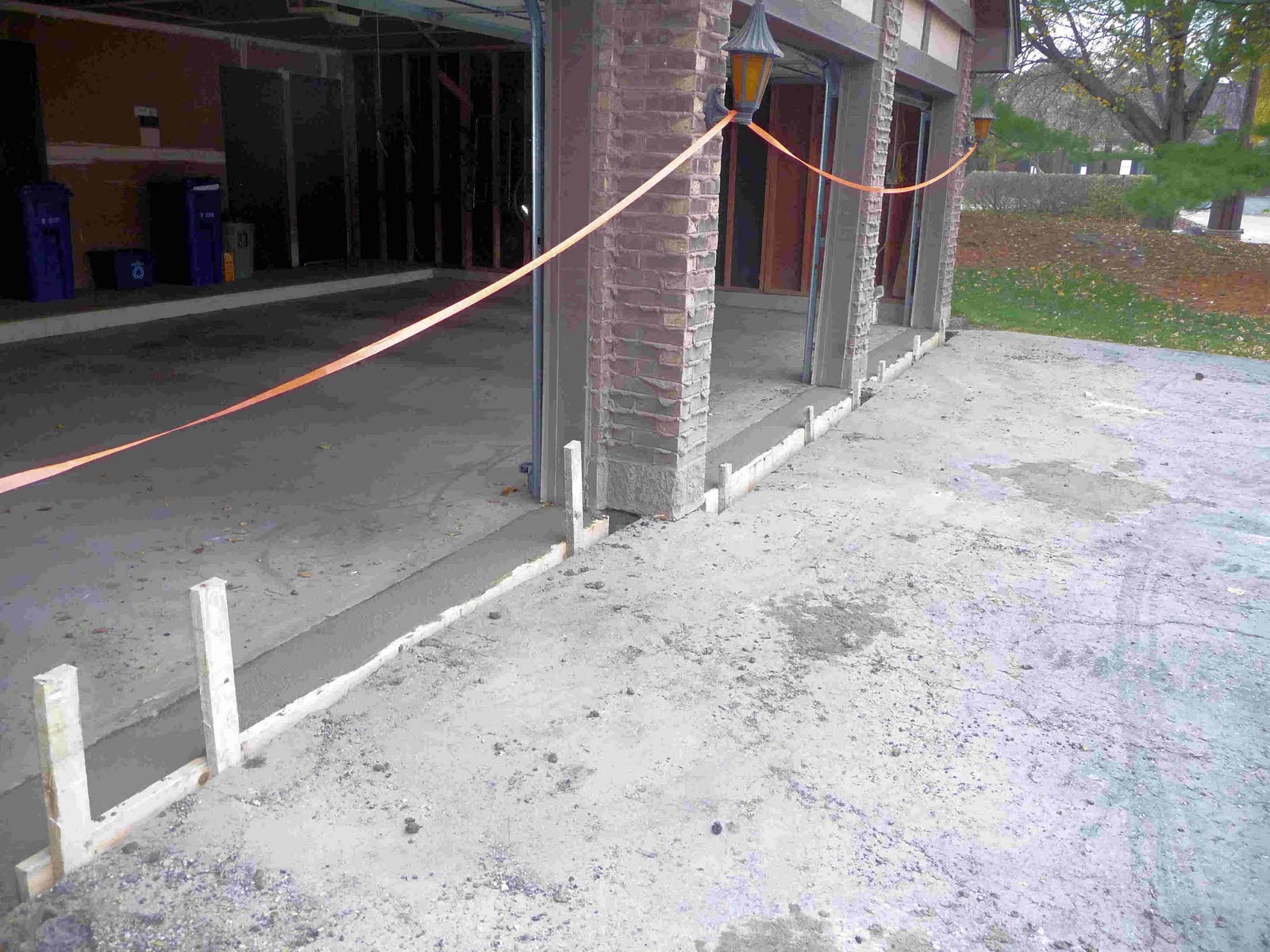
Here's a few photos of the driveway replacement at 1733H. Work was finally authorized for the board selected and "approved" driveways at the September association meeting. However, that work did not commence until November. Concrete work was done on the day this photo was taken, which was November 4. There was no advance notice to the unit owners and so one car was blocked in the garage. That owner got a surprise upon return from a short trip, and couldn't retrieve the automobile. Wooden planks were put into position to permit the car to be driven out of the garage.

The work will remain incomplete for this year, as it has been suspended. Asphalt will be done next year, or so the board announced at the November 12th meeting. The trench running the width of the garage will be filled with limestone screenings, which are very small chips of limestone. This is a loose, porous material, and water will migrate into the sub-base this winter. It remains to be seen if this will cause further problems with this garage floor. Last year, the floor heaved and several cracks running in a large "Y" in the floor from the entrance to the interior, widened to about 3/8 of an inch and the floor lifted. It has since returned to a normal position. My concern and that of the former Architectural Director was that permanent damage could occur to the floor, resulting in the need for costly repair and/or poor seal of the garage door.

So, we have run out of time for work this year, exactly as I predicted. Earlier in the year, certain board members had parties on the agenda and other special interests on the part of our CD interfered. The new board took too long to pick up the reigns for this project, which needed to be done "immediately" and so they announced at the November association meeting that "we have run out of time and the weather is against us".  Frankly, that is an excuse and is not quite accurate.  I sent a letter to the management company immediately after the election because I knew this new board would not get into immediate action required to get the job done this year. I decided to support them to the extent of pointing out the "immediacy" for action. Of course, when one of two transitioning board members voted "NO" for driveway repairs, it isn't too difficult to determine how this will go. Interests are elsewhere, and I and the rest of the unit owners in the affected buildings apparently aren't "special friends".

I delayed posting these photos, pending the outcome and action of the board. I was not surprised, but I have to say that I was disappointed. One can always "hope" that things will turn out, but of course, mixing virtues with action items usually results in failure, as it did in this case

When I provided my concerns about project timelines during the "unit owner's" portion of an association meeting early last year and also expressed my concern about lack of prioritization of tasks, I was considered a "kookoo". Of course, I am simplifying this. Of course there was prioritization on the part of board members, but there was insufficient alignment with the goals of the Architectural Director. Is it any wonder he no longer wanted the job? When the characteristics of an organization are such that it becomes impossible to do a good job, it is best to simply walk away and put someone's talents to use for another purpose.

Well, all  I can say is that the delays which postponed a vote for this work until the September meeting had a predictable outcome. So we are on "hold" until next year. Sorry to say "I told you so".  Meanwhile, we can all get "touchy-feely" and say such things as "Oh, what a shame" and "Isn't it too bad"! But the truth is, this outcome was predicted and was preventable.

As they say in management "You either get results or reasons."

Wednesday, August 12, 2009

Too Hard on the ROC?

0 comments
First, I really like it here, at BLMH. I like my neighbors. All are friendly, some stop to chat while they are strolling with their pet. Some are quiet. Some are young and single, some married couples and some are retirees. Some of my immediate neighbors help each other and we share chores. Some help me with the snow shoveling, when we get that dusting, or more that isn’t handled by the professional service. Some of my neighbors vacuum the halls. Some roll in my recycling bin on Friday, if I arrive late in the evening. Some do nothing. That’s the way it is, but they are all friendly and some are congenial and would probably be fun at a party. This has inspired me to share homemade cinnamon buns with them in the cold of winter. How else to say “thank you” with some grit to it? As a good baker, that’s one small way I can do so.

Some slow down as they drive by and some even wave. Some speed on by, preoccupied. Most are courteous and are obviously simply going about the business of living their lives, as I am.

I like the 40 acres of well cared and landscaped grounds and buildings. In the nearly 9 years I have been here, maintenance and decorating and painting has been at least a “4 out of 5” as they say. The financial wherewithal of the association has improved, remarkably. How else to describe a nearly 5 fold increase in reserves over 10 years, while simultaneously funding and completing reserves projects? This was accomplished because of the partnership that existed between our Board of Manager and our unit owners.

So what’s the problem? I’ve attended a few association meetings and frankly, at one point I thought I was attending the wrong meetings, or I was on another planet. I have observed a half dozen or so people whom I have come to view as chronically complaining individuals. But then I realized that they and their point of view, which they so vigorously promoted, was less than 2% of the owners here at BLMH. But they were and are persistent.

I have dealt with, lived and worked with people who are chronically dissatisfied or unhappy. Some work vigorously to prove their point. The most persistent, are somewhat like the honey bee. Yes, there is sugar and honey there and that is the attraction. But there is also a stinger. The most bitter and virulent, will hide that stinger but the moment you turn your back, they’ll use it. I’ve concluded that’s the way it is in our society. There are people who are what they seem to be and there are others who are not. We can all operate that way. Life is a choice, and allow me to demonstrate.

I sometimes think that living here at BLMH is a metaphor for the entire country. We have a great life, better than 90% of the people living on the planet. So what is the problem? I have concluded that some people are never happy. Some are bitter, and work hard at promoting their position. Some, like rebellious teenagers who never grew up, like to play the game “I won’t and you can’t make me”. As we age we become more sophisticated, some of us become very proficient at the game of “life sucks” and combine it with “I won’t and you can’t make me”. The best are adept in enrolling others in their causes, both for good and for trouble. We all need or should have a purpose in life. The question is, are our actions to be life affirming or not?

Our association is a microcosm of society in general. We have people who are willing to participate, and we have people who are willing to tear down those who participate. Critics of this blog could say that is what I am doing. However, last year, I suspected that a few dissatisfied individuals were attempting to run their racket and take a dump on my lawn. I decided to stand up, although I fully realized in doing so I would become a target and a magnet.

Recently, I have been asked why I was being so hard on the group known as the ROC or Residents of Change, and specifically their board members. I sometimes take a stand when I am confronted with the forces of negativity. I don’t think I’ve been unfair in my critique. However, to provide a serious reply requires presentation of my perspective. I also direct the reader to my post of September 27, 2008. From my perspective, I’d like to think that people, after creating quite a ruckus, disrupting meetings, running a campaign and then being elected, would read their campaign literature, the Illinois Condominium Act, their signed agreements and oaths, and then act accordingly.

Apparently, expecting people to do what they agreed to do, may be too much to ask. Making broad declarations and promises was easy. Developing concrete plans is more difficult, and carrying them out to fruition is more difficult still. The world is full of idea people. I say that based on my experience and many years in business. I too have a lot of good ideas. But it takes a lot to make ideas a reality, and that includes a structure for fulfillment, which is a topic for another post.

I’ve been told that if it’s so easy, why don’t I try running for the board? First, it isn’t easy. That’s why I am always skeptical of people who make big promises with little to show at the time the promises are made. Secondly, working on the board is an open ended agreement. My experience with people of varying capabilities indicates that taking on these types of agreements can be like stepping into a black hole. Take it on and expand to fill the void and then what happens? You get accused of micro-managing. I know, I’ve been there and done that, as they say.

The truth is, it is impossible to satisfy everyone all of the time. So anyone who steps up to the plate and joins the board with the intention of keeping people happy is destined to failure. The alternative, which is satisfying a small but very vocal and visible group is worse. It requires the board member to abrogate his or her responsibilities. As a unit owner, simply because you don’t attend association meetings or harangue the board doesn’t mean you are completely satisfied. Nor does it mean that your needs as a unit owner should be put to the rear of the line. But it is so easy for a board member to acquiesce to that in-your-face minority and that is the pull.

I was recently asked why it was that my window sills were upgraded. I was asked “who did I know?”, and the implication was that I get favored treatment from the board. I have a B unit, so my window sills were not upgraded. I am expected to replace my dormer window when the roof is replaced, just as is expected of everyone else owning a B unit. So much for “favored treatment”. I have pointed out that the juniper, that is laying on its side at the front entrance has been like that for 9 years. As far as I know, none of my fellow residents have made a request about this, either. But that is the level of jealousy and backbiting that exists, even among our board members, one of whom was the source of the question. If there is an issue or a position, I suggest that board member do an analysis of the work orders for the past 5 years. I too would like to know at which addresses the money is spent. However, I think developing a criteria and prioritization scheme for maintenance and landscaping for each and every address would be a better use of time. But if this is an issue, there are ways to address it.

Another reason not to run for the board is the fact that I’ve never been particularly interested in bird-dogging people. I'm not talking about managing contractors, which is an altogether different thing. I’m even less interested in micro management. If someone drops the ball, the solution is simple, they should clean up the mess and then get on with it. If they are intransigent, and unwilling, or persist in doing it their way, that simply adds to the work load, and creates a drag on the team. As I stated in another post, teams are easy if everyone can pull the oars together. But if board members can’t or won’t pick up the oars, or lack fundamental skills, won't keep agreements or follow directions, then there are limits to what can be achieved. Again, that’s the problem with big promises made in a vacuum. Once one is seated in the boat and told to pick up the oar, then and only then does the real work begin. Politicians are adroit at campaigning, and spending other peoples money. Based on a lifetime of careful observation I say they are terrible at getting the job done. They are also skillful at creating misdirection and telling others what they should do. One solution is to acquire staffs and delegate. That’s why government grows and bloats. So do other organizations.

I have an issue with the formation of any group in the association which has an agenda, and then attempts to place hand picked candidates on the board for the purpose of furthering that agenda. In actuality, candidates so placed and elected do not have a mandate to do anything other than to operate for the benefit of all unit owners. They are required to operate in a manner that is uniform and fair to all unit owners. They cannot represent or speak for a select group of unit owners, no matter what promises were made. To do so is inconsistent with their fiduciary duties, their oaths, agreements and the Illinois Condominium Act. It requires them to operate in a consistent manner and with integrity. So the very premise of such a group seems counter to the purpose of an elected, impartial representative board. Certainly, promoting the agenda of a few is not operating for all of us. But that group is still here, and now, having placed their “chosen” candidates on the board, they have expected action on their agenda. In political circles, that is called payback, isn’t it?

At present, this group may have changed its tactics. We now have a “neighbors club”. It may or may not be affiliated. Time will tell!

I understand this club is currently promoting the neighborhood picnic. But I also understand that the circulars for the picnic include the statement that we can “keep our community friendly and beautiful”. So is it to be a social club or something else? Possibly something else. A party sounds fine, I just hope they don’t band together and show up at association meetings demanding painted garage interiors, benches, new and expanded landscaping, new patios or expanded paving around them or whatever it is that meets the ambiguous definition of a “beautiful” community. I would hope that the club's definition includes unit owner decoration of patios within the rules, picking up street trash and retrieving and stowing their neighbors trash and recycling cans on Fridays, or some such. Of course, perhaps we are entering the next phase of the new era at BLMH, and the “Neighborly Police” will be there to assure that residents toe the neighborly line.

Sorry to sound cynical, but I am convinced that there are no limits or boundaries for some of these people. I have a few nails retrieved from my automobile tires, as evidence of what I speak, and the card of the police officer I called to discuss this with, as well as the receipts for the repair and replacement of the tires.

I do understand that unit owners will have complaints, and it is human nature to sometimes expect special treatment. Making requests or demands is one way to have things done “your way”. But it can be carried to extremes. If you don’t get your way, then create a disturbance. Raise the banner of “unfairness” of “injustice” or “oppression” etc. Throw the buzz words and slogans around and blow off steam. Stir people up and get agreement. There are always a few willing to agree that life is terrible, no matter how wonderful it is. That however, should not result in action by the board of managers. Nor should board members champion such an agenda. I do expect the board of managers will listen, within time constraints at meetings. But every unit owner should be given his or her minute. The members of the board are not required to act, unless the resulting action were something that would be, should be, and will be done for any and all unit owners, is consistent with the rules and is within established and projected budgets. Allowing every unit owner attending an association meeting equal time to address the board of managers seems an appropriate expression of being neighborly and courteous, but at many meetings I barely get 30 seconds to address the board and sometimes no time. And I’m not alone. Why? because my time was surrendered willingly or unwillingly to another unit owner who took more time, or there were long rants about injustice, etc.

I also understand that things “can be better”. As an advocate of “continuous improvement” I know things can ALWAYS be better. I also know it takes resources. I have an expression which I have used from time to time with clients and companies that make certain types of demands. It is “we can do anything, all that is required is time and money”. Our board has limited time, limited resources and the association a defined and limited budget. However, the ROC got around that by saying things like “keeping assessments as low as possible”, but never gave me a definitive answer of how they would achieve that. The implication was that the board was lazy, inefficient, wasteful and possibly stupid, and so too were our contractors and management company. But the ROC knew how to set things right! Fire them all! Well, I don’t see ROC board members resigning when things go bad, or did I?

I also believe that improvement begins with each of us as individuals. I am always skeptical and cynical of people who act in such a manner or imply that improvement begins elsewhere. I know I can do better. I’ve spent thousands of hours and even more money on “self improvement”, time management, communications and other courses, and I’ve put a lot of what I learned to good use. So I’m not going to wait for someone else to step up to the plate. Nor am I an idiot who will willingly walk into the buzz saw, nor am I a door mat. Improvement begins in my life and my unit and it includes how I treat my immediate neighbors, my board members and my extended community. It includes simple things such as being respectful during association meetings and sharing the floor by limiting one’s time in front of the board. However, throwing buzz words around is very easy. “Walking the talk” is the difficult part. From past experience, I know that when I am up against the wall, I am less gracious. But how often are we up really against the wall? How are we as neighbors at other times?

Saying “things should be better” is a very ambiguous statement and I do not and will not adhere to the position that such a statement is justification for disrupting the operation of the association. I think there needs to be a prioritization. But apparently, I have different priorities. That is why I will never agree that an ambiguous and subjective agenda in which “we should all be more neighborly” is the appropriate criteria for the operation of an association and its board of managers. Neighborliness, in my eyes, is a worthy goal for the residents and it is their responsibility to make that happen by living their lives in a manner consistent with that. Demanding that the association operate by some undefined standard of “neighborliness” is ridiculous. We do have rules and regulations and those do define some aspects of acceptable conduct in the association. So when people come to association meetings and harangue the R&R Director about the perceived “unfair” enforcement of the rules, I think they want it both ways. Rules that they see as unnecessary are to be eliminated or modified. They want the association to adhere only to their perception of “being neighborly” and will attempt to change the rules to get to that place. But doesn’t being neighborly include living in a manner such that the social norms, and that includes the rules that are in place, are adhered to? Or am I confused again?

Some people are still making declarations about how “mean spirited” and un-neighborly it was to have the semi-trailer that was parked on the property towed. They are entitled to their opinions but they should stop beating that drum. The “neighbors” could have alerted the driver to move the truck out to the city boulevard, etc. etc. But they didn’t and the vehicle was towed in accordance with the posted signs. They could have quietly passed the hat, but they didn’t. End of story.

Certainly, residents should be neighborly and should pursue any hobbies they choose. If they want social activities, they certainly don’t need anyone’s permission, as long as such activities adhere to the association rules. They don’t need anyone’s permission to have a dinner party, BBQ on their patio, walk the grounds and say “good day”. As far as I know, they can paint their rusting air conditioners, keep their patios tidy, retrieve their neighbor’s trash cans on Fridays, help with snow shoveling, pick up discards in the street, keep the speed limits and so on, all within the rules. We also have a wonderful park adjacent for public parties, etc.

But that park apparently isn’t convenient or adequate for the parties some residents envision, nor apparently is the restriction on garage sales. So they pump up their elected representative(s) and come to the meetings and disrupt them. Sure, all of this would be nice. So would free beer and margaritas at the northerly entrance every Friday night. It seems it is the position of some that “neighborliness” can be discarded as soon as it is necessary to run an agenda to get whatever it is they want. Lest we forget, our board members are our neighbors too. So don’t they merit the same “concern and respect” that anyone else living or who has ownership in BLMH should get? Well, apparently not. I personally think the high point of foolishness or hypocrisy was reached when board members were attacked because they were “un-neighborly”. So, in the name of someone’s pet cause, it’s apparently OK and justifiable to trash some of our elected volunteer board members, and past board members. How quickly we can put our standards and slogans aside when it suits achieving our objectives.

The ROC agenda included an association “where we all can be heard”. Based on the past 11 months, it seems that agenda was really about an association “where a select few of us can be heard and get our way.” What about a fair and uniform treatment of all unit owners? That’s what is expected and required. There was a lot of noise about “open communications”. The ROC stated that “residents are virtually prohibited from expressing their thoughts to any board member.” They went on to say “Under the current directorship of our association, there is no mechanism in place to receive residents’ suggestions, comments, general questions, and yes, even complaints.” I didn’t agree with that statement, but I will talk about how it was and is. At the time these statements were published, when I inquired as to why there was no ROC website in which all unit owners could be informed, I was told, in writing that “The board does not allow any such communications; therefore there can be no website unless the board allows one.” You can imagine how surprised I was! This blog was up and running and I had, and still have, no one’s permission. This led me to wonder, what was the real reason no such site existed? One possible answer, was a lack of technical acumen. Another was a lack of true commitment to open communications.

Here we are 11 months later, and the same “underground” communications pipelines exist, and of course, so does this blog. However, this blog is open. The pipelines are not. The association does have a larger newsletter with “interesting” articles on history, architecture and carefully selected residents. In 33 years I may make it to the top of the list. I suspect I’ll never meet the rigorous criteria. As requested in letters and emails to the board, I would first like expanded statements on issues, the challenges in running the association and so on from current and previous board members with minimal editing, but that email was never acknowledged or answered. Of course, the excuse could be made that “we, the ROC don’t control the entire board and we are not allowed”. I was given that excuse nearly a year ago. I didn’t buy it then and I won’t buy it now.

I asked the ROC candidates to explain their statements about a repressive board. This was what they wrote: “Well, the definitions of repression are to hold back or keep from some action; to control so strictly or severely as to prevent natural development or expression; to impose an inhibiting discipline that discourages free thinking. How much brighter our community could be if we lived under the opposite umbrella of progressiveness, enlightenment, open-mindedness, tolerance, cordiality, and good humor.” No specifics or examples to demonstrate this open ended statement were provided. Come to think of it, isn’t this blog a natural development or expression? However, my written request of June 19 for consideration of the blog as an “official” one has never been given a response by anyone on the board. I even offered to engage in a discussion about what would be suitable content. However, I was told by one of the board members that my blog is a problem.

I wrote the ROC about communications and this is part of the written reply: “Call it just plain old common courtesy, but we believe that every question from a resident should be answered, even if it is simply to say that their inquiry was received and someone will get back to them regarding it.” Well, in the 11 months since, that I’ve written letters and emails, only two have ever gotten a response. Even direct emails don’t always get acknowledged. It’s my conjecture that my letters, or emails and this blog don’t adhere to the official party line. Perhaps I’m providing too much “free thinking”. That’s one possible reason for being ignored. It may be that they don’t want to hear from me, or, what I say doesn’t fit their opinions or I simply don’t count as I have never been a ROC member or whatever their current name is. Oh, and should you wonder what I am, it's simply this; I'm a BLMH unit owner, just like 336 others, most of whom live here and are my neighbors.

A lot was made about assessments. Official ROC statements included one about outraged unit owners. The data, including that published in this blog simply doesn’t support the issues raised by a small number of unit owners nor the position taken. In a written response from the ROC candidates on the issue of assessment increases, two statements stood out. First, I was only “one of two” unit owners who had brought up the issue of assessments. Not consistent with statements about “outraged” unit owners, and second, it was the official ROC candidate’s position that rather than having assessments as high as possible, they should be as low as possible. Consistent with that statement, one of the newly elected ROC candidates immediately voted for 0% assessment increase. This even though there were projected COLA increases of 5.8%, a barely started re-roofing project (only one roof of 44 completed as of 1/1/09, I believe) and the hard work of the board the past 10 years to build up reserves. But I guess we don’t need facts or budget analysis to make these incendiary statements.

I’ve never had a single ROC member and that includes the board members, ever discuss my published financial analysis. I did once receive a very brief comment. One of the things you will notice about the analysis, is that it took about 20 years to get to the financial state of this association in 1998. It took another 10 years to reverse the course and correct that problem. I conclude that making what appears to be simple changes may require, if they are allowed to continue and accumulate, years to correct. That is why I am very apprehensive when cavalier judgments, evaluations and declarations are made about our assessments, or our management and maintenance companies. Simple annual changes were made to the association finances over a period of 20 years. I am sure a lot of people were extremely pleased with the low assessments. One of our ROC board members made the statement of being here for over 20 years. During 10 years of that period, our finances eroded, and it took another 10 years to correct this and get to where we are today. In fact, for six of those years, the assessments increases were 0%, exactly what was wanted by one of the ROC board managers last year.

I’ve never seen or heard a single ROC person ever have anything good to say about the correction of the finances and the incredible achievement of this association. Quite the contrary. So I say they are not straight about these things. In fact, if the approach to be taken by the board is to satisfy any and all unit owner complaints, which seems to be the position of the ROC, then I say that they would like to return to a direction in which the association was headed "in the good old days", which if uncorrected would have resulted in bankruptcy or very large special assessments. In 2001, I was extremely alarmed by the financial condition of the association before I purchased. I wrote a long letter to the management company and this resulted in a response, including a long conversation with our current professional manager. He assured me the board was working diligently to correct this situation with his assistance. He assured me that the board was opposed to special assessments. He provided earlier financial data to demonstrate that the board was not only committed but was taking action consistent with that stated commitment. On review, I decided that he and the board was aware of the need to work on assessments and reserves and they would keep their word. I then purchased. It took in all nearly 10 years to correct that situation. That board, some of whom were "run off on a rail" as the expression goes, did keep it's word, the reserves have been incredibly increased and there have not been special assessments. Considering the reward the deposed board members got, I do have to ask why on earth would someone ever run for the board in this association? I also want to state that in 2002 I cautioned that we should be prepared for fireworks a few years down the road. And so, here we are!

I do have an answer to the question of why would anyone run for the board, and it is contained in the beginning of this post. It includes my neighbors and the courteous, friendly and non-complaining people who live in this community, the majority of whom I have concluded are quite happy to be here. They pay their assessments and they know that they are not entitled to anything more than any one of us. It also includes the members of the board who work hard and provide time and talent to get the job done, and who make it a point to represent each and every unit owner equally, impartially and fairly.

On the subject of budgeting, I would think that taking actions consistent with the ROC position of “keeping assessments as low as possible” would result in performing maintenance and growing reserves first, and then, and only then and if the budget included unexpended funds earmarked for that specific purpose, would new work or expanded projects be considered, and that includes landscaping. Sure, some of this may be obvious or “black and white”, and there is also “shades of gray”. I think it is common sense and it isn’t too difficult if the goal is to “keep assessments as low as possible”. That means spending as little as possible, which means performing needed maintenance and repairs, and tabling everything else. Gray is adding embellishments, or expanding projects. For example, a black and white area is maintaining the grounds. Gray is adding shrubs or flowers, especially if sick or dying trees have not first been removed, which means those expenses are yet to be realized. Black and white is the numerous reserve based projects such as the roofing replacement. Gray is also comparing 30 year roofing to 15 year roofing. However, I can comprehend the attraction of a 30 year roof. The existing roofs must be stripped. So either way, each roofing method includes labor, materials, tools, insurance, overhead and profit. The basic difference between installing 15 year or 30 year shingles will be the cost of materials. The other costs remain pretty much unchanged. So what would you do? Spend a bit more to double the life of the roof, or go low ball and spend again in 15 years? The Architectural Director stated his case and the board has, for the moment, decided to go with 30 year architectural shingles. But the next board may reverse direction and go for the lowest possible cost, which means the cheapest materials available. That would be entirely in keeping with the ROC’s published position to “keep costs as low as possible”. So if they do that, unit owner’s shouldn’t be too surprised.

For each project, whether it be landscaping, concrete, sills or roofs, there are costs and benefits to be compared. All needs and projects must be prioritized. How else to avoid exceeding the budget? Exceeding the budget assures the need for higher assessments, which is exactly the opposite of “keeping assessments as low as possible.” It also seems that some people like to complain “what do we get for the money we pay to the association?” The same person who made that statement at a recent association meeting recently pointed to an unpainted chimney and quipped “another poorly done job”. I pointed out that the chimneys probably weren’t part of the painting contract but are most likely a part of the roofing project. The complaints then moved on to something else. Some people will never be satisfied. But why would any member of the board then act on their ongoing complaints? Our board is not comprised of puppets, who are to dance every time a unit owner shouts. Our board is in the business of managing the association, with the input of our professional managers and our professional maintenance and landscaping companies.

Black and white is replacing driveways pointed out by the management company and reviewed by the board. Black and white is modifying landscaping to prevent water from entering garages. Black and white is replacing roofs on schedule. Ditto for roadways. Black and white is repairing faulty sidewalks, or raising those that are under water during storms and collect mud. Gray would be adding benches, adding landscaping or having the association paying for unit B dormer windows, etc. Any of those “gray area” items should only be accomplished after other work for the year is identified and full costs are known. That’s common sense, isn’t it?

We have a roofing project underway. We don’t know the condition of the roofs under the shingles, nor do we know how many 4x8 plywood sheets will be replaced. We don’t know the condition of the framing and wood in the vicinity of the existing B unit dormer style windows. So we really don’t know the full costs of the project which will replace these roofs. True, we did accept bids and contracts were awarded. So we do know the base costs. But that is all that we know with certainty. What about the cost of coordinated landscaping modifications for drainage improvements? So it is inaccurate to say that the roofing project will cost a certain amount, as was published in our newsletter. That’s why the Architectural Director was unhappy that information was published in the newsletter and said so during an association meeting. So, has our Communications Director now published what will be construed to be a promise about how much the roofing projects will cost, and when the total costs are added, which will certainly be higher, will unit owners or others raise a ruckus about “cost overruns”? The alternative, which is to assume the amount of the extras, etc. and publish a higher estimated figure, is also risky and inaccurate.

What else is unusual about the project? Well, specifications were written and reviewed and issued. The bids that were received were compared and a successful bidder was selected. It’s usual to compare price, features and performance, which includes warranties. On that basis a contract was awarded. However, it is not necessary to tell the unsuccessful bidders what the award price was. Why not? Because that tells the unsuccessful bidders, and anyone else who gets their hands on that information, exactly how low they must bid to get the work. That may prevent us from getting the lowest possible price in the future. But, our Communications Director made the independent decision to publish this data. I know because this was discussed after the fact during as association meeting that I was present to. Is this a big deal? Well, who knows how much pencil sharpening the unsuccessful bidders would have done to get the next roof. Now we’ll never know. Using a little arithmetic, I can conjecture a difference of $100,000 or so. That’s the possible amount that a little pencil sharpening for pricing of 40 roofs could achieve and that is a big deal.

The ROC can make a lot of grand statements, and even grander shows and demonstrations. But the truth is, it’s very easy to flush money if you don’t know what you are doing, or, if with the best of intentions, you insist upon doing things your way and ignore the resources around you.

One of the big upsets for some unit owners was the “unsightly” snow removal equipment parked on one of the cul-de-sacs. This came up during the unit owner portion of an association meeting. Well, I did a little research. One of the reasons the equipment was parked there was because the garage, which the previous board president had arranged to be available, was not renewed. But our new board members didn’t know that. They didn’t need or want the input of the past president, either. So they did it their way. Politically, it was a triumph as it demonstrated again how ineffective and uncaring the remaining board members were, or so we sitting in the audience were led to believe. But who was really ineffective?

Many of the projects, including both architectural and landscaping aren’t prioritized. What’s more important; doing roofs or adding shrubs? What are the timetables? That determines how rapidly the reserves have to be accumulated and the rate at which they will be depleted. I’ve completed a spreadsheet with the projections. However, without accurate data about the true and total cost of the current roofing project, to release this data would be irresponsible. For that reason you haven’t seen the information in this blog. I’ve been asked how it is that I have access and special information. I don’t. I have the same information that every other unit owner has. I have the budgets for every year one was issued to me as a unit owner. I have a slightly earlier budget, which was given to me when I asked about justification for assessment increases. I have the numbers discussed openly during some of the association meetings I have attended and which I wrote down during those meetings. That’s the information I have used for all of my financial analysis. That’s it and nothing more.

Returning to the roofing project, I do understand some of the issues. For example, the concerns about stating specifically when each roof will be replaced. As was presented during an association meeting by the Architectural Director, if next year a roof is inspected or because of winter damage it is determined replacement should occur, it may be bumped up the schedule. He expressed the concern that unit owners may take a published schedule as a “cast in stone” promise, which it is not. Furthermore, future boards may make significant changes to any and all projects, or add new ones and change the schedule or order of events. If we have a new management company, they may also take a different tack. Prior to 1998, building the reserves seems to have been a very low priority. With the current emphasis on lowering assessments, our new and future boards may again change direction.

The final comment on the roofing project. It currently includes insulation. There was a lot of discussion at association meetings about this and about adding gutters. The problem with gutters is they fill with ice, as we all have noticed above our driveways each winter. Freeze thaw may result in ice dams. Then there are other problems to contend with. One of the causes of ice dams is poor roofing insulation. So the current plan to insulate may provide the opportunity to add gutters. A side effect or possible side benefit. However, I would suggest caution, because some of the ice formations I have seen have been extensive, and my building did have an ice dam above the garage a few years ago, which is unheated and uninsulated. In one of those fluke weather phenomenon’s, the gutter was frozen and there was ice and snow on the roof and we got a significant rain fall. Fortunately the water simply backed up on the roof and ran under the shingles and into the garage. There was no damage to any unit and only minor repairs were required in the garage. But what if this had occurred on another section of roof above the occupied units? That would have been an altogether different outcome.

On the subject of prioritization and prioritizing landscaping, we have many ornamental trees, with lifespan of 25 to 30 years. When will it be necessary to replace these? Is this part of the landscaping plan? Do we have a prioritized and comparative list of every address with needs in terms of landscaping, drainage, roofs and driveway replacement? If not, why not? I attend association meetings in which unit owners attend and attempt to strong arm the board into making concessions to project timetables or add embellishments. For example, pavers placed alongside patios were, in the past, the unit owner responsibility and at unit owner expense. But today we have requests for the association to provide these. That would seem to require an increase in the landscaping budget, or reducing landscaping in other areas to accommodate this escalation of association maintenance. Sometimes it appears that “the squeaky wheel gets the grease”. At other times, it seems to be a political circus, where those in the know or with clout or the ear of the board get things done. I’ve been accused of having such special access. However, the last request of any kind I made was to fix a problem with a chimney. That was about four years ago. I also requested a look at the water sometimes entering the garage. I was told during an association meeting earlier this year that the problem will be corrected when the roof is replaced. I was asked my opinion about unit owner responsibility to pay for a new window when the roofing project is done. I said that I thought that was appropriate and consistent with the fact that windows are the property and obligation of individual unit owners. I am a B unit owner and the window is my responsibility.

Then there was the apparent attempt to fire our maintenance company and professional manager. This is still a work in progress. Some people are resolute and are determined. Apparently, promises must be kept. Some of the association meetings I attended were as close to a kangaroo court as I have ever experienced in my lifetime. I understand where some people are coming from. Go for the big contracts and tackle them. Get the cheapest labor possible. The rationale seems to be, “We don’t need specifications and we can make do with a handful of handymen.” Just go for the lowest bidder. I know of unit owners who routinely use unlicensed and unbonded handymen to perform work in their units. That is their choice, under current rules. However, it is not a good one. If there are damages, or injury, the unit owner will be responsible. However, a business such as our association cannot operate that way. Our contractors must be licensed, bonded and insured. That includes at an absolute minimum workmen’s compensation and business liability insurance and for certain work, city certification. It also means trained professionals, but certainly a laborer is appropriate for certain tasks. Any other position by members of our board I construe as risk taking and irresponsible. But there are those who insist it can be done in a better way. Well, I suggest they deal with their immediate board responsibilities and once they have demonstrated impeccability and superior performance in that area, they will then be ready to be considered to take on larger responsibilities.

Attempts to replace the management company were also of concern to me. I frankly cannot understand the alleged unresolved issue with communications. If I have a supplier who is capable in certain areas and has a weakness, what is the rational response? Fire them? And hire whom to replace them? Wouldn’t it make more sense to determine how to improve the communications, even if that means hiring a 24 hour answering service to direct calls? Or is there an even better way? I believe there is more than one way to accomplish a result. But, the solution was always “fire the management company!” That type of approach is the core of the ROC approach; get rid of the board, get rid of the management and get rid of the maintenance company. Doesn’t that seem a bit strange? Is it possible there is another agenda at work here? Or is this simply an expression of a hypocritical approach to “being neighborly” as applied to our suppliers and contractors, wherein we choose not to work with them, instead we choose to bully, manipulate and dominate them?

Where I come from, it is expected that you will get the job done with the people and materials on hand. You determine what is missing to prevent getting the job done and you provide that. You look for the weak link in the chain and you strengthen it. When you walk in or when things get difficult, you don’t jump up and declare “This is completely unworkable and I need a new “whatever” because it’s impossible to get my job done.” That is misdirection. Rather, what is required is an honest and open appraisal of “what is missing”. Only after exhausting the alternatives do you sit back and say “it’s unworkable”. Our board is qualified by their own written statements. We now have members of the board of managers who were elected last year and were hand picked by the ROC because of their skills and that included “back-grounds in conflict resolution and team building.” Apparently, a part of the team building included the decision to ignore our replaced board members, to exclude former members from the “team” and so forth. With many years of board experience, I would think that our former president would have been an invaluable resource and that people who are skillful at conflict resolution and team building would find a way to pick her brain. But no, there was no such initiative on the part of our new board members. Yet, the ROC candidate campaign literature stated. “There is no bad blood or contentious history between us and board members.” They didn’t state that there was no bad blood with the management company or our maintenance company. So perhaps I should have expected what has ensued.

Our ROC elected board members signed the candidacy forms stating they had the necessary skills to do what it is that must be done, and they went further in the campaign literature they printed and distributed. We have a Communications Director. Isn’t handling communications issues and breakdowns of any and all kinds a part of that job?

Specifications or the lack of them come up from time to time. In that area, there is no level playing field. We have some written specifications. I am unawares of specifications for maintaining our landscaping, trees and so on. Of course, we probably do get bids. What is the criteria for competitive bids? As for writing a specification, copying a bid is not writing a specification, nor is it ethical. Most suppliers issue bids which provide no additional details because they have been burned by unethical practices which include copying their bids and distributing them to competitors. So editing an earlier bid is no substitute for generating a specification. But as I have written in earlier posts and at great length, writing a good specification is a really difficult job.

Writing a specification for the multi-discipline business of maintaining a 40 acre community is a very difficult task. I’ve written some of the issues elsewhere on this blog. But the argument has been “we don’t think we’re getting the bang for the buck from our whatchamacallit company”. Usually the discussion is about our maintenance company, but the theme is pervasive. OK, that’s an opinion but based on what? I’ve prepared specifications for multi million dollar projects, I’ve evaluated and selected the bidders, justified that to the corporate owners and managers and boards, managed those projects, designed systems, etc. and I would not make the kind of grand statements that I have seen made at association meetings. I have wondered “how can they make those statements?” Where are they going with this and who are they going to replace our maintenance company with? In the absence of a specification, anyone can come in, give us a bid for $10,000 a year less, especially after we publish and discuss the existing cost details with every Tom, Dick and Harry handyman or maintenance guy in the county. But the result would be that we now have ourselves a winner. But what is the job to be done? What compromises and what “extras” aren’t included in the contract? In the absence of facts and certainty, it seems some members of the board are willing to “roll the dice” and take a chance. Is that an appropriate way to run an association?

Of course, if you think our management company and our maintenance company and perhaps everybody else is stupid, incompetent or whatever, then you can’t listen to what our hired professionals are saying because they can’t be trusted, can they? Talk about digging a hole! On the other hand, the rationale seems to be that any maintenance guy or girl who walks into an association meeting, they of course can be trusted. This is not conjecture on my part. I attended an association meeting and observed this.

If it’s all so easy, then why are the board members working so hard at getting the job in hand done? Maybe that’s because it isn’t so easy. Perhaps we’re dealing with a lot of arrogance and attitude.

A lot of time was spent in association meetings discussing a “block party”. I mean a lot of time. Finally, the ground rules for such a party were set. The problem was, a few people wanted an association sanctioned party on the grounds. Discussion was frequently interrupted by proponents of the party. Common sense told me that, hey, just go across the street on public property and have your party. But no, that wasn’t good enough. Issues such as association liability were to be ignored, shouted the proponents. Concerns about liability were apparently delusional. Boos and hisses and jeers from the audience. Well, after wasting all of that valuable time, it seems that an insurance rider was required at additional expense. Alcohol was to be prohibited by the insurance company or the insurance voided. So after all of that, we go full circle and now there is an unsanctioned party, which means no association liability, which will be held across the street. Much to do about nothing. But couldn’t it have started that way? What was the point behind the contentious meetings and grandstanding? Was it to make a statement that our existing board members were…. what? Well, I’m not sure, but when I re-read the ROC published and distributed documents, I get a sense of where they were going. And, the course they set out on isn’t yet done, is it? Currently, two of three ROC candidates who were elected remain on the board. More are probably on the way.

Perhaps it’s me, but there are days when I conclude that I don’t belong at BLMH, and perhaps I should just move on and either rent or sell my unit. Perhaps “they” are correct and I’m being too hard on the ROC. Well, I didn’t stir things up, march and make bold promises. I didn’t trash the board, our professional managers or the maintenance company. Nor do I have the position that people are universally stupid. Sometimes we may act in less than a competent manner, but we do have common sense, and we do have average skills. So what is missing? I don’t think open ended “change” is a good thing. If you do, then you must be enjoying the state of the economy.

But perhaps I am out of step with reality. Perhaps I should just stand back, continue to watch the show, and simply report what I see. After all, some people think running an association well is simple and easy. So isn’t it?

One final item. The timing of the creation of this blog has been questioned. It was close to the surfacing of the ROC. I began this blog in August of 2008 as a hobby and it took a while to get the templates completed. I did so over the labor day weekend. So the first “official” post was September 7, 2008. I’m not a website designer, etc. so I’m not that proficient. However, I have built and maintained and do maintain a website and several blogs. I find it to be not too difficult, but it can be time consuming. However, as with most endeavors, once a certain plateau is reached, the level of difficulty is reduced. This is my 80th post on this blog.

Thursday, March 19, 2009

Possible Assessment Savings Outlined at the March 12 Meeting

5 comments
To jump to comments to this post, click here

Here is a list of possible savings to the association that were mentioned by board members during the March meeting. I made this list by adding up the different projects and issues and their cost, as described by the board during the meeting. On the other hand, I have not made a list of spending INCREASES. There have been a few of those mentioned at board meetings; for example, a "reserve study". I'll post those later, once the numbers are known.

Total possible annual savings of the items listed below=
$37,950. This, over a 20 year period, which is about the life of the roofs, would yield a total savings of $759,000 in today's dollars (no adjustment for inflation). That's a lot of money, enough to do the roofs on at least 15 buildings in the year 2029! Imagine, with NO assessment increases, we could save sufficient funds to do 15 buildings. Amazing! Of course, this money could "burn a hole" in the pocket of future boards, and they could spend it.

To actually accomplish these savings, the board would have to vote on specific actions, and unit owners would also have to agree and possibly alter some of their behaviour. So let your board know what you think!


  1. A possible $13,300 savings each year, if architectural shingles are used during the forthcoming roofing project, and roof life is extended by 5 years.

  2. A possible $84,000 savings by having Unit "B" owners pay for replacement of roof windows, at a cost of $1,000 each. This would reduce the cost to the association for this project by about 8%. "B" unit owners would see a temporary assessment increase. Savings each year, over 20 years ($84,000 / 20) = $4,200.

  3. Changing the painting schedule from once each 5 years, to once each 6 years. Possible annual savings = $14,450.

  4. Voluntary elimination of feeding of critters, birds and other wildlife at BLMH. Possible savings each year, by eliminating the need to trap of animals = $6,000.
Total possible savings, EACH YEAR, from the above = $37,950. The cost of the windows would be a savings to about 75% of the unit owners; the "B" unit owners would assume the cost of the windows and they would not see a savings for this item. Perhaps there are some other trade-offs possible?

If you have any other ideas, let your board know! Or, let me know and I'll publish them here and pass them along.

Saturday, March 14, 2009

Update - Board Meeting of March 12, 2009

7 comments
-------------------------------------------------------------
Other recent posts (Click On to Go To):
Comparison of Natural Gas Plans, posted March 10
The Three Domains of Knowledge posted March 13
-------------------------------------------------------------
Meeting Highlights:
Reserved "Guest" Parking is Eliminated, Driveways, Rules and Regulation Infractions, Contracts, Specifications, Bid versus No-Bid Issues, Roofing Project and Continued Discussion of Assessment for Unit B Owners for Roof Window Replacement

To Jump to the Comments of readers of this post, click here:
Comments to this Post


All of our board members, with the exception of the Landscape Director were present for the meeting. There were about 10 units represented by unit owners. The open portion of the meeting ran from about 7:00pm to 9:30pm and then the unit owners were excused and the board went into executive (closed) session.

Here are my observations from my attendance at this board meeting. The Guest Parking was, I understand, voted upon after the unit owners were excused for executive session, and has been eliminated [i.e., it is no longer a violation for residents to park in the spaces labelled "reserved for guest", which effectively eliminates this as guest parking.]. I am not aware of an announcement to the unit owners prior to their dismissal by the President and I left the room at executive session as requested by management and the board President. The doors were not opened nor were unit owners invited back into the room at the end of executive session.

Please note that if you require clarification, the source is the board. I can render comments and so on, but the board is making the decisions in open session, executive (closed) session and with management. They need your input. Attend the meetings! It is my goal that these notes will provide you with a summary of the discussion between the various members of the board, the management and the unit owners in attendance. If you have questions or comments, please email me. However, if possible, do attend the meetings!

If you have an issue with the board, my suggestion is this: write a letter to the Management Office and include your name and address. Request that the letter be copied and given to the board members, and then sign, date and mail it. Keep a copy of the letter and file it somewhere were you can find it for board meetings and so on. Writing a letter serves several purposes, including: 1) it gets the information or issue into the hands of everyone who is in a position of authority and responsibility; 2) it documents your communication; 3) sending it to the Management Office and the board makes it a part of the record; 4) written letters allow the writer to fully express themselves in a way that can be brief and is reproducible, so everyone gets the identical communications.

If someone arrives at your door with a petition, think long and hard before you sign it. My recommendation is DON’T! If you think a petition has merit, think about the issue, take the time and a 42 cent stamp and then write a letter, in your own words, about the issues or concerns that you have and send it to the Management Office. Don’t become a copying machine with a signature, mouthing someone else’s words, concerns, issues and agenda. That includes what I write here. We have politicians at BLMH and don’t be used by them. Authenticity is what is required. We all language things differently and your concerns, expressed in your own words are what the board needs to hear.

1. At several times during the meeting, the Director – Secretary and Welcoming addressed the unit owners who were present and provided an explanation of previous events that had a bearing on the discussion currently in place. [Comment: This type of information injection is most helpful to unit owners, such as myself. It places the conversation into a context, which is frequently broader than the one that is currently in progress. ]

2. As part of the “Treasurer’s Report” our Architectural Director/Treasurer presented information regarding the movement of some funds from money market accounts to short term (6 month) CDs as well as information on the earnings (interest) on these investments.

3. The “Management Report” included a brief discussion about work order histories, a reference to a work order for a roof leak repair (cost $1,250 and approved by the board) and acknowledged the updated sales report and insurance reports, both of which were not revealed or discussed.

4. Work orders discussed included reported concrete patio failure(s), driveway issues with photos presented by our Communications Director. At one unit, portions of the asphalt driveway have lifted to the extent that the owner has stated that they cannot enter their garage without “bottoming” of their automobile. The Architectural Director/Treasurer recommended prioritizing the work on the driveway of a unit with the lifted asphalt, and placing it first on the replacement list. Later in the evening the board discussed the need to quickly prepare an evaluation of all driveways, to which management agreed. Management will group driveways by their condition, for the purpose of determining the order of replacement and repairs. During the session open to the unit owners, several present including myself described the failure of repairs, the buckling or lifting of asphalt and in my case, the separation of the garage concrete slab and widening of a crack therein as water flows back against the garage and into the earth at the seam where asphalt meets the concrete garage floor, and also into the garage. Freeze – thaw is now damaging the concrete floor of the garage, as the destruction of the asphalt driveway has now expanded to include the concrete garage slab. In my case, the seal of the garage door has reduced effectiveness because of the shifting of the concrete slab.

5. The roofing project was discussed during this portion of the meeting and during the committee reports. A breakdown of costs for the most recent (2005?) roof replacement is underway and will be presented to the board by the next meeting. The Architectural Director/Treasurer provided a summary of the preparation of specifications, of the type and quality of materials anticipated, of the desire to open up the bid process by restating parts of the specifications to allow more installers who use differing suppliers and nail guns to bid. The Architectural Director/Treasurer prefers the use of “architectural grade” shingles. These have a life of up to 30 years, but require stripping at the end of that life; only one layer of this type of shingle is permitted on the roof. The longer life of these shingles and their ability to hide roof imperfections was stated as advantages of use. However, the Architectural Director/Treasurer also stated that it is prudent to plan on a life span less than the maximum. He stated that 20 years as a realistic minimum life span. This then moved into a discussion of methods to extend the life of the roof. The Architectural Director/Treasurer stated that installation of insulation baffles to assure free air flow, increased soffit vent area, the increase of attic airflow and the use of insulation in the attic space would all contribute to longer life of the roofing components. He used a figure of 5 years as an achievable extension of life [Comment: if an improvement from 20 to 25 years is achieved, then in the span of 75 year building life, the number of times a project of this type must occur is reduced from five to four. A figure of $1 million has been used by the board as a possible total budget number for the current roofing project. If that is true, then reducing the number of roofing projects from four to three will save $1 million over that 75 year life. That is a $13,300 savings each year, which is, of course, assessments that do not have to be collected, or monies that can be spent on other projects. Note: This is a simplified financial perspective and does not include the costs of alternative shingles, inflation or interest. ]

The Architectural Director/Treasurer stated that specifications will be complete for the April board meeting, and that his target is the completion of two roofing projects in 2009. This work must be completed prior to hurricane season, at which time, plywood becomes extremely difficult to obtain.

The Architectural Director described how installation of insulation in the attic would benefit all unit owners. Longer roof life is a savings to all unit owners. Heat rises in the units via convection and he stated the case for some savings accruing for the first floor unit owners. He also pointed out that there are other projects which directly benefit first floor owners only, such as improvements to concrete patios, and lintels.

The Architectural Director again restated the case for diverting water from the center of the driveway [for example, between A and B unit garages] to a discharge point off of the gabled entrances or off of a new “shed” roof as the case might be for buildings that do not currently have a gabled entrance. This must be agreed upon by the board to finalize the specifications for the roof. He said the principal advantage of the shed roof over a gabled entrance was cost. He acknowledged that the earlier attempts were not an immediate success.

A brief discussion of warranty for roofing was included in the overall roofing discussion. Warranties are of various types and qualities. Warranties by roofers must be backed by the manufacturers. [Comment: I expressed to the board during this meeting and the February meeting, that I had direct experience with the superiority of a manufacturer’s warranty over that of the roofer. A commercial building I am involved in had a roofing project completed about 15 years ago. The roofer has since gone out of business. The manufacturer has assumed the responsibility for the warranty and that includes workmanship and materials for the entire 20 year period of the warranty. This has saved the building owner a considerable amount of money.]

The Architectural Director/ Treasurer opened up the discussion to include the replacement of B unit windows and framing in the roof gable. [Comment: this, too is an ongoing discussion from earlier board meetings]. This is expected to be done as part of the roofing project. The reasons cited include: 1) the age of the existing windows, approximately 30 years; 2) the problems experienced with roof leaks, which in some cases are actually the result of window, sill and framing leaks, and specific examples were cited; 3) the desire to avoid doing this roofing project and then over the span of the next 20 to 25 years and before another roofing project, investing assessment dollars into roof repairs which are the result of window and sill failures (typical cost today +$1,200 each).

The discussion included types of windows, manufacturers and the materials available. Samples of finishes were demonstrated. The Architectural Director/ Treasurer stated that difficulties had been encountered in finding windows matching our design (non-casement) with suitable finish and described some of the options and their advantages and disadvantages to unit owners. One window which is a very good design uses a painted finish. (Paint over vinyl?). This is of concern as the finish must last the life of the window. The Architectural Director/Treasurer went on to describe some of the issues of applying paint over vinyl or similar products, and that includes building trim, the effect of heating and expansion on materials that have been painted, and the issue with seams that open and close or material buckling, all due to expansion and contraction of the underlying materials. [Comment: Window warranties were not discussed, but it would be prudent to have a warranty that meets or exceeds the life span of the roofing material used. In this case, 25 or 30 years. Window finishes must also be warranted by the manufacturer. Of course, it is very difficult to anticipate who will or will not be in business in 30 years; especially in the current economic climate. I have been told by architects that it is preferable to use the best materials possible for the application as opposed to a warranty of inferior materials. ]

The discussion moved into the issue of who is to assume the financial burden for the window replacement, and if it is the “B” unit owner, then how to deal with the situation where a “B” unit owner has recently replaced a roof window, which will again be replaced as the surrounding framing is replaced. Management pointed out that unit owners must be immediately notified (the newsletter was mentioned as the method), as there should be no further rooftop window replacements by unit owners, if it is anticipated that these will be replaced as the roofing project proceeds to their building. The discussion then gravitated to the issue of compensation of “B” unit owners who have recently replaced their rooftop windows and would now be expected to again replace the roof window. A discussion of what the definition of “recent replacement” might be (5 years was cited) and the need for proof of replacement (a receipt) which would date the replacement. The discussion also included the issue of “B” unit owner payment methods and plans. During that portion of the meeting open to unit owners’ comments, the concern of a potential 33% assessment increase for “B” unit owners was mentioned by the Architectural Director/ Treasurer. During the period that comments were welcomed from the floor, I suggested that the benefits of attic insulation to the “B” unit owners HVAC energy related expenses would, over time, offset the cost of the installation of the roof window. An energy audit could confirm this. [Comment: the addition of ceiling insulation should lower the energy usage of second floor units. This could influence a unit owner’s decision of which energy plan to use, assuming natural gas is used. See my post “Nicor Gas on the "Budget Plan"” dated March 10. The subject of ceiling insulation, drainage and so on is an ongoing discussion and I do not believe
it is resolved nor a final decision has been reached. Progress is, however being made.

6. The discussion of winter and ice damage, driveways and so on also included the item of a “warped” garage door which was described as “water damage”. This is a metal door, and the board discussed and agreed for the association to assume the financial responsibility for repair. [Comment: How does water warp a metal door?].

7. Reserve study proposals were discussed. The board desires proposals from those who could perform the reserve study. Some have been received, but certain members of the board directed the management company to obtain “glossies” and sales materials from the bidders and distribute same to the board. There was a discussion of the possibility of the preparation of a reserve study proposal by the management company, and this was approved. Review of the proposals was deferred until next month. During the open portion of recent board meetings, there have been discussions about the need or lack of need for a reserve study, the benefits to be derived there from, and the potential pitfalls. No such discussion occurred during this meeting.

8. The janitorial contract and the bids received were discussed. During previous meetings there have been discussions about increasing the frequency of cleaning from once every other week to weekly. The bidders provided two quotes, one for each frequency. The Communications Director asked the Manager if the value of any of the bids had been revealed to other bidders. He emphatically said "No" and elaborated. A discussion ensued among the board members pertaining to the condition of the halls, the advantages of more frequent cleaning and the costs of the proposals for once weekly cleaning. Those proposals exceeded the budget and the Architectural Director/Treasurer pointed out that approval of bids which exceed the budgeted amounts require the board to determine where this excess is to come from and further, if this is to occur, then what is the point of the budget? Is the purpose of the budget a guide to aid the board in its decision making? The board then discussed the possibility of a “hybrid” schedule, which has more frequent cleanings at certain times of the year. Management pointed out that no such bids existed, as the board had not directed management to acquire them. Conversation then moved to the floor, and unit owners described how they clean the halls, and that is certainly an option. The board voted and selected a vendor with a cleaning schedule of once every other week. [Comment: I have attended meetings, and some unit owners have expressed outrage at the need to intervene to maintain the building common areas. This is, I think, a non-issue. I and some of my fellow unit owners do, from time to time , intervene and vacuum the halls, sweep, and clean windows. We also shovel the snow, sweep snow from the rooftop before it freezes in the gutters, and spread salt. I also think this issue is one of several that has been seized upon by elements at BLMH for political advantage, and consequently has been blown out of proportion. During meetings it has been used as an example of poor or mis-management. "Change" was the election mantra and specific "change" is the goal. ]

9. Landscaping and mulching contracts were briefly discussed by the board. Harrow Court is on the schedule for this year.

10. Painting was discussed. Management advised that we are on a 5-year schedule. The Architectural Director/Treasurer asked if a 6 year schedule was workable [Comment: this would reduce annual costs by about 17%. The possibility of a six year schedule is interesting. No one on the board appeared to pick up the idea and champion it. But this idea could save us $14,450 each year, using 2009's budget as a guide]. Our Director – Secretary and Welcoming, addressed the unit owners with a discussion of the boards experience that the various buildings wear unevenly. This is attributable to the presence of pets, children, teenagers, the number of occupants in a building, and so on.

11. Pothole repairs to streets were discussed. These are currently underway but are considered to be “temporary fixes” and not permanent solutions. Management and the board discussed the fact that proper and long lasting repairs cannot be made until hot patches are installed during warm weather. One hole has been overlooked, was added to the “to do” list, and is near the northerly entrance.

12. The board discussed a unit owner’s installation of a “vent less” fireplace. The chimney is shared by two units and there are specific guidelines to be adhered to. The Architectural Director/Treasurer related his experience with this type of fireplace and his concerns. It was his recommendation the unit owner consider the use of a “fireplace insert”.

13. The board discussed some of the decision making process. Our Director – Secretary and Welcoming pointed out to the unit owners who were present that it is the board, and the board alone that will make the decisions. Unit owners’ comments and input are welcome, but unit owners cannot vote on the matters at hand. [Comment: To expand on this, the board can discuss, vote and alter any issue, including any and all Rules and Regulations at any time, and can do whatever they wish, as long as they adhere to the “Condominium Act”. This act is, however, not all inclusive. Following the Condominium Act does not assure a well run, financially viable association. Many of the provisions of the act are what are referred to as “minimum standards”. Most people are unhappy with minimums; if that were untrue, then we would be pleased to have our units barely heated, streets barely paved, paint peeling, and coffers and reserves empty. There would be no trees, no grass and only sufficient lighting to meet city codes. Roofs can be patched for 30 or more years, if necessary. It is possible for boards to operate associations this way, and some do. IT IS LEGAL to do so; there are no laws to protect us and to assure that our association is well run, efficient and has sufficient operating funds and reserves, or that misguided boards, no matter how well meaning, will operate with good judgement or prudence. The term “sufficient” as applied to finances can be misconstrued and misrepresented, and even reserve studies can and are manipulated. All that management needs to do is hire a firm that will say what a board wants to hear, and management will defer to the wishes of the board, because management was and is hired by the board. If a board wants to run an agenda that management opposes, all the board has to do is replace the management firm with one that is amenable to the wishes of the board. Is that one of the unstated goals under the banner of "change"? Is that one of the back door promises that was made? All will, in time be revealed, and true intentions will be unconcealed.]

14. For that portion of the meeting devoted to “Committee Reports” the Communications Director made requests of the other board members to have their written materials for inclusion in the newsletter in her hands no later than March 26, to facilitate issuance of the newsletter during the first week in April. A discussion ensued among the board members and counter-offers and promises were made.

15. The renewal of the contract with the company which provides the maintenance and engineered solutions for the association was discussed by the board. There are no other bidders and the state of specifications has been unacceptable to several board members. This was again an issue for the President and the Communications Director. The Landscaping Director who has also taken issue with this was not present at the meeting. The dollar amounts of the bid and the increase over previous contracts (1.52% per year) were discussed. The general nature of the work to be performed and which had been performed, with specific examples of the work, which included project management and custom engineered and designed solutions to problems which lowered operating and maintenance costs, and reduced the need for future expenditure or manhours, were all cited by the Architectural Director/Treasurer. He cited specific cases where direct involvement of this firm saved thousands of dollars; in one case he mentioned the figure of $12,000. He cited the special knowledge and resources of that firm, including the in-house training programs. He asked the Communications Director if she had ever visited that firm’s facility and the response was “No”. These pros and cons were discussed by the board. However, the lack of formal, complete and thorough specifications continued to be a problem for two board members. What ensued was a discussion of who and how to prepare a sufficiently thorough and technically complete specification so that viable alternative bids could be acquired. The discussion included the difficulty of this task and who was qualified to make such a specification. It was stated that there is no doubt a specification can be written, but this isn’t a painting or cleaning contract; it is a very complex task that the successful “contractor” is asked to do. Such a contract would require an equally complex specification. The Architectural Director/ Treasurer stated that he was not qualified to make this specification. The discussion included a description of various aspects of the work, but it was also acknowledged that these descriptions were incomplete and inadequate [Comment: somewhat similar to viewing the tip of an iceberg; there is a lot that is unseen and unknown]. Also discussed was the timing and concerns about delay of issuance of a contract, its impact on the roofing project and possible loss of the services of the firm in question. Also discussed with management’s input were expectations for cost increases; the first year for a new firm is a “learning experience” with inefficiencies; these are usually recaptured by the third year, but not always and are certainly not guaranteed. The risks inherent in choosing a new firm to do the work, which is very broad in scope and includes the need for a licensed and bonded single source firm with certified electrician, plumbers, carpenters, masons, laborers, stream and pump maintenance, etc.; literally a broad brush stroke of skills and the difficulties in finding firms capable of providing these skill on an ongoing basis. Unlike construction, this requires a small, multi faceted and very skillful team with good engineering management, readily available to be on site when called upon. The Communications Director cited the “many complaints” against the firm in question and the President asked how to deal with this. The conversation was opened to the floor, and of the unit owners who were present, not one had a negative word against the firm, and three gave excellent opinion and described their specific experiences. I was given an opportunity to address the board from the floor and I pointed out the use of imprecise terms such as “many” was inappropriate. The Communications Director cited the ROC survey. I suggested that the same rigor must be applied to unit owner complaints as is applied to unit owner rule violations. They must be very well documented, and data acquired. Various aspects of the debate among the board members continued. In response to a unit owner’s question, management pointed out that the three-year contract in question had a cancellation clause. After further discussion, a vote was taken to retain the firm and it passed, with one “Nay” vote.

[Comment: I have written, reviewed and awarded contracts for very complex systems and projects which involved many millions of dollars, multiple vendors and contractors and the coordination thereof. These projects required years to design and engineer and also required years to build. These were not “boiler plate” specs for “off the shelf” standardized systems and components, downloaded and printed. That today, is what many people in our PC infested world have come to view as “specifications”. Because of my involvement in these very complex, unique and costly projects, I can appreciate the difficulty of the specification writing task and the possible pitfalls.

The BLMH complex lies somewhere between the most simple and the most complex specifications. It would be possible to write an adequate specification, but to do so would require thorough and intimate knowledge of the tasks to be done. The resulting specification would include, but not be limited to, descriptions of all of the work including a thorough and complete list of all maintenance items and projects included in the contract. It would include current and anticipated projects for the entire life of the contract, the schedule of these projects so that bidders can evaluate manpower requirements and possibly include detailed drawings and Gannt style diagrams. It would require detailed and accurate descriptions of the quality of all aspects of that work, the materials to be used, the methods to be used and so on. The specification would establish minimum standards for the performance of the contract. It in fact, would be multiple specifications under an umbrella document. I said “pitfalls” can occur when writing this specification because poorly written specifications result in large loopholes and permit performance shortfalls, or can be so rigid as to restrict creativity and require constant intervention by management to discuss interpretation and to approve deviations. The specification is blueprint which establishes conditions of satisfaction and controls costs.

The use of imprecise terms or broad language such as “all”, “some”, “a few” or “many” will cause bid imperfections and permit the bidders to use their best judgment. When a relationship exists between the parties of a contract, there may be a condition of trust and expectations of performance that are not written. The contractor may have a knowledge of the task that exceeds that of the owner, board or management. In such a situation, the contractor literally “fills in the blanks” and performs the work and uses components and methods that assure meeting or exceeding the unwritten expectation. In a new relationship, no such pre-existing standard exists and must be generated, over time.

So, improper or imprecise language may not jeopardize a task well defined by specification or a long term working relationship. But it will result in performance shortfalls when working with a new contractor. Such impreciseness must be avoided when preparing specifications for complex systems, which is precisely what this association encompasses. It includes a “complex” of buildings and grounds which includes “sub systems” such as electrical distribution, power, lighting, water, sewer, wastewater, streams, ponds, buildings, grounds, streets, sidewalks, curbs, drainage, etc. etc. The purpose of the specification is to establish a standard for performance. Such a standard would be compromised by the use of imprecise terms or language such as “some” or “many” which would result in openings for extras and could yield an unenforceable contract. On the other hand, too rigid a specification can run up the costs and result in higher than necessary contract prices. If the board is truly serious about a specification, a firm should be hired to write one. The board should then take the resulting specification and re-write it using the expert or site specific knowledge of the current management firm and long term board members who have had responsibilities for directing the current contract. An internal analysis of all work orders would be helpful, but in itself would not yield a standard for the work performed in response to the work order. I have more than a few “horror stories” about the consequences of specification failure and some wonderful examples. My work involves analysis of contract and specification failures, performance failures and failures to achieve objectives. Perhaps in another post? Finally, I want to say that there is a world of difference when preparing specification for the maintenance of a complex such as BLMH as compared to simple, well defined tasks or systems comprised of multiples of standardized and commoditized products such as PCs, network components, switches and hubs and even automobile repair. End of Comment.]

16. A unit owner asked management if the existing television antennas were “digital ready” and he was provided with an explanation of the multiple sources that management had obtained expert opinion from and the conclusion was “Yes, they are”. Buildings contain an antenna in the roof space above the “B” unit. This is wired into all the units of the building. Unit owners must have digital TV converter boxes for older “analog” TVs. Otherwise, and for all cable TV users, no converter box is required.

17. A unit owner addressed the board and asked why we had all these rules and regulations if we don’t enforce them. He then provided a detailed list of observed violations, which included storage on patios, personal belonging on the lawns, trash in the garage, bed sheets in windows, the feeding of the animals and “dogs gone wild” i.e. unleashed and owner ignored droppings. The Rules Director advised that during inclement weather it is not always possible to walk the grounds. She also advised that the rules, indeed, are enforced. The board then described the methods and fines that are levied, how they can accrue and ultimately can result in legal action and a lien against the offending owner. The unit owner was unconvinced and pressed. He also asked how does one avoid owner reprisals for complaints. Other unit owners who were in attendance cited their experiences with violators, including open security doors, unusual numbers of residents in “families” and parking issues. An owner requested that a review be made of some of the “no parking” areas to see if they can be expanded, to alleviate parking problems. Guest parking was cited by owners as “always occupied” and never available. The discussion continued with questions about what are our community's standards for the definition of a “family”, as our rules and regulations state that a unit may only be occupied by “one family”. A unit owner suggested to the President that she contact the code enforcer in our town and provided a name to contact. The discussion of violations included noisy units and exercise equipment in units which have caused physical damage to the unit below; for instance, cracked ceilings and items falling from walls due to excessive vibration. It included speeding problems, and an owner’s experience with two speeding families, who were followed to their doorstep; one said “so what?” when confronted, the other apologized and promised not to do it again. Specific instructions were given by management to unit owners on how to deal with violations. A written description is necessary with as much information as possible. The identity of the unit owner who filed the complaint or noted the violation will not be revealed unless the case goes to court. Recently the newsletter included a form for this purpose, but a letter will work. Include date, time, address, description of the violation, and if a motor vehicle is involved then the description of the vehicle and license plate. Also include your name and address. If a motor vehicle is involved, management will determine if it is owned by a unit owner and a violation will be issued.

18. [Comment: “Guest Parking” was listed on the “Bulletin” posted in each building lobby as being on the agenda during the meeting of March 12. However, there was limited discussion, no motion and no vote during open session prior to the closed executive session. I assumed it had been deferred to the next meeting, but I was obviously incorrect. I have been informed that the board took a vote after the unit owners were dismissed for closed door session. There is no longer any "reserved" guest parking at BLMH. During the meetings I attended, the unit owners who attended and addressed the board on this subject were all in favor of continuing some form of guest parking. However, I expect I will be told that “many” people were not in favor of continuing guest parking. Promises were made and promises are, sometimes, kept is also an explanation. ]

19. The discussion on violations led to a discussion of the consequences of feeding animals. The Architectural Director/Treasurer advised the unit owners that trapping animals costs this association $6,000 a year. This does not include repairs to units and the attics, when animals have chewed their way through walls, entered units and wreaked havoc or have bedded down in attics. The question posed by the Architectural Director/Treasurer was: where do we want our money spent? There are apparently restrictions to the trapping and release of animals by unit owners. Problems with eastern gray squirrels and chipmunks were discussed. [Comment: One of the first things an expert will tell you if there is a discussion about controlling critters, is that their food source must be found and eliminated. If unit owners are feeding birds, some of that gets to squirrels, who have two litters a year. On March 10 I saw a hawk in a low branch near the stream behind Harrow Court. It too was drawn by the food supply; in this case, by the prolific critters we have on our grounds. Coyotes and owls have also been sighted. They also are a part of the food chain. I suppose one could say “Feed a squirrel and attract a coyote”! I wonder how much was collected in fines this past year, for critter and bird feeding violations? I'll bet it wasn't equal to the amount spent by our association. So our fines aren't high enough!]

20. A unit owner asked if there had been any underground water main breakages. This was in response to a discussion about a large pile of detritus in one area of the grounds. Management said it was due to work by the local power utility. The Architectural Director/Treasurer responded "No" and reminded us that this phenomenon was linked to the flushing of water lines by the city. This relationship was first discovered by our past President. Flushing will begin this year in April, and we will, at that time, know if the pattern continues.

21 . A unit owner inquired into the status of the “official” website, and said that it was rumored to be undertaken by someone outside the board. The President responded and said that the website is underway but that launch has been delayed by the inability to find a suitable, available domain name. The website was described as requiring a lot of effort and work was also proceeding on an “official” blog. No specific timetable was given for the official launch of either. The President advised that her husband who was sufficiently proficient was working on the website.