Updated Surplus Numbers

Updated Surplus Numbers
Updated Surplus Numbers: Actual surplus 2018 per audit was $85,163.
Boards 2011-2018 implemented policies and procedures with specific goals:
stabilize owner fees, achieve maintenance objectives and achieve annual budget surpluses.
Any surplus was retained by the association.
The board elected in fall 2018 decided to increase owner fees, even in view of a large potential surplus

Average fees prior to 2019

Average fees prior to 2019
Average fees per owner prior to 2019:
RED indicates the consequences had boards continued the fee policies prior to 2010,
BLUE indicates actual fees. These moderated when better policies and financial controls were put in place by boards

Better budgeting could have resulted in lower fees

Better budgeting could have resulted in lower fees
Better budgeting could have resulted in lower fees:
RED line = actual fees enacted by boards,
BLUE line = alternate, fees, ultimately lower with same association income lower had
boards used better financial controls and focused on long term fee stability
Showing posts with label Budget. Show all posts

Saturday, December 18, 2021

Creating Budget Surpluses through better Processes

0 comments


Budget status August 31, 2018, prior to annual budget meeting

Bookmark and Share

This post will compare two budgets. The 2018 annual budget included a zero percent fee increase.  This was not an accident, nor was it a financial gamble.  This was the last budget I participated in at BLMH and it was one of a series that created a surplus.  In other words, the board ran the association in such a manner that all work per the Operations & Maintenance (O&M) budget was completed, the Replacement Fund (reserves) were fully funded, but not all owner fees were spent to accomplish this.

2018 was the culmination of 8 years of hard work and planning. 

Creating annual budgets was a challenge during my board tenure, from September 2010 until September 2018.  This period included the "Great Recession" and fallout from the 2008 banking crises. We experienced owner fee delinquencies that exceeded $80,000 in one year. Yet, we stabilized fees and avoided the 3 to 7% annual fee increases of earlier boards, and we simultaneously eliminated an extensive maintenance and repair backlog.

During this period Homeowners Associations (HOAs) experienced severe financial difficulties. Some owners found that they could not afford to pay the mortgages and HOA fees. Dealing with this was a challenge for boards.  To do so responsibly as a board member required that owners be held accountable for their agreements. In other words, all owners were equally and fairly required to pay their fees.  The budgets were constructed with that understanding, even though some owners did not, and some foreclosed.  As a consequence, annual "bad debt", which is uncollectable fees reached a peak in 2013 and 2014 of about $30,000.

Commencing in 2011 significant changes were made to better monitor and control the fallout of delinquencies and foreclosures, and in so doing, shield other owners from the consequences of their neighbor's misfortune or financial mistakes.  Earlier boards had never considered such problems and so there were limited financial controls in place.  I saw the handwriting on the wall in December 2006 and so I began preparing.  Few would listen at the time.  By fall of 2008 owners elected a new board with no prior HOA board experience, and very limited business experience.  Some said "We have enough money" but I attributed that to denial.  It wasn't until September 2010 that things had become so ugly that desperation set in among owners and some board members.  So, I got a seat on the board but it was solely because of an earlier treasurer who created a vacancy for me.  "You can lead them to water, but you can't make them drink" is an old expression.  

From the period 2011-2018 the board was diligent in collecting fees.  I've written about that in other posts.  Even so, there were significant delinquencies and "bad debt" which is owner fees and related legal collection expenses which were owed the association and never collected.

Delinquencies and "Bad Debt" 2009-2018

As a responsible fiduciary I worked to construct budgets which would balance, keep fees to a minimum, maintain the association and a balance. It isn't possible to create a "perfect" budget in which expenses match the forecast made in the prior year. As a consequence, budgets were designed to create a small surplus each year.  Of course, that might or might not occur.  The budget could balance, but it was paramount not to overcharge owners, or create a shortfall which would be an issue for the next year's board to deal with. So, I led boards in creating budgets which could include a small surplus.

That small, anticipated surplus was to be a cushion.  If such a surplus did occur, it was a contribution to the Replacement Fund (reserves).  This was important because there were failing roofs at end of anticipated life as well as failing streets and failing water mains that had to be dealt with.


Friday, November 12, 2021

Budget Contra Amounts and "Bad Debt"

0 comments


Significant "Past Due" Amounts, per year, showing
"Bad Debt"
Presented monthly to boards by me. (Note 1)


Some fees in arrears to the Association may become "Bad Debt"
In 2013, according to audit, the amount of Bad Debt was $24,563.
"Bad Debt" in the audits is money owed the association that is never collected.

Bookmark and Share

A "contra" account was added to the 2013 annual budget and budgets thereafter.  In the 2019 budget the Board, under old leadership and board president, the board decided to use a "$0" contra amount. In other words, that board decided that all fees due the association would be collected in the calendar year and there would be no "Bad Debt".  

That is not always the case and this post indicates why. I challenged that board but under that president, they not only raised fees with a large apparent budget surplus, they also decided that there would be no "Bad Debt" in 2019.

Keep in mind that in any calendar year there are owners who are in arrears a portion of their fees.  The board knows the precise amount because they are provided with a detailed delinquency report by management each month.  The budget provided to owners usually doesn't indicate delinquencies. The budget YTD (year to date) and Projected Year-End numbers are a fiction because they indicate that all owner fees have been paid year to date, and that all fees will be paid within the calendar year. 

It may be reasonable to assume that most delinquent amounts will be collected by the association.  However, once the board initiates legal action on the part of the association to collect those delinquent fees, it is probable that not all will be collected.

The "contra" amount is a negative number which reduces the amount of budgeted income to the Association. A contra budget category was considered necessary because in bankruptcy court debts may be discharged which means the debtor's fees cannot be recovered.  Furthermore, during foreclosure proceedings not all debts to the association may be recovered. In other words, some fees owed the association may never be recovered.  Such debt is classified by the accountants when doing the audit as "Bad Debt".

The "contra" amount used by the Board in the budgets to owners was -$4,000, although significantly higher amounts were not recovered during a number of years. The annual audits reveal the actual amount of the contra amount and define them as "Bad Debt".   Of course, while doing the annual budget the board can only rely upon prior years audits.  These are helpful indicators.

Here are a few amounts per the audits of a few recent years.  I haven't bothered to publish all of the years 2012 to 2018.  I have not had access to the audits of 2019 and 2020.  Audits cannot be completed until the following year, so the audit for 2021 won't be completed until 2022. That doesn't mean that the audits will be readily available to owners. For example, my access to the 2018 audit was delayed by the board for more than a year after that audit was completed. The following are from audits:

  • For the year 2010 the "bad debt" was $6,575.
  • For the year 2012 it was $7,000.
  • For the year 2013 it was $24,563.
  • For the year 2014 it was $7,631
  • For the year 2017 it was $900. (Note 1).
  • For the year 2018 the bad debt was $3,943. (Note 2).
  • For the 2019 budget, the board decided to use $0 (Note 3). 
Why do some debts become "Bad Debts"?
Under the Illinois Condominium Property Act, if a unit is foreclosed and sold to a third part, the Association may be able to collect six (6) months of common expenses and court costs, provided certain steps are taken by the Association. Those steps include initiating its own collection action. If no action is taken and an account is or becomes delinquent, the association attorney has recommended that the Board proceed with a forcible entry and detainer action, so that it may collect some funds, even if the foreclosure is completed. 

In bankruptcy court debts may be discharged which means the debtor's fees cannot be recovered.  Furthermore, during foreclosure proceedings not all debts to the association may be recovered. In other words, some fees owed the association may never be recovered.  

Notes:
  1. Each month I prepared an updated spreadsheet using the information provided by management to each of the board members.  My spreadsheet was a "delinquency" spreadsheet and it included tables, charts and graphs from 2008-September 2018.  To be accurate, the financial audits should be used to determine the actual amount of bad debt. The audits include the amount of bad debt, year by year. Because the board creates budgets in November for the following year, the actual amount of bad debt is unknown.  Which is why my spreadsheets were updated monthly to indicate to the board the current amount that owners are in arrears to the association.  The spreadsheet showed this as a table for recent months and also year by year from January 2009 to my final in September 2018. Several charts were included. 
    Typical Delinquent and Bad Debt Spreadsheet (click to enlarge)
    Prepared monthly by me and provided to the board
    Uses the Management data provided to all board members each month.

  2. The "Proposed" budget for 2018 indicated a projected December 31, 2017 contra amount of $7,640.  The Board decided to use $4,000 as the contra amount for the 2018 budget, primarily because of the uncertainty.  Boards really don't know the actual "Bad Debt" for any year until the financial audit is completed.
  3. The board elected in September 2018 decided to use a $0 contra amount for the budget of 2019. I sternly admonished them for that and the fee increase.  That board had three experienced board members, two have been on the board for a combined 30+ years.
  4. Not all board presidents have been equally skillful, and one has been opposed to the use of the "contra" account in the budgets.  The association has been fortunate to have had several presidents who were better leaders as presidents, with varying skill sets and capabilities.  In the period 2011-2015 our board president's work experience was that as a Certified Public Accountant.  My work experience included president of a small "C" corporation, other management positions, and engineer in various capacities.   I'd worked in a leadership role with American multinational corporations and with their management as well as with companies and Nationals of Brazil, UK, Canada, France, Germany, Saudi Arabia, etc.


(c) 2021 N. Retzke


Tuesday, October 12, 2021

Yet Another Annual Budget Q&A

0 comments


Good O&M budgets, maintenance and controls can avoid deficits and may
create annual surpluses, even

when delinquencies (Note 4) and foreclosures were present.
I left the board prior to the creation of the 2019 budget.
That board was aware of a surplus in yellow, but the board made a fee increase. 
Note: to determine actual surpluses requires an audit.

Bookmark and Share

Republished 10/12-15/2021 Added charts, added topics, fee table, additional facts.

It's that time for a new association budget.  I've posted many times here about budgets, the process to prepare them and a few issues that I faced on the board. My posts have included some things to be considered when constructing budgets.  

I talked until I was blue in the face to educate boards 2011-2018.  I created lots of spread sheets. A few of the earlier charts shared with owners and boards are included here.

I post this as an aid to avoid the mistakes of the past. (Note 8, 9).

What is the Budget Meeting?

The budget meeting is an annual event, usually held in October. During the meeting the entire board determines the budget for the following year. The board sets the fees required to achieve that budget. The fees may increase, decrease or remain the same. 

The meeting is of only about 2 or 3 hours duration. It is open to owner observation. It is the culmination of work by management and other board members. 

In fact, I spent hundreds of hours each year on budgeting and related tasks. Those tasks included the hours required in preparing and reviewing reserve studies, supplemental spread sheets and reports.  

The actual budget meeting was a formal meeting was a review of the budget requirements and a discussion of how to deal with the costs anticipated to occur in the following year. It was a business meeting and should be conducted as one.  

Personal agendas and emotions including fear should be checked at the door by board members. It should be replaced by their fiduciary responsibilities and simple business sense. For some on the board constructing budgets is like an  Olympics for which they are ill-prepared. God help the owners who elect boards based upon the pap in the Candidates Form.  But then, owners do get the board that they elected. And they get the results, the maintenance (or lack thereof) and the fees. 

How to avoid emotions? Run the numbers and prepare the spreadsheets. However,  not all board members are swayed by facts. 

About special assessments.  If special assessments were required, that determination would have been made prior to the budget meeting.  However, some board members would dangle that specter during the budget meetings. I concluded that was a manipulative ploy using fear to run an agenda and promote fee increases.  I prefer working with the numbers; that’s what fiduciaries should do. 

I've included a table of fees (Note 6 ). Earlier fees and some of the budget discussions failed to distinguish the requirements of the O&M budget and those of the Replacement Fund.  

Separating the Budgets

One of the things I did was to separate the amounts and percentages of fee changes into two categories: Replacement Fund and Operations & Maintenance Budgets.  I tracked the amounts and percentage of each of these categories independently. That is how I know the dollar amount and the percentage of the budget allocated to the Replacement Fund.  I may publish that here in a future post. Boards were provided with the amounts each year and decided what they were to be via the budgeting process. Each board member could have run their own numbers each and every year.  I did give my charts, etc. to the board  and while on the board I did discuss this thoroughly and completely with the entire board. 

On a positive note, a portion of higher O&M fees may have flowed into reserves if there was a surplus. How is that? Read on. I have an opinion that boards did flush owner fees by avoiding such things as stream maintenance, which resulted in larger water usage. Yes, that water did eventually find its way under buildings and to the water table.  I say it contributed to some expensive maintenance problems. It was addressed as the roofing project wound down.

Prior to October 2010 boards failed  to distinguish  between the requirements of the O&M budgets, and the Replacement Fund, and provide owners with that information as percentages of the budget.  Emphasis was on budget increase percentages to fees.  This is why, in 2006 owners began to clamor for more transparency. A previous lack of formal reserve studies blindsided a new board in 2009. 

I made it a point, commencing with a board position in September 2010 to provide transparency. 


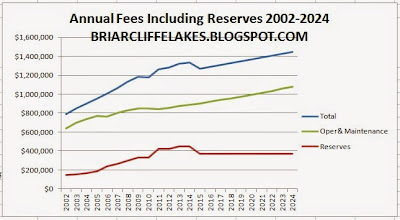
Annual Fees Including Replacement Fund and O&M Budgets

Budgeting is a normal exercise in business. 

Good budgeting is not an easy task. By "good" I mean accurate budgets that avoid excessive surpluses and deficits. Constructing good budgets requires a lot of background work. It required many, many hours of my time each year.

It is true that boards will attempt to avoid deficits.  So shouldn't they also track surpluses? In fact, I've observed an emphasis about avoiding budget shortfalls. I think this emphasis can be traced to the problems of early budgets at BLMH. Fees gyrated wildly, and then the board began accumulating funds for large projects.  In fact, for a time reserves were underfunded. My accountant flagged that when I considered a purchase in 2001. 

The real purpose of budgeting

I say, Budgeting is based upon fact and is a means to manage the fees extracted from owners.  It is a creative exercise which has factual and philosophical underpinnings. It may be distorted by the emotions or positions of some board members. Those board members, if fearful of a special assessment, are easily manipulated by others.  Those board members, if disdainful of owners, may be inclined to favor higher fees than required by the facts.

"Do you want to avoid a special assessment? Then vote for my 5% increase. " 

Those in fear on the board are are so easily manipulated, and they have been. Owners deserve better but pretend they are living in a apartment, and expect others to protect their financial interests in the HOA, because those on the board are elected volunteers.

Some board members view it as an exercise of "Good versus bad" or "Right versus wrong" and some see it as a means solely to avoid special assessments.

In this post I'll merely summarize and provide a few notes, including a table of annual fee increases.  This post includes a review of methods, surpluses and what to do if there are deficits and O&M expenses exceed fees collected.

In fact, the budget process at BLMH has improved significantly since 2010.  So much so that in recent years even with modest fee increases annual surpluses were created. What happens to those surpluses? Read on.  

Why a Budget?

The Illinois Condominium Act requires that HOA boards prepare an annual budget, submit it to owners for comment, and in consideration of such comments the board votes to approve or alter the budget. 

The budget is essential to maintain the association and pay the day to day bills. It also includes a Replacement Fund for reserves to address longer term infrastructure repairs. 

The two aspects of the budget are the Operations and Maintenance (O&M), and the Replacement Fund.

In fact, the board has quite a lot of latitude, but for some it is ithe eqivelant of the Olymics when contructing a budget. An Olympics for which they are unprepared. 

Operating costs from previous years history are an aid for construction the O&M portion. There are those who resist this, and prefer to avoid the history of the association. Matching their years on the board to the budgets and the reserves accumulated may indicate why.

There are reasons and then there is "Why".

 Professionally prepared, independent Reserve Studies are essential to the Replacement Fund portion. However, these are only guides. The board makes all of the decisions, as fiduciaries and are to operate in the best interests of the owners.

Under all circumstances, boards must be mindful of the financial capacity of the owners. The Illinois Condominium Act (ILCA) stipulated that in the preparation of budgets the board must consider "the financial impact on unit owners, and the market value of the condominium units, of any assessment increase needed to fund reserves."  (Note 1). This was a serious budget consideration by the boards of 2010-2018.

I want to note that Reserves Studies may provide a a worst case scenario which are unrealistic. Some board member will use that to promote their personal agenda. Boards must set priorities and construct budgets in such as manner as to be in the best interests of the owners.  That was my guiding light. Boards 2010-2018 did strive to operate the association within the budgets.

A failure to do so will spend more money than necessary, requiring higher fees. This cycle will continue indefinitely unless checked by the board.  At BLMH committees and management have provided input to the advisors who prepared the reserve studies 2010-2015.  I was a member of these committees. The committee prepared and  submitted detailed reports to boards for the budgets prepared in 2010-2017.  Other committee members have included the treasurer and the maintenance director. (Note 2). 

I want to point out that while I was on the board some board members argued in favor of using "The  worst case scenario" when constructing budgets. I did not agree to that approach. It is the board's responsibility to avoid such a scenario and if such a situation does occur, deal with it in such a manner that does not penalize the owners. Each year I as a board member pointed to the ILCA statement above, and to  others, as guidance for the board.

One board member rebuffed me with this statement about owners: "We should not cater to the lowest common denominator."  I don't recall ever seeing that position on a Candidate's form leading up to any election.

In fact, boards should do their utmost to design a good budget.  However, I need to add "Good for whom?" because I served with board members who placed the owners at the lowest tier.

I was on the board from October 2010 to October 2018. I was involved in constructing 9 annual budgets.  The annual fees over that period increased $512 per owner (average annual), or about $51 per year. The Replacement Fund contribution during that period, excluding surpluses, was almost $4,000,000.   

There were heated debates and it was because of a group led one board member who continuously argue ford even larger fee increases.  I asked  "Why?" I led the group arguing for modest fee increases, using fact based analysis. Because of my position I and two other board members experienced personal attacks by one board member.  There were times it was facts, including numbers, documentation and historical data versus a belief system.   

It is important to realize there are actually two budgets which are ultimately combined

The annual budget includes money to pay for next year’s annual expenses, that's the Operations & Maintenance (O&M) budget.  There is also money for funding the Replacement Fund (Reserves).  These are separate and distinct.

These are to be discussed separately by the board when constructing the annual budget.  The annual needs are then combined into a single budget.

Surpluses may be generated when the actual O&M expenses in a year are less than the budgeted amount.  These surpluses should be recognized.  If large surpluses are generated and are ignored by a board when making future budgets, then those boards are, in fact, levying a stealth, higher fee to the owners. I became aware that some earlier boards didn't know such surpluses may exist. It was really about flying by the seat of one's pants.  

I can state categorically that BLMH has had board members who refuse to acknowledge the existence of surpluses when constructing the budget.  Their mantra is “There is never enough money”.  I have a different perspective. I say “Boards will spend every dollar levied on owners.”  In other words, owners should be mindful. and provide proper oversight the the board.  

For the 2019 budget the fees extracted from owners were increased by the board, even with the facts of a large surplus, noted in the beginning of this post. I objected formally via email. My spreadsheets and supporting documents were ignored and the entire board voted for a fee increase.  I must ask and I did, "What is the factual basis for a fee increase?" I did not receive a meaningful response. Most CYA responses by management are "I have forwarded this to the board". LOL. But I cannot fault management because it is the board that made the decision.  I can fault a board, which hides behind management.

All sources of Income need to be considered

The budget includes projected income. That income assumes that all owners will pay their fees and that all fees will be collected. In the short-term, the owners may be in arrears by $30,000, or more. That was included in the Newsletter to owners In December 2008. The new board, after my departure has not provided his information to owners, and when asked during the September 20121 board meeting they stammered and stonewalled. 

In fact, some fees owed the association may never be collected.  There is a contra account for that.  This is an amount subtracted from income to account for fees that may not be collected and will be “bad debt” which is uncollectible debt for the association.

Other sources of revenue include legal fees collected and fines.  Of course, an association should not levy fines as a means to generate revenue. Fines are a means to obtain rules compliance from owners. I've listened to one board member during a budget meeting who bragged about the amount of fines collected, as if it were a wonderful accomplishment.

The contra account is useful when determining if surpluses or shortfalls occur in a yearly budget.

Budgeting is an educated guessing game, with really serious consequences for owners

One thing to understand is that budgets are based upon projections. One part, the Operations & Maintenance budget, has short term implications. Problems that occur in one year can be corrected, improvements made and addressed in the next year. However, costs are always changing. There may be utility price increases and so on.

Budgeting, therefor is also a learning experience. Boards should approach this rationally and keep their emotions in check. In depth, annual financial analysis beyond the framework of a budget is very helpful.  The charts in my blog, and this post, were part of hundreds of spreadsheets I created and provided to the owners and the board to provide better insights, better forecasts and most importantly, better budgets

Were the O&M budgets while I was on the board, better budgets? Well, I was able to document consistent and sometimes large surpluses.  But to achieve this required a step change of improvements in maintenance. Better O&M controls contributed to better budgets and that was ultimately translated into lower fee increases for owners. 

The Replacement Fund portion of the budget, which funds reserves, is a much longer term exercise. The reserves studies I participated in were a 40 year projection into the future. Boards should be mindful that this year’s budget may have long term implications. On the other hand, because reserves are long term financial buckets, they can have less influence on overall annual budgets.  At BLMH when I tendered a bid to purchase my unit in 2001 the replacement funds were about 14.5% of the annual budget. From 2015-2017 during the period I was on the board the replacement funds peaked at nearly 36% of the budget.

Avoiding Smoke and Mirrors

As an example, I provide this. Once I achieved a seat on the board and began analyzing past budgets, interviewing contractors and management, etc. I discovered that one of the techniques used by boards prior to 2009 was to roll maintenance hours which exceeded the budgeted allotment into the next year.

That kicked the can down the road, and hamstrung any board that followed.  The budgets were apparently sometimes balanced this way.  It worked, I guess.  However, fees from 2001 to 2009 increased nevertheless by large annual amounts.  Postponed maintenance and deficient reserves can overwhelm any budget.

How much latitude does the board have in constructing the budget? (Note 9)

Management prepares a template of the O&M budget which includes the previous year's data, the current year's data as of September 30, and a projection to year end. As a board member I did a lot of supplemental research each year including determining Utility cost increases, reviewing contract dates and so on. This was appended to management's budget spreadsheet and became an important part of the board's budget decision making process.

I suggested adding a contra account item to recognize uncollectible fees.  Management can explain that to the board. The president at the time, a CPA, agreed and after board discussion it was added.  The boards of 2019-2020 zeroed the amount, even though the balance sheet indicated that contra amounts do exist.  Is this important?  It's only a few thousand dollars, but $4,000 is about $12 per owner.  

These small things add up.  

One of the things I began doing was tracking surpluses so they could become part of the annual budget discussions.  The chart above provides an indication of the magnitude of some of these.  

In constructing a budget it is essential to establish a baseline.  That is, determine as accurately as possible the expenditures for the coming year.  This included O&M  and adjustments to the replacement fund in recognition of current and identified circumstances.

Past reserve studies have included things that did not occur and were averted by boards that chose a different approach. In doing so, special assessments, fees increase of 10% and so on were averted. 

Does the budget include estimates?

Yes it does. For example, the water used by the association is a variable. Each utility closet for 4-units includes 5 water meters. One of these is for the association use, including outside spigots. The water will be used to replenish streams and for watering replacement grass, sod, shrubs and trees. It is not possible to predict how much water will be used next year. Water rates need to be adjusted if the city anticipates an increase in the following year.

Electricity for outside lighting, the hallways and the garage interiors is based upon the previous year's billing and rates.  I investigated potential rate hikes each year.  The electricity consumption also was based upon a prohibition of using common area outlets (garages) for electric cars and other unusual usage.

Snow removal is via contract.  However that contract anticipates a certain amount of snow and ice. If there is unusual snowfall in the next year, the costs will increase. Ice requires additional work on streets, driveways and building entries. Walks are not maintained or cleaned in the winter months, which is why I added large caution notices to the newsletters. A board could choose to clean those walks at significant annual expense and in so doing the association would take on additional liability for falls and injury.

Boards consider these and other estimates to construct the budget.

Annual Replacement Fund Adjustments

Contributions to the Replacement Fund may be adjusted in recognition of unusual circumstances not anticipated in the Reserve Study.  For example, the condition of trees has resulted in an additional amount each year to address this.  There is no special category in the Landscaping to address the redoing of the property entrances, or the area along the frontage at 1825-1827 Lakecliffe.  The existing category amounts may be adequate for replacement of dying shrubbery throughout the property, maintenance of shoreline, etc.

The information in the reserve studies should be a component in the board annual review of the contributions to the Replacement Fund.  However, the board has great latitude in this, as previously mentioned here.  Some boards do not conduct such reviews.

A failure to turn over the water mains to the city may require future boards to increase fees to accommodate the costs of total replacement. The current board includes several members who were briefed thoroughly by me about this when I was on the board. 

Does the budget include a surplus?

Yes, some do.  For the O&M budget 2011-2018 I advocated using the baseline, and then adding amounts to specific categories to deal with unknowns. I would prepare a modified version of Management's spreadsheet with notes and suggestions for adjustments, Some categories were increased by the board and others decreased. Note that I was never the treasurer.  I was willing to do this, I took the time and I was sufficiently capable. 

The board discussed each item and category, line by line.  Further adjustments were then made. 

At the end of the year management provided the board with the outcome.  Yes, we did accomplish surpluses in the O&M budget. Earlier boards ignored such surpluses, as did the board of 2019-2010 . Why? One should ask "What was their agenda?"  Such a position has supported higher fee increases. 

Boards do have the ability to make a one time, annual adjustment to Replacement fund contributions to deal with an O&M budget issue. Boards should work to stabilize fees and avoid wild gyrations.  In the period 

However, it would be cynical of a board to increase O&M contributions rather than properly fund the  Replacement Fund contributions for the purpose of generating an apparent surplus in any year.  Politicians are adroit at such machinations, and I have wondered about some board members: "How low can they go?" Of course, there should never be politics among board members in a HOA, but when there are elections at stake politics may triumph; getting a seat on the board shouldn't be about an ego.

Why design a budget with a surplus?

The answer lies in answering the question: "What happens if there is a surplus?", and the related question "What happens if the O&M budget falls short and actual costs exceed the budget amounts?".  

In fact, it is impossible to design a perfect budget. Any board that claims to have done so has either been incredibly lucky or manipulated facts,  

Generating a surplus is very desirable and beneficial to owners. However, a surplus should never be created artificially via higher than necessary fees. Some boards may be inclined to increase fees rather than create controls. Boards may then brag that "We balanced the budget!"  But did they do their fiduciary duty?

What if there is a budget shortfall?

If the total amount of the O&M expenditures exceed the budget, then what happens is this: money is borrowed from the Replacement Fund to make up that shortfall. If this occurs, management can determine the circumstance, but the actual amount is revealed by audit. 

This is not desirable, but does not constitute a crisis.  Some boards feel that this could necessitate a special assessment.  Not true. Nor is it a terrible event. It is undesirable and must be avoided, period.  But again, by using controls, not artificially high budgets. 

If O&M  expense exceeds the budget, or owner delinquencies impact the budget, an automatic borrowing from reserves will occur. This is automatic because bills get paid and the funds are not segregated, but via accounting means. Management information may indicate how a shortfall occurred, but the precise amount of any borrowing will be only revealed during the audit and reconciliation. It will be addressed as part of the audit.

However, these things must be monitored and controlled within the ability of the board and in consideration of the ILCA.  

At BLMH possible annual deficits may be created by the amount of fee delinquencies in any year, which is why there is a contra account in the budget. A deficit may also be created by unusual circumstance.  It is important to monitor actual costs and trends. 

If there is a budget shortfall, the audit will show the amount and determine repayment.  Of course, if a board refuses to acknowledge the contra account category by funding it, they are pretending that all fees will be collected.  This is more smoke and mirrors.

A budget surplus may create the funds to repay such borrowing with no detrimental impact to owners; i.e, no fee increases for that purpose and no long term impact on the value of reserves.

What happens if there is a surplus?

In fact, from 2011-2018 an extraordinary amount of work was put into constructing budgets that would generate an annual surplus without requiring fee increases and might create such a surplus.  Improved maintenance contributed. That was a part of the improved controls. (Note 3).

In fact, information provided by management indicated that significant surpluses were generated. However, the actual amount of the surplus may not be determined until the financial audit. A table is included at the beginning of this post.

When an O&M budget surplus occurs, there are two possibilities:

  1. The surplus may be added to the Replacement Fund, increasing the value of the reserves.
  2. The amount may be returned to owners, if allowed by the Bylaws, etc. 

In fact, to my knowledge at BLMH all surpluses have been put into the Replacement Fund and none explicitly returned to owners.

Some numbers in support of good budgets and good process:

1. Let's begin with older budgets, using the automatic fee increases:   Annual fees from 2001 to 2008, an 8-year period, increased about $1,155 per owner per year.  About $1,518,000 was collected for the Replacement Fund  (Note 4, 5). The position for increases as discussed during that period before the owners was presented this way: That smaller fee increases of 3 to 5% were better than special assessments.

Actual increases were about 7.5% each year.  So boards argued that smaller increases were better, but in fact, the boards levied larger increases than what was presented to owners as the basis of the board's position. In other words, the board promoted 3% annual fee increases but actually extracted 7.5% annual fees increases from the owners. I say, read those annual candidate's forms and be skeptical.

During that period the annual budgets were in the range $787,000 to $1,131,000, an increase of almost 44% over that period.

2. Using improved budget process methods.  The results were achieved using annual surveys of critical and expensive infrastructure, improved cost controls, improved budget models, reserve studies, improved maintenance and establishment of priorities.  All reviewed annually. 

Annual fees from 2009 to 2018, a 10-year period, with new boards,  increased about $511 per owner. About $4,007,000 was collected for the Replacement Fund (Note 5). Annual budgets were in the range $1,181,000 to $1,352,000, an increase of more than 14% over that period.

3. Looking at the a 5 year period with much improved budget processes. This was after adaption of several reserve study updates, further improved cost controls and infrastructure improvements to reduce O&M costs:

Annual fees from 2013 to 2018 collected nearly $2,055,000 for the Replacement Fund. (Note 5). Owner fees during that period increased by $92 per owner. Annual budgets were in the range $1,313,000 to $1,352,000. An increase of less than 3% over that period.

4. Detailed review of 2019-2021 is not possible because I lack sufficient data to do so.  Here are a few earlier charts. At least three of the current board members were present during these presentation.


The chart for fees indicates that fees plateaued under new boards 2008-2018


Annual Fees Including Replacement Fund and O&M Budgets

Annual Reserve Contributions - Recent Years
This does not include O&M surpluses which were also Reserve Contributions.
In other words, actual Reserve Contributions 2011-2018
were greater than depicted here.
In one 5-year period, 2014-2018 surpluses may have been as great as $439,000.
(c) N. Retzke 2016-2021


Fees have a bearing on unit prices.
Affordability is determined by Monthly Payments: Mortgage, Real Estate Taxes and HOA Fees.
In fact, from 2019-2021 unit prices increased an additional 30%.

Delinquencies stabilized (c) N. Retzke 2021

Real and Projected Fee Increases (c) N. Retzke 2021


How fees escalated at BLMH from 1978 to 2014
Had the boards used better budgeting controls, the fees in 2014 would have 
been lower, and yet the association would have collected the
 same money from the unit owners throughout that 36 year period.  


Possible fees into the future, beginning in September 2016
I provided this to the board, and to all of the owners during the 
September 2016 annual meeting.
The point of the graph was to emphasize the long term consequences
 of various annual fee increases.
In fact, the actual fee increases by the boards in the period 1999-2010 were
much larger than those in this chart.


Notes:

1. The Illinois Condominium Act includes this as part of the statute:

(765 ILCS 605/9) (from Ch. 30, par. 309)

 (c) Budget and reserves.

(2) All budgets adopted by a board of managers on or
    
after July 1, 1990 shall provide for reasonable reserves for capital expenditures and deferred maintenance for repair or replacement of the common elements. To determine the amount of reserves appropriate for an association, the board of managers shall take into consideration the following: (i) the repair and replacement cost, and the estimated useful life, of the property which the association is obligated to maintain, including but not limited to structural and mechanical components, surfaces of the buildings and common elements, and energy systems and equipment; (ii) the current and anticipated return on investment of association funds; (iii) any independent professional reserve study which the association may obtain; (iv) the financial impact on unit owners, and the market value of the condominium units, of any assessment increase needed to fund reserves; and (v) the ability of the association to obtain financing or refinancing.

2. A number of boards including 2010 and 2014-2018 did an extraordinary amount of work on Reserve Studies. In fact, 2010 was the first year such a study was prepared by an outside firm.  An extraordinary amount of work was undertaken by a board committee in the period leading up to 2017.  That committee was comprised of the president, treasurer and maintenance director. It was intended to prepare information for board discussion for the advisors, so that an update could be prepared in 2017-2018.  However, disruption of the budget meeting in fall of 2016 by a board member prevented discussion during that meeting and information was tabled until 2017.  

3. The association uses an extraordinary amount of water for the streams and for the grounds including trees, grass and other landscaping.  A lot of water was being lost in the streams, which  were in serious disrepair. One was nothing more than a muddy gulch and others had numerous large cracks. Wooden bridge and deck supports ran through the concrete and were underwater, contributing to additional water loses and maintenance. A large quantity of water was being lost. This damaged some garages and created other issues.  Stream repairs included concrete deck supports which reduced water loss. Stream and pond repairs closed most of the cracks which lost water. Replacement of a pump discharge line further reduced water loss and reduced the mud.  These things combined should decrease water consumption and that means lower utility bills. Replacing wooden supports means those unit decks will no longer fall into the streams, etc. Maintenance hours and costs should be reduced for this. 

4.  Budgetary numbers are from spreadsheets I constructed from information provided by management. Delinquencies were per financials and until 2019 the treasurer would discuss the amounts during the open session of the monthly meetings. Prior to 2019 the dollar amounts were occasionally published in the official newsletters.  All owners are given a budget sheet each year.  In the past, management also provided owners with balance sheets and the Treasurer would provide summary data during meetings and in the newsletters.  This practice was suspended by the board of 2019.  As a board member I was given monthly financial data by management, as were all board members. This included a balance sheet as well as income and expense information.  Audits are completed by an accountant, but audited information requires time to prepare and is delayed by a year or so. Getting any financial information beyond the budget which is published is very difficult.  For example, during the September annual meeting an owner asked about delinquencies and bank balances. The board could not answer the question. That is why financial information for 2019-2021 is not included here.

5.  Fee numbers per owner are simplified as the fees divided by the number of units. If fact, the fees per unit are determined by percentage ownership and not all units have the same number. That percentage was determined by the builder and is a part of the Bylaws and Declarations of the HOA.  If all ownership was uniform, each owner's fees would be 1/336 or 0.2976190476190476% of the total of fees levied each year.

6.  A table of fee increases, by year. Note that budgets and fees are determined by the board during a budget meeting held normally in October. In other words, the budget for 2019 was determine by the board elected in September 2018. I included some notes. For example, a reserve study in 2010 impacted the budget and fees of 2011. I departed the board as of September 28, 2018. Owners are allowed to comment on budgets prior to formal vote and passage by the board: 

Year  and Percent Fee Change 

1978 +35.0
1979 +22.0
1980 +26.0
1981 +25.0
1982 -12.0
1983 0.0
1984 +10.0
1985 0.0
1986 0.0
1987 +5.0
1988 0.0
1989 +12.0
1990 +5.0
1991   0.0
1992   0.0
1993 +6.0
1994 +3.0
1995 +4.0
1996 +5.0
1997 +3.0
1998 +3.0
1999 +11.0
2000 +11.0
2001 +9.0
2002 +6.0
2003 +7.9
2004 +6.5
2005 +5.8
2006 +5.4
2007 +6.0
2008 +5.5
2009 +5.1 (New board September, new 2010 budget)
2010   0.0  (I joined the board September 2010, after completion of reserve study)
2011 +7.0 (First reserve study used to determine; study flawed)
2012 +3.0 (Subsequent reserve study used)
2013 +2.0
2014 +1.0
2015 -2.0 (Updated reserve study)
2016 +1.5
2017 +1.5
2018  0.0 (my last year on the board)

7. Here is a link to more than 40 earlier posts.  

Click for link to: Budgeting Posts

8, This process would be so much easier if board members checked their personal agendas and baggage at the door. To take their personal agenda further, at least one board member has threatened management with dismissal if they didn't comply.  How do I know that?  Because that board member bragged to me about their power to do so. 

I have not posted most of the melodrama or animosity I had to endure while preparing budgets and on the board. I am not a therapist nor am I a financial counselor. As a board member I was not required to assess the source of the fear of board members when they were confronted with the discussion or possibility of  special assessments. At times some board members stated that if a specific fee increase did not occur, then special assessments would occur. In fact, I say the best way to avoid special assessments is proper, but not excessive, maintenance and proper budgets which include adequate reserves.  To do this means good reserve studies properly updated.  Yet, the first formal study completed by an outside firm did not occur until 2010. Some boards made this process far more difficult than it should have been. 

9. According to the Bylaws, the board can enact fee increases up to 15% with no need to listen to or accept any owner input or comment. The bylaws state "If an adopted budget requires assessment against the Unit Owners in any fiscal or calendar year exceeding one hundred fifteen percent (115%) of the assessments for the preceding year the Board of Managers, upon written petition of Unit Owners with twenty percent (20%) of the votes of the Association filed within fourteen (14) days of the Board action, shall call a meeting of the Unit Owners within thirty (30) days of the date of filing of the petition to consider the budget. 

10. The over zealous scheduler published an incomplete version.  This was updated and re-published at 3:00am 10/12/2021

(c) N. Retzke 2021


Wednesday, November 28, 2018

Proposal by the board for a fee increase in view of a $128,012 budget surplus

0 comments

Bookmark and Share


I got my proposed HOA budget for 2019. The new board can't even do the arithmetic. Here's a small portion of my comments to this so called "Board of Fiduciaries".

I have reviewed the “2019 Proposed Budget”. There are serious issues. I want to be clear about one thing. The board is solely responsible for the budget. Management provides bookkeeping service and guidance, but the decision is the boards.  The facts indicate that a fee increase is unnecessary, and the proposed increase is not 1.88% per the documents, it is actually 1.66%.
There are certain principles in these matters that guide boards:
  1. Treat all owners equally and fairly. Treat them as the shareholders they are. Board members are representatives of the owners. Board members are not “higher” in stature than are the owners. They are not the exclusive member of a club of elites.
  2. Boards must operate as fiduciaries. Fiduciaries represent the owners and are held to a much higher standard than other owners or management. “In the performance of their duties, the officers and members of the board, whether appointed by the developer or elected by the unit owners, shall exercise the care required of a fiduciary of the unit owners.” - Illinois Condominium Act
  3. Avoid running one’s personal agenda when on the board.  To do so is a breach of fiduciary duties.
  4. Board members are required to use business common sense.
  5. Board members are required to operate with full awareness of the facts and merits which guide their decisions.
  6. Board members must vote independently using only the facts and the guiding principles listed here. This is not about politics. Politicians are not required to be fiduciaries.  Board member are so required.
  7. When using the guidance of experts, including the association’s management company, the board members must remember that these experts are not fiduciaries. They will not be held accountable as such. They provide professional guidance, but are also hired contractors. Contractors operate at the whim, beck and call of the board and can be replaced. And our management does know that. In fact, attempts have been made by boards at BLMH to replace “non-compliant” managers. For any board member to threaten a manager for failing to “go along” with the agenda of that board member is a breach of fiduciary duties.  Fiduciaries must do independent, confirming research in the fulfillment of their duties.
  8. The president serves as spokesperson for the board of directors in most matters relating to general association business. As an officer of the association, the president has an affirmative duty to carry out the responsibilities of the office in the best interests of the association and as a fiduciary for the owners. As such, the president has special responsibilities to keep the entire board informed and to acknowledge conflicts of interest during the formulation of budgets, rules and so on. A failure to do so is a failure in the duties of president, which is even more significant than the duties of the remainder of the board.
The numbers indicate this board voted for an unnecessary fee increase. Each and every board member has failed in their duty to the owners of this association. Because I understand this was a “unanimous” vote the entire board has acted irresponsibly. Here is how:
  1. A failure to make a decision entirely using only the facts. Those facts include an extraordinarily large projected surplus with no indication in the proposed budget that anything else will occur in 2019.
  2. The board ignored all of the recent surpluses. The facts indicate that budget surplus occurred each and every year from 2012 to the present. Did the president inform the board of this? Why not? Board members promoting fee increases are duty bound to inform all other members of the board of such things during financial discussions about setting the budget.
  3. The board ignored the fact that the reserves requirements are being met.
  4. The board ignored the fact that additional $hundereds of thousands of dollars have been contributed to reserves since 2012. This is optional; boards in the past have transferred all budget surpluses to reserves using this means. Under the circumstances a board comprised of fiduciaries should also discuss the possibility that any reserve funds exceeding “reasonable reserve requirements” be returned to owners. If this is not discussed that too is a breach of duty. Apparently the board failed to vote independently upon the merits of the proposed budget. Why was that? Did it play “follow the leader”? Did board members vote to support a buddy on the board? Or did they simply take the easy path, rather than do their duty? Each board member represents the owners only. Voting to support the agenda of a “friend” or bully on the board is a breach of one’s fiduciary duties.
  5. The board failed to take into account the current situation for all owners in the Association. For example, did the board review and discuss the any recent evictions, foreclosures and seriously delinquent owners when making this decision? “ All budgets ....shall provide for reasonable reserves for capital expenditures and deferred maintenance for repair or replacement of the common elements. To determine the amount of reserves appropriate for an association, the board of managers shall take into consideration ......the financial impact on unit owners, and the market value of the condominium units, of any assessment increase needed to fund reserves… - Illinois Condominium Act (complete text of this section of the Act is contained later in this letter.)  I can state the when I, as president,  introduced this as a discussion topic during a recent budget meeting that one board member who insists upon annual fee increases attempted to shut down this conversation by stating that “We are not supposed to cater to the lowest common denominator.”  Bailey, Scudder and Seery were present for that pronouncement.   Boards are supposed to represent all owners!
  6. The board is not mandated to make reserves “as high as possible”. Per the Illinois Condominium Act, the board must provide for “reasonable” reserves.
  7. The board failed to take into account the willingness of the City of Wheaton to assume responsibility for the Associations Water Mains. That willingness represents $millions in savings for owners; more money than the recent roofing project, which took more than $million in owner fees. Why was this  ignored? Because one board member says “It will never happen?”  Really? Neither the board or management can predict the outcome of this future event. But boards can destroy it by failing to do everything in its power to make it a reality. Such a failure under those circumstances would be sabotage of the owners.  The board is obligated as fiduciaries to do everything in its power to make this transfer occur.  What has it done to move this forward? My guess: “Nothing”. Yet, the board apparently prefers to pretend to ignore this significant financial event when constructing a budget. That’s disgusting, particularly for the sole purpose of orchestrating a fee increase.
  8. The board is not to base fees upon their personal financial ability, or inability to meet the fees required to live in our association.  Nor is it to raise fees because of the financial ability or willingness of friends or neighbors in the association, because they “can afford it”. Your “friends” and “neighbors” have no fiduciary responsibilities. Only the board does.
  9. Board members are to vote independently. Following the lead of anyone on the board is a failure of fiduciary duties.  It is lazy and irresponsible to vote a certain way on a board comprised of fiduciaries because someone told a board member to do so. For example, board member question: “Is this fee increase necessary?” Response of the president: Absolutely necessary.” The board member who asked the question thereupon voted for a fee increase.
  10. To use one’s position on the board to promote one’s agenda, and in this case, to promote an unnecessary fee increase for no other reason than because “I can do so because I am a board member” is callous and self-serving. At its worst, it is malicious.
  11. Voting for an unnecessary fee increase simply because “it is a small one” or because of a belief that “We always must have a fee increase” is a failure of duty. There is no legal or financial reason for an annual fee increase. Fees are to be based upon the numbers and the facts available. This is another manifestation of a personal agenda on the board.  Personal beliefs and agendas are not facts.
It is likely that boards since 2012 have directed an additional $440,000 into reserves than was required by the budgets. All of it came from budget surpluses. Apparently the board wants more.
One definition of “Greed” is a fear of not having enough. Apparently this board is being greedy. 

Some owners have asked me why I chose not to run once again for the board of this HOA.
  1. I decided to create an opening for others to step up to the plate. “Nature abhors a vacuum.”
  2. I decided to see if my eight years of guidance, mentoring and positive results had made any difference with the entrenched on the board.
  3. I wanted to observe how a board with three members (now four) with 50+ years of "experience" would operate, after I departed. LOL. They all reverted to being "the lowest common denominator" which is the term one board member used to rebut the discussion I initiated about the financial impact on our owners when the board constructs the budget. I was quoting the following at the time: " All budgets ....shall provide for reasonable reserves for capital expenditures and deferred maintenance for repair or replacement of the common elements. To determine the amount of reserves appropriate for an association, the board of managers shall take into consideration ......the financial impact on unit owners, and the market value of the condominium units, of any assessment increase needed to fund reserves… - Illinois Condominium Act. 

Yes, we have had board members who hold owners in complete disdain and disregard. All owners that is, who aren't personal friends.

I had concluded after eight years on the board that we had board members who were grossly incompetent or unsuited to be fiduciaries with such responsibilities.  They were not operating for the benefit of the owners, but for personal agendas, and the agendas of their leader on the board, or friends. However, the only way to dislodge them and prove my case would be to leave the board.  They would soon show their hand. Owners could then choose.

The answer to question #2 is obvious: Nope, none at all.
That’s not good for the owners of this association.  I guess the primary duty of owners is to pay the bills for the decisions of the board.  We have had some really incompetent boards. Will 2019 be better than this? Or just another bad board?   
In my letter to the board I said "I look forward to a candid response from the board. Not from management. These decisions are being made by board members and they need to stand on their own two legs, rather than hiding behind management and lawyers. “The incompetent gleefully spend the money of others to defend their poor decisions. “ – Norman Retzke""

I suggested to the board that they take a stroll down memory lane:

Over a period of 11 years, from 1998 to 2009 the boards ramped up fees at an average annual rate of 6.85%. Owner fees nearly doubled over that period, reaching about $295 per month in 2009. But by the fall of 2008 the angry owners had enough. The president and most of that board was replaced.
In 1998 I understand the reserves totaled $86,321.  By October 2008, with Lakecliffe Drive failing, the board had allocated only $90,208 to Paving and that included all streets and 84 driveways.  The roofing project began in 2005 at 1775-1777 Gloucester, the address of the president at the time. That roof had previously been re-shingled in 2001, according to a 2006 letter my management. That was the only roof  completed prior to 2009.  By 2009 the reserve allocation for roofs was lacking about $1,241,000, which is the reason the board prior to 2009 stated during board meetings that it would replace roofs “at the last possible moment” and maybe one or two per year. There was no formal pronouncement, but I concluded this was because of funding issues.   There was no money allocated in the budget for water main failures, yet they had occurred frequently commencing 2001 or so.  There was a large and growing backlog of other projects, as the board attempted to accumulate sufficient funds for the roofing project. Yet, no formal information to owners. There had never been an independently conducted outside reserve study for the association. 
Yes, there were real money issues and a lot of angry owners.  Some people prefer to operate out of the past, because it is easier the living in the present.
But that was then and this is now. This association is very, very different today than it was in 2008.  Board members should operate in the present.
 It is my understanding that other Associations now visit ours to see what a really well run and maintained association looks like. Yes it is very different today. It really is time to live in the present, not in the past.

According to the Illinois Condominium Act:

(765 ILCS 605/9) (from Ch. 30, par. 309) 
    Sec. 9.

(2) All budgets adopted by a board of managers on or
    
after July 1, 1990 shall provide for reasonable reserves for capital expenditures and deferred maintenance for repair or replacement of the common elements. To determine the amount of reserves appropriate for an association, the board of managers shall take into consideration the following: (i) the repair and replacement cost, and the estimated useful life, of the property which the association is obligated to maintain, including but not limited to structural and mechanical components, surfaces of the buildings and common elements, and energy systems and equipment; (ii) the current and anticipated return on investment of association funds; (iii) any independent professional reserve study which the association may obtain; (iv) the financial impact on unit owners, and the market value of the condominium units, of any assessment increase needed to fund reserves; and (v) the ability of the association to obtain financing or refinancing.

The above emphasis is mine. Here is the most  recent reserve projections for this association. This was presented to every owner and board member who attended the September 2018 annual meeting. It has also been presented to boards earlier, as part of normal board business discussions.

Present for this were current board members Bailey, Calvo, Scudder and Seery.  The data indicates reasonable reserve requirements have been met. I'll be posting more on this.

Projected Reserve Balances
It has come to my attention that one owners is now stumping for the board and promoting a fee increase. Based primarily upon that individual's ability to pay it, and the fact it is a "small" increase.

Merely an opinionated owners who wants to support her friend on the board. These opinions are bullshit.   Boards are fiduciaries and they operator for all owners, not simply for those who can afford small fee increases. Here's what one of the friends of the current president says about this. I need to point out that this fee increase is unnecessary and that this individual is "tony" and can afford the small increase:

"I believe modest increases (maybe not every year) are important to avoid getting into a similar deficit situation as we were years ago. If Briarcliffe Lakes was in great shape and there was no possibility of costly surprises in coming years, I would support your endeavor.  However for me, that rational is unrealistic. Being prepared and gently padding the reserves, regardless if budgets/projections warrant it or not, in my opinion are the right path to take.  "

A few years ago this same owner was also promoting a multi-million dollar mortgage for this association. Why? Probably because she could afford the payments. But not everyone can. My point is, owners act on their own behalf; they are not fiduciaries. Boards who pick and choose the comments of owners as a justification for their actions are irresponsible. They are not operating as fiduciaries.

Bad business decisions are bad decisions, and the association is to be operated like a business. Board members are not a group of elites in a private club.

The question owners should ask in these situations is this: "If the board is not operating on my behalf, then on whose behalf are they operating?"  If owners don't like the answer, then they should do something about it. 


LOL


Tuesday, November 27, 2018

Proposed 2019 Budget, potential $128,000 surplus = 1.88% Fee Increase

0 comments


Bookmark and Share
Well, she's back and it shows. With a potential $128,000 budget surplus, the new board led by the "Fee Raiser" has decided upon a "1.88%" fee increase. Why? Well it seems she thinks costs are going up by about $22,415. Yet that board is using the same basic budget that was created in the fall of 2017.

If those numbers seem an odd justification for a fee increase it is because they are.

This board apparently believes that even if they use the 2018 budget for 2019 which projects a surplus from expenses of more than $94,000 that they will be completely unable to generate a surplus in 2019.   Is that the definition of incompetence? I'll let the reader decide.

Even though there are absolutely no numbers to support such an outlandish position, she tells the board that a fee increase is necessary because costs will somehow, magically rise more than $116,000 in 2019. However, she can only identify cost increases of $22,415.  Oddly reserve categories are being ignored and to justify a larger fee, some reserve items are going to expensed in "Operations and Maintenance".  To get her way she'll do just about anything I guess.

I'm sure management will get the blame. Or perhaps she'll throw the new treasurer under the bus.  But here are the facts.

The board is solely responsible for the “Proposed 2019 Budget”. The role of management in these financial matters is to provide a bookkeeping service and to provide sufficient guidance to keep the board from going completely off the rails. Management will not and does not construct the budget. It is really important for the board to ask the right questions of management and prepare. Management will not argue against unnecessary fee increases proposed by any board. Management is well aware that it serves solely at the discretion and whim of the boards. Boards and owners should read the Illinois Condominium Act for further details about the duties, responsibilities and legal obligations of the board.

Now you know why I am off the board. 
I've had to deal with this since 2011. That included ugliness and personal attacks at anyone who didn't agree with a fee increase each year. There was a dislike for a former president who was a CPA. When he left after three years she and the locksteps did not say a "thank you" or even a "goodbye". Even going so far as to accuse the Finance Committee of "malfeasance" because they would not vote for yet another of her unnecessary fee increases.  A favorite expression: "Throw them under the bus."

Our mortal sin? A fee decrease of 2% one year and a 0% fee increase another. Yes, we actually decreased fees one year. That was unforgivable, but we had a valid reason. And what really pissed her off was that a budget surplus occurred. 

The three of us decided not to run and I decided to see what she and her lockstep buddies would do. Well, now we know. Financially flog the owners once more.

I do understand it is a small increase. But it is absolutely unnecessary according to the finance projections. We are not behind in our reserve contributions. In 2018 we identified a multi- million dollar cost saving for owners. I don't think this is the manner in which fiduciaries are supposed to operate.

All I can say is "Owners get the boards they elect". So again at BLMH the owners created this. They decided to sit back. LOL.

She will really make me look good. Here's my leadership record, and let's not forget all of the capital projects that were completed:
  • Average annual fee increases of less than 1% from 2014 through 2018 (Actual 0.40%).
  • Annual budget surpluses.
  • Full funding of reserves during the years 2014 through 2018.
  • Approximately an additional $300,000 added to reserves 2014 through 2017.
  • A potential addition of $440,000 added to reserves 2014 through 2018.
  • Avoidance of 5% annual fee increases while achieving the same results.
I'll say that again. To replicate the results would have required an annual fee increase of 5%.  But that was the preferred method. To me it is apparent that the lazy prefer to raise the fees on the owners. "fiduciary"? what is that? Believe me, to get her eyes to really pop, all I had to do was talk about our owners as the "shareholders" they really are.

So here's some the legacy: Over a period of 11 years, from 1998 to 2009 the boards and I do believe she was president for all of those years, they ramped up fees at an average annual rate of 6.85%. Owner fees nearly doubled over that period, reaching about $295 per month in 2009. But by the fall of 2008 the angry owners had enough. The president and most of that board was replaced.

So what was the state of infrastructure during the above:


  • In 1998 I understand the reserves totaled $86,321. 
  • In October 2008, with Lakecliffe Drive failing, the board had allocated only $90,208 to Paving and that included all streets and 84 driveways. 
  • The roofing project began in 2005 at 1775-1777 Gloucester, the address of the president.
  • Only one roof was completed prior to 2009. 
  • By 2009 the reserve allocation for roofs was lacking about $1,241,000, which is the reason the board prior to 2009 stated during board meetings that it would replace roofs “at the last possible moment” and maybe one or two per year. This was apparently because of funding issues. 
  • There was no money allocated in the budget for water main failures, yet they had occurred frequently commencing 2001 or so. 
  • There was a large and growing backlog of other projects. 
  • There had never been an independently conducted outside reserve study for the association. 
  • Yes, there were real money issues and a lot of angry owners. 

I made the critical error of asking her back as Treasurer in 2011.  She is a good bookkeeper and can sign checks and compare invoices to assure they are ours. She likes to hobnob with the powerful. A typical politician.  She even brags about how she accomplished all of this success with a columnar pad.  Insists that computers including spreadsheets are unnecessary.. Hmmm, perhaps that is a part of the problem. LOL.

How much is enough?
Somehow she intends to spend more than the budget that is being used by the 2018 board under such "leadership". How much more out of Operations and Maintenance? Oh, about $116,922 more in 2019 than was spent in 2018.  How can that be?

Never mind that we've had budget surpluses every year since 2012.

We had a large projected surplus in 2017, but 2018 is the largest ever. How large is this? Back in 1998 this individual was on the board and I understand the entire reserves were about $90,000. I'll be posting more about the consequences of this management style. LOL.

The "Fee Raiser" insisted to the one board member who asked "Is this necessary" that "Yes, it is absolutely necessary". So the board ignored the budget surplus and decided to raise fees, apparently just because they can.

The "Fee Raiser" was voted out in 2008 and may be seeking revenge upon the ungrateful owners who booted her and most of her board that year.

I've done the numbers and frankly this is stupid. ? Instead, the board chooses to ignore the projected surplus and is pretending there is a budget issue when there is none. Why is that?

What are the Owners? 
Well, their sole purpose appears to be to generate income for the association, unless they are friends.

Favorite Quotes
Our Fee Raiser is long on quotes:
"Follow the numbers" (apparently only applies to others)
"You can paint a pig but it is still a pig" (describing BLMH)
"You can throw them under the bus" (describing others)
"Stupid is as stupid does" (describing others, including boards and owners)
"You can't teach an old dog new tricks" (proves that!).
etc.

Perhaps she's living by her mottos. Who knows?

I've sent specifics to a few owners. One of the questions I'm asking the board is "How much is enough?"  Apparently as much as she can squeeze from the owners.

I wonder how long it will take to ruin the association?  Any bets?

Here's the most recent budget. This one is the one that's being replicated for 2019 and this one will apparently generate a six figure surplus:


BLMH 2018 Budget