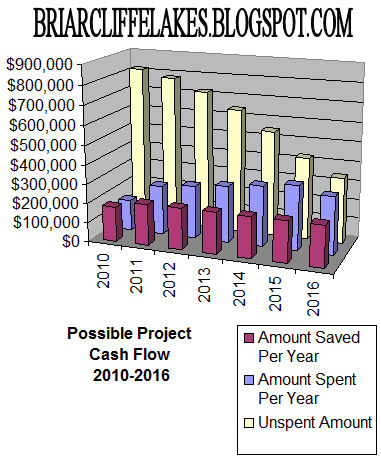
Updated Surplus Numbers

Updated Surplus Numbers
Updated Surplus Numbers: Actual surplus 2018 per audit was $85,163.
Boards 2011-2018 implemented policies and procedures with specific goals:
stabilize owner fees, achieve maintenance objectives and achieve annual budget surpluses.
Any surplus was retained by the association.
The board elected in fall 2018 decided to increase owner fees, even in view of a large potential surplus

Average fees prior to 2019

Average fees prior to 2019
Average fees per owner prior to 2019:
RED indicates the consequences had boards continued the fee policies prior to 2010,
BLUE indicates actual fees. These moderated when better policies and financial controls were put in place by boards

Better budgeting could have resulted in lower fees

Better budgeting could have resulted in lower fees
Better budgeting could have resulted in lower fees:
RED line = actual fees enacted by boards,
BLUE line = alternate, fees, ultimately lower with same association income lower had
boards used better financial controls and focused on long term fee stability
Showing posts with label Board Duties and Responsibilities. Show all posts

Thursday, November 11, 2021

Financial Impact of Fees for Reserves

0 comments


Unit Prices at BLMH  2009-2018
A total of 165 units sold, 2009 through July 2018
Boards 2019-2021 aren't as transparent.

Bookmark and Share

Boards determine the annual budgets, including the Operations and Maintenance (O&M) budget as well as the allocation to the Replacement Fund (Reserves).  While I was a member of the board I created a series of spreadsheets. These were produced with the information management provided to the board each month.   

Looking at the charts I publish here may be considered a waste of time.  I know, this is "old stuff" and some on the board have argued that owners are already aware of it. One board member used that argument as the basis not to publish information in the Newsletter.  

In fact, 165 units were sold in the period 2009 to July, 2018.  I don't have the unit sales from August 2018 until October 2021 at my fingertips.   More than half of the units at BLMH have been sold since 2009.  Since 2015 about one-fourth of the units at BLMH have been sold.   

So, this is "new" to many on the board as well as to recent owners.  I doubt if the "old timers" on the board, those who lived here 20, 30 or more years, have spilled the beans to the others on the board. After all, for some information is power.

My point in saying the above, is that a substantial number of owners are unawares of the issues that transpired at BLMH prior to 2015.  They may think that the situation of the last six years is typical. It isn't. (Note 1). 

While I was a board member I created hundreds of spreadsheets and charts so the boards could make the best possible decisions. Some were also part of the annual meetings in special presentations to owners. 

I also concluded that for some board members it was an "out of sight, out of mind" situation.  Graphs can  consolidate and present reams of data with a chronological context. My experience has indicated that we have difficulty comprehending columns and rows of numbers. To really understand tabular data may requires better conceptual and critical thinking skills. Boards are no different than anyone else. Nor are boards good at retaining information.  I realize my limitations which is why I keep notes and build spreadsheets and charts and do additional data analysis. 

Nor do board member pass what they know on to the boards that follow them. Information in monthly packets seems to be quickly forgotten. I think sometimes that is deliberate.

I provided insights on this blog and when I was president of the association I presented to owners who attended the annual meeting. The chart above was part of a presentation to owners and was published here in September 2018.

The board is provided sales information, month by month, which is how I created the "Average Unit Prices" for 2009-2018, above.

A few additional annual budget inputs.
There weren't significant surpluses from 2000-2013.
Some data for 2019 is unknown, because the board didn't publish it
and provide it to all owners.

The chart above was useful for determining the financial health of owners, because it included the number of owners significantly delinquent and the amount owed.  The number of owners owing small amounts (less than $100) and those small amounts were ignored because that eliminated minor fines, etc. What remained was the number of owners significantly in arrears. 

A part of a monthly spreadsheet I prepared showing owner 
delinquencies, 2008-2018. I also presented to owners,
last time was during the September 2018 annual meeting.

The banking crisis occurred in 2008, and the "great recession" occurred between 2007 and 2009.  There were a significant number of foreclosures at the association and that continued for several years after the recession ended. I don't show the amount of "bad debt" which is the amounts never collected from owners. (Note 2, 3).

The boards were given all of the details by management via monthly packets of information. The packets were to be studied by board members and then discussed during open sessions, unless there was a specific prohibition as per the Illinois Condominium Act. I noted board members were inclined to only talk about some of the new that they felt was "good news".  

I used data provided by management to the board each month. I tracked the amount owed by owners and the number owning, month by month.  I provided a printout of a customized, updated spreadsheet to the board each month, in the period March, 2011 until September 12, 2018.  The sheet was useful when doing the budgets.  The unit prices, delinquencies and fee increases indicated the plight of owners.  

When serious delinquencies peaked at nearly 16%, it meant that one over in each building was seriously delinquent (40 8-unit and 4 4-unit).

The charts clearly illustrate the financial problems faced by owners in the period 2010-2014. Not all board members were empathetic to the plight of owners.

Using the information, on unit price declines, delinquencies and foreclosures I petitioned the board to tread carefully when raising fees to accommodate increases to the Replacement Fund (Reserves). Unit prices bottomed in 2012, but didn't recover until 2015. I don't think prices have returned to the peaks of 2006-2007.

So how did boards respond?  That was determined by leadership and board makeup.  In any board, some members coast and follow a leader. That may be the president, or not. As a board member I was obviously concerned about the financial impact of fee increases, etc. on owners.  Which is why I took the time to build spreadsheets, and issue specific charts to the board.  It didn't sway all board members.

The financial situation of owners is one of the reasons I worked double time to manage fee increases. I recall an association meeting when an owner came to the meeting and petitioned the board for some relief from the fee increases each year.  The owner said "I'm retired and living on fixed income." The president responded "We all are. We all have a similar problem. Simply because some of us aren't retired and work doesn't mean we can ask the boss for a raise every time we face a financial issue."  However, the board did work to reduce the fee increases because we saw the financial carnage inflicted upon owners in the management packet each month.  This was a motive force for the improved controls to better manage fee increase 2012-2018.  However, not all board members were empathetic and at least one was of the opinion their first responsibility was to the association. I argued that isn't what the Illinois Condominium Act states. That too didn't influence all board members. (Note 4).

In a seven member board, four must be aligned and vote together to pass a directive, etc. We have had boards with only six members and that can result in tie votes.  Such ties can only be broken when one board member switches sides in the vote, breaking the tie.  We have had board members who are committed first and foremost to their personal agenda. These board members attempt to build a coalition aligned with their agenda and beliefs. In the ugliest situations they will drive off other board members who aren't aligned with their position, so as to build a coalition. The association has lost some good board members that way. Owners are oblivious. 

If a tie vote occurs and a board member switches their vote and goes "to the other side", thereby breaking the tie, it may be treated as tantamount to treason.  On one occasion a board member decided to vote for a lower fee increase. The coalition leader who was pressing for a larger fee increase attempted to have the vote nullified.  Then attempted to get the rebel to declare it to be a "mistake" and change his/her vote.  The goal was to require a re-vote in which the larger fee increase would be passed. 


The Illinois Condominium Act states that Boards must consider the value of the units as well as the financial impact on owners when determining reserves via the annual budgets:

(765 ILCS 605/9) (from Ch. 30, par. 309)
    Sec. 9. Sharing of expenses - Lien for nonpayment.

2) All budgets adopted by a board of managers on or
    
after July 1, 1990 shall provide for reasonable reserves for capital expenditures and deferred maintenance for repair or replacement of the common elements. To determine the amount of reserves appropriate for an association, the board of managers shall take into consideration the following: (i) the repair and replacement cost, and the estimated useful life, of the property which the association is obligated to maintain, including but not limited to structural and mechanical components, surfaces of the buildings and common elements, and energy systems and equipment; (ii) the current and anticipated return on investment of association funds; (iii) any independent professional reserve study which the association may obtain; (iv) the financial impact on unit owners, and the market value of the condominium units, of any assessment increase needed to fund reserves; and (v) the ability of the association to obtain financing or refinancing.

Notes:
  1. Owners think that future fee increases will be less than 1.5% per year.  They are unaware of the consequences of some of the horrific water main breaks that occurred prior to 2015.  The recent newsletter mentioned a cost of $50,000 for one break, but in fact, a few years ago the association spent about $65,000 for the plumber plus asphalt replacement and lawn repairs as well as maintenance workers to clean up the mess.  Recent buyers aren't aware that owners described Lakecliffe Blvd as a "minefield" in 2013 or so.  They are unawares that as early as 2011 real estate prices were much lower, and one unit sold for about $60,000.  They are unawares that today, units are selling for 80% more in price than they were 9 years ago.    They are unawares that the City of Wheaton condemned all of the fireplaces on the property, and the struggle it was to get that addressed. It took more than four years, coordination of unit owners on the first and second floors, letters by me to the City to get better guidance, etc.  I suggest owners, and the board, are unprepared for the future at BLMH. There's an old expression "Those who are unaware of history are inclined to repeat it".  Even the old timers seem to have forgotten, or would prefer to forget, rather than be implicated by the earlier issues.  
  2. A "contra" account was added to the 2013 annual budget and budgets thereafter until the budget of 2019 by a new board. The "contra" amount is a negative number which reduced the amount of budgeted income to the Association. This was considered necessary because in bankruptcy court debts may be discharged which means the debtor's fees cannot be recovered.  Furthermore, during foreclosure proceedings not all debts to the association may be recovered. In other words, some fees owed the association may never be recovered.  The amount used by the Board in the budgets to owners was -$4,000, although significantly higher amounts were not recovered in a number of years. The annual audits reveal the actual amount of the contra amount as "Bad Debt".   For the year 2010 the "bad debt" per the audit was $6,575.  For the year 2012 it was $7,000. For the year 2013 it was $24,563. The most recent audit I have been able to get was for the year 2018. The bad debt that year was $3,943
  3. Under the Illinois Condominium Property Act, if a unit is foreclosed and sold to a third part, the Association may be able to collect six (6) months of common expenses and court costs, provided certain steps are taken by the Association. Those steps include initiating its own collection action. If no action is taken and an account is or becomes delinquent, the association attorney recommended that the Board proceed with a forcible entry and detainer action, so that it may collect some funds, even if the foreclosure is completed. 
  4. I left the board for a variety of reasons. One was because during my final year I decided the board makeup for the next year would comprised of passive-aggressives with increased covert, undermining  activity. I'd experienced that for a few years and as I am fond of saying "Owners get the boards they elect". So, I let the owners choose the new board.

(c) N. Retzke 2021


Friday, February 23, 2018

HOA Committees - Purpose and Issues

0 comments

Bookmark and Share


If you are a HOA owner or are considering a purchase you will see a list of "board members" in your newsletter or a list of "directors" or "committees".   What is that about?

I'll use our association as an example. We are a not-for-profit corporation. That means we have the following corporate officers:
  • A President
  • A Secretary
  • A Treasurer
However, for practical reasons we also need someone to chair the meetings and perform the president's duties in the event of the absence of the president, and so we also have:
  • A Vice-President
The above roles provide no guidance and minimal insights into the duties performed or required by the board of a HOA, so the board divvies up the duties. In our HOA as many as 7 people are elected or appointed to the board. In recent years we usually had 6 on the board.

Board Position Assignments and Committees
Once a year our HOA holds elections for board positions. I assume that is so for other HOAs. Owners decide to run for the board and from the list of candidates a sufficient number are (hopefully) elected to fill the empty or expiring board positions.

Once elected, board members may be provided with a list from which to choose their duties. Why? Because there are many tasks to be done and these are accomplished by part-time volunteers. That means  1) there are time constraints, 2) the volunteer may have a specific interest or skill, 3) there may be a personal agenda, and 4) there may be an interest in having a position that requires minimum involvement or work.

The board members can pick and choose their duties and hopefully everyone will be served, all positions will be filled, and more or less equitably.  In practice that doesn't occur. Not every elected board member is willing to choose the difficult positions, so it may be required that a single board member will fulfill the duties of multiple positions.  In fact, unless boards are willing to enforce a "everyone works" policy it may have board members with no assigned duties. Those individuals are required to only read official materials before meetings, attend the meetings and vote.

While personal agendas may be present, they are not inherently a problem unless the board member runs that agenda whenever possible to the avoidance of all else, or to the detriment of the HOA and the owners.

Here is a list of our current board position assignments, in no particular order:
  • Architecture & Projects
  • Finance
  • Landscaping
  • Maintenance
  • Rules & Regulations
  • Welcoming
We've also had additional positions in the recent past, such as:
  • Communications
Each of the above positions leads a committee. Each committee may be comprised of one or more board members, and of interested owners.

At BLMH, we currently have no owner participation on committees. Or to be more accurate, no formal participation. We do have a social club and several board members attend the club meetings. I think it is fair to say that some social club members use those meetings as a means to avoid attending the formal HOA meetings while achieving access to board members. Some may also attempt to influence the board members and so the club members could be considered unofficial members of committees.

Our board is fully staffed and there are committees. It should all be smooth operations, right? Not quite!

Are the requirements and duties equally distributed?
In a perfect HOA they would be; but this is reality we are dealing with. It is useful to remember that these positions are entirely voluntary.   Some members of the committees pick and choose their tasks within the committee. Of course, all board members vote. That's one reason to be on a board and it is the only task that is equally distributed on boards.

When I first came to have a board position we had the following official duties per person:
  • Architecture, Projects & Maintenance
  • Finance
  • Landscaping
  • Rules & Regulations
  • Welcoming
  • Communications
For a time, these were the actual duties assigned per person for 5 board members:
  1. Architecture, Projects, Maintenance & Newsletter.
  2. Finance.
  3. Landscaping.
  4. Rules & Regulations.
  5. Welcoming.
I suggested to the board that maintenance be seperated, but the board at the time resisted that. Having one person responsible for all capital projects and maintenance seemed to be a bit excessive. Furthermore, it struck me as one of the reasons some issues were overlooked.  In the recent past the task was largely maintenance, with less than $180,000 collected for capital projects each year. The age and condition of the HOA changed that and the reserve collections more than doubled, and expenditures reached up to $450,000 in a single year (roofs, streets, water mains, streams, common decks, driveways, etc.). One board member was attempting to orchestrate this, read specifications, bid documents, monitor the actual construction, etc. And that same individual was doing the same for a variety of maintenance projects and spearheading the newsletter.

Finally the board did agree to separate the two positions when another board member agreed to be the Maintenance Committee. However, the projects and maintenance committees do continue to work closely together.

Why were board members reluctant to separate the positions? Some are resistant to change. Perhaps some insular board members think they that the new members should carry a larger burden, or perhaps the board can succeed at driving off new members by burying them in tasks. That's a good strategy.  At BLMH for a variety of reasons some board members don't regularly walk the property and some are limited in their physical activities. Some don't consider such activities to be their responsibility and of course, we are all "busy".  Some board members rely upon others to do the "heavy lifting".  Some rely upon others to provide photos, surveys, videos, printed reports and spreadsheets.

Why the unequal distribution? Basically time, technology access and ability,with personal inclination. Board members and committees are comprised of some members with a lack of available personal technology, minimal technology skills, physical impediments and time constraints. As a consequence duties are not equally distributed and a few may do the work required of the many.

Getting committee tasks done
Whatever the board committee size and structure, these committee tasks do have to get done, don't they? The straightforward answer is "Perhaps not."  For example, when I first assumed a board position in 2010 I was surprised to discover that there had not been any surveys of garage floors, concrete patios, etc. in many years.  No one on the board could tell me their specific condition and there was no documentation. Management had not recently been instructed to conduct such surveys with a board member.   Boards apparently operated based upon owner complaints. Why? One reason was insufficient funds. It is difficult to look for problems when you know you may not have the funds available to solve any you discover. However, operating with a lack of information makes good decision making impossible.

There was one exception. About 10 years ago the Rules Committee had multiple members. The goal at the time was to streamline the rules and get rid of those which were unpopular among a group of owners. For a short time the HOA was run like a social club. Those rule changes never came about because the board members involved resigned upon realizing that the entire board would not take their approach and there would probably be insufficient board votes for the proposed rules changes.

Sometimes boards avoid committees
Committees can always use members outside the elected board. However, some boards are insular and operate as if owners are pests or that owners may have an agenda or ulterior motives. For board members it is true that having an owner or owners on the committee does require direction of those owners.

Some boards don't like to be observed by owners. Having an owner on a committee provides that owner with insights into issues, problems and access to board operation. In the worst examples board members are distrustful of owners.

Some board members will go to great lengths to prevent owners from participating on committees.

What are the warning signs?
At BLMH some board members say that "owners are disinterested and uninvolved". I agree that in a community of 336 owners there is ample evidence that owners are uninvolved. The average number attending recent monthly HOA meetings is fewer than 6, and sometimes two of those are former board members. However, I don't include the annual meeting or winter meetings, as weather can make attendance inconvenient. In fact, recently the board decided to cancel a meeting due to weather concerns. As for the annual meetings, we were unable to get a quorum of voters for the elections, so it was necessary to re-run it. Yes, there is a lack of interest.

So what gives?  The HOA appears to be running well. Some owners take that to mean that their involvement isn't necessary.  Ditto for the boards; owner involvement may be considered of little benefit to the HOA. I assert that from time to time when owners approach the board and request to serve on committees that they are rebuffed. My evidence? Even though owners have made that request, we haven't had a non-board member owner on a committee in 8 years.  There is a reason for that.

Is that a problem? Yes it is.

How to get more owners on committees and fill board positions
There are things that can be done.
  1. Make continuous requests of owners who attend HOA meetings.
  2. Make continuous requests in the newsletters.
  3. Make it a point to board members that owners participation in committees is normal while the opposite is abnormal.
  4. Use owners who ask to join committees, rather than rebuffing (ignoring) them. 
  5. Communicate with owners about the issues. 
Why won't this work?

If most of the board doesn't want owners involved, then they will find a way to discourage them and burn committee members. Resistant and insular boards do burn other board members, too.

If owners prefer complacency, that is the way it will be.

The challenge is to get realistic and helpful owner involvement. If the HOA doesn't, the day will come when new board members with no prior experience will attempt to run the HOA. That did not work well in the past and there is no evidence that it will work well in the future.


Sunday, March 12, 2017

How Long Should One Be On A HOA Board?

0 comments


Volunteer: a person who freely offers to take part in an enterprise or undertake a task.

I've been an owner of a unit in the HOA for about 15 years. These are my observations during those 15 years of "observing HOA boards in action." This will be a diverse post.

Providing some perspective: (this link will open a new window).
http://briarcliffelakes.blogspot.com/2008/09/about-our-condominium.html

Unfortunately, the boards of 2002 and beyond had decided upon upscale architectural roof improvements. That decision would require at least twice the expenditure I predicted in 2008. Time was most certainly not on the side of the HOA.

About this post
This post cannot go into all of the planning and preparation required to be a successful HOA board member. But it can address the question posed in the title of this post.  The subtitle could be "Who should be on a HOA Board?" It's my opinion that only those who are willing to get the job done, have specific skills and are willing to work and to learn should be on a HOA board.

Some owners are of the opinion that the best years of BLMH lie ahead of us. That may be true, but it will not happen automatically. Our boards are aging. Our boards usually have one or more vacancies. We need capable replacements. We need a plan. Attracting new, responsible and capable board members is a necessity. Mentoring of new board members is a necessity. But this won't be easy and cannot and will not happen with the current structure, which includes the board in total. I am convinced that board members in recent years have not realized the seriousness of this situation, nor have they been willing to do anything about it. Just more of the "same old, same old." Denial is not a good mechanism for achieving results.

Our most recent board president decided not to run for re-election and departed. In tbe vacuum that was created I took his place. He was by several decades the youngest member of the board. Now, one would think that after 3 years of service that one should have a choice on how they spend their life, and he made that choice. Surprisingly, I heard Sean's departure explained as "He resigned." That's how quickly board members are dismissed here at BLMH. Apparently if you decide to move on and vacate that prized spot for another owner, you have abandoned your post.

I was unaware of any interest on the part of some board members as to why he left when he did. To the entrenched he was treated as an interloper, a "newbie." At least one was happy with the departure. It meant getting an opposing viewpoint out of the way. Shortly thereafter we returned to the "same old, same old" of "We need significantly higher fees,"  Really?

In some environments it is difficult to attract talent. There are barriers and turf wars, too. To overcome this gravity it usually requires a crises. That's what happened in 2008. But first the finger pointing begins. Only after the emotional stuff passes can the work begin. I suppose it may take another crises or two. I won't be here to clean up the next big mess,

Sean left after three years of service. I'm here for going on seven years. I took this on because I saw a serious crisis, a lack of foresight and the willingness of boards to take short term measures while failing to deal with the unpopular, uncomfortable, or long term issues. BTW, raising fees in the face of the lack of an independently prepared reserve study is questionable, in my opinion. This HOA didn't have such a prepared study for 30+ years. Was it stupidity or sadism?  Who knows? Ask the board members from the 1990s and 2000s. I can only provide true insights into the thinking of board members from 2010 and beyond. Prior to that it was behind the veil of "executive privilege" or hidden by backdoor machinations.

There is an underlying question to be asked. That is "How long should a HOA board member serve?" If there is a legitimate answer, it is determined by another question which is "What is required to serve successfully as a HOA board member?"

The foundation is a willingness and ability to serve as a fiduciary
This post won't delve into fiduciary duties and these obligations for a board member. I've published earlier posts on that subject. I will say this. I've heard board members describe being a fiduciary as "doing the right thing" or "being fair" or "being just."  I wish that was the case, but it isn't. The standards are higher. "Fairness" implies impartiality and owner equality. Some boards have had real difficulties achieving that.

The Illinois Condominium Act (ICA) does set some guidelines for HOA board members. However, those guidelines don't assure a successfully run association.

Our HOA has a "oath" that board members are to take. There are guidelines and minimum requirements that are circulated to all owners each year as part of the election cycle. Owners are made aware of the duties and obligations so they may choose to knowingly volunteer. However, these guidelines barely scratch the surface.

Another question to be answered is "What are the skills and tools required for a board member to successfully complete their tasks?" Yet another is "What are the time requirements?"

All of the above, if taken together, may provide some insights into the question posed in the title of this post. When we look at skills, tools and time requirements we will discover that the guidelines are very ambiguous and incomplete. I fact, at BLMH our board agreements are "open ended." Boards have been skewed toward attracting retirees or those who can expand the available task to fill the available time.

So some  board members may camp out at the Management office because they literally have nothing else to do. Some would prefer weekday meetings during normal business hours, and in fact, the only way to interact with management outside of the monthly HOA meeting is via email or during normal business hours. That doesn't work if a board member has any other obligations. It does, however, create an artificial barrier to participation. At times, I have concluded that is an intent of some boards and board members.  This too must change.

Communications and Spending
Interestingly, there is no communication requirement to be a board member. Simply come to the monthly meetings, prepared or not. So some board members seldom use email or don't have it. Over the years I've concluded that some either don't read the monthly management packet, or don't understand it.

We don't need to have email, period. Nor is a cell phone or the use text messaging a requirement, either. This led me to retort to a comment by a board member that "There was a time when we didn't have telephones."

But this is also the consequence of a board of volunteers. Having technology available is at a cost. Some board members are simply unwilling to make that donation to their HOA. Can you blame them? Yet, there is a problem and a paradox. We today have owners who expect near instant response to their communications and demands. Yet. they don't want to pay the fees for this. They expect boards to provide their own technology and cater to their every need, want and desire. This, when coupled with board members who have very limited communication ability creates an undermining situation.

In a large HOA which spends more than $1 million each year and with a 2 hour monthly meeting to make that decision, or at most 24 hours per year, wouldn't you think it be a requirement that board members have "up to date" communications abilities? Let me put it this way. For each hour of a board meeting the board is spending or collecting more than $42,000.

That spending is based upon a myriad of decisions. Some based on contracts, and some spur of the moment.

A lack of understanding
Some board members didn't understand the requirements when elected. A very few have thought that their duties and responsibilities were primarily to attend HOA meetings and to vote. Furthermore, if a board member is unsure then there is a real tendency to find a leader to follow. That is not the best way to spend $42,000 per hour and that is why I press board members to participate and be aware of all things that require their vote.

However, board members often forget that their decisions during each HOA meeting will spend $42,000 of fees. I sometime wonder if each owner knew that each and every HOA meeting literally determines how $250 of their money would be spent, would they attend it?

That's something I'll be putting in a newsletter.

Perceptions of being a board member
According to some owners, being a board members means one is to be "the boss" or "the bully." It may be an opportunity to be popular, or run a social group. In recent years some board members have brought these perceptions with them and have run their rackets. In fact, the real requirements of a board member is to make good business decisions, be fully informed of all of the goings ons of the HOA, ask good questions, treat all owners fairly and uniformly and follow the ICA guidelines. The monthly information packet is merely the wrapper.

Treating owners as the shareholders they are has apparently been beyond some.

Why Are Skills, Tools, and Time Important?
At BLMH our board is a working board. Management provides information and guidance. The board ultimately makes most of the decisions. In a HOA as large and built such as BLMH, this can be a difficult task. It is also about 40 years of age.

One thing that is an unstated requirement for board members is familiarity with the HOA. That includes the property, the business and how HOAs and boards work. This sets a high bar for a new board member. As I once explained to a newly elected Architecture & Maintenance Director "You will have to hit the ground running." He didn't fully comprehend what I was saying. This is in fact, true for all board members.

An Example
The first task our newly elected boards are faced with is determining the annual budget! In other words, determining owner fees and spending projections.  This immediately determined an issue for the "change" board of 2008.  That board couldn't reduce the fee increases when they had to confront the financial issues facing this HOA. So they took the bitter pill.

Boards are elected in September and in October the budget meeting is held. For a new board, that is actually a daunting task. With management's guidance even a new board can do this. But there are always unknowns in any budget. Board members must do their own preparatory research. They must study previous budgets. This isn't about providing a "rubber stamp" and there is historical evidence of just how financially dangerous that really is. I usually spend days preparing. A new board probably won't do that, and established boards may not do that. Setting fees must match spending requirements for the year and that includes long term reserve requirements. To accomplish this the previous year's budget must be scrutinized and compared to actual spending for the year. To make this even more difficult, at the time of the budget meeting the year is only 75% complete. It is possible for projection errors to occur.

Why is it so difficult?
For the above reasons, budgeting is more difficult than necessary. The explanation I've been given by our most experienced boards is "That's the way it has always been." It is implied this is the proper way and it is unchangeable. That's not necessarily so.

The current approach favors the most experienced board members and places newer board members at a severe disadvantage. This is because of the timing of the budget meeting(s), the difficulty involved and the need for "expert" knowledge. I have come to view our budgets as potential minefields. Even the board "experts" don't get it right all the time.

What is a newer board member to do? Well, as they lack "expert" knowledge gained by being a board member for a few years or a few decades, it is not unusual for board members to align into groups. Even experienced board members who are less aware of the intricacies of the finances will do this.

So we have factions on the board, and in the end, we really don't have six or seven board members. In fact, we may only have one or two. Board members may align behind the most vocal or most forceful board member. That completely short-circuits the decision making process. The result may be bad decisions and sometimes the promotion of simplistic arguments. One's "gut" may play a part as decisions become based upon emotions or beliefs.  This HOA went down a financial rabbit hole for several decades. It is only now seeing daylight.

What is really required to make good decisions is:
  1. Ability to Act as a Fiduciary. 
  2. Informed and Knowledgeable board members.
  3. Factual and Complete Information.
  4. Truly Open Dialog.
  5. Ability and Willingness to Ask Responsible Questions. 
  6. Ability and Willingness to Listen. 
  7. Partnership with Professional Managers.
  8. Ability to Use Critical Thinking Skills.
  9. Personal Well-Being. 
  10. Responsibly Involved Owners.
Working With New Boards
If a board functions with the above requirements satisfied, then it is possible that even with new board members successful results can be achieved. Not simply occasionally, but consistently. 

This post cannot go into all of the planning and preparation required to be a successful HOA board member. But it can address the question posed in the title of this post.  The subtitle could be "Who should be on a HOA Board?" It's my opinion that only those who are willing to get the job done, have specific skills and are willing to work and to learn should be on a HOA board. 

New board members need to be mentored. Mentoring required the transfer of  the "expert" knowledge gained by experienced board members to newer ones. It requires respectful and honest dialog. There is no shame in saying "I don't know." Of course, there is a lot we don't know. None of us, not one, has any secret knowledge of the future and there will always be uncertainty. 

Mentoring requires imparting a lot of knowledge in all areas to all board members, both new and experienced. 

Mentoring is also the most rapid way for a new board member to gain knowledge.

If boards are unwilling to mentor others and actively train their replacements, then the HOA has a problem. 

How Long Should One Be On A HOA Board?
This is actually two questions. 
  1. How long does it take to become a successful board member?
  2. When or why should a board member step down? 
The answer to the first question is dependent upon the other, more experienced board members as well as the board member himself or herself.  Suitable knowledge of the HOA, confidence and ability cannot be achieved in one or two years. 

There are exceptions to any rule. If a newly appointed or elected board member has actively served on Committees, studied the HOA in great detail for a period of years, and so on, then that experience will assist them in "getting fully up to speed" in the shortest possible time. 

However, most board members will not be aware of what truly is required of them until they are on the job. Even with experience, it will require one or more years to become reasonably proficient as a board member.  

Board Realities
It is useful to be aware that board members, as a group, make decisions in all areas of the HOA. This includes Finance, Maintenance, Projects, Landscaping, Rules and so on. A truly proficient board is comprised of members who have a good understanding of all of these areas. It is obvious this cannot occur in a year or two. In fact, some boards have members in which some members have very limited understanding of some of these areas. That does limit the effectiveness of the boards. It does not cripple boards unless they break into factions. By a faction I mean a group which aligns behind a person or persons and expects them to provide direction. It is a "follow the leader" approach which frequently has rubber stamped voting as a consequence. 

Boards in which there are factions frequently devolve into a couple of camps in which followers simply do as told, out of loyalty or whatever. Of course, a board may simply have a single powerful leader and everyone is bullied or agrees to "fall into line." Board members may simply give up and walk because they see the handwriting on the wall. This is in fact is how some HOAs are run into the ground. Less than good decisions are made, sometimes for years. Those who could make better decisions leave of their own volition or simply give up, or are driven off. The result can be higher fees, financial distress, maintenance issues and unhappy owners. 

The second question involves time duration on the board. There is no reason a person shouldn't serve on a board for decades. However, longevity has its problems. 

One problem with aging is our cognitive ability. As we age, we lose some of our mental faculties. Some will always point to the exception to the rule and say "It won't happen to me" but in fact, it happens to all of us. 

Another problem with aging is physical ability and stamina. As we age, we will experience physical maladies. True, some may experience this later in life than others. A very, very few may be physically able until the day of their death. Dying young may have some advantage, but at a price for the individual. We may kid ourselves. Yes medicines can alleviate some of the symptoms of aging. Many medicines also have serious side effects. Particularly if taken for longer periods of time.

In a HOA as large as this one, physical ability is necessary to view the grounds, monitor the fronts and rear of buildings, participate in physical surveys, interact with management on site while contracts are underway and so on. These are some of the things that reveal the "pulse" of the HOA, It is a fact that at BLMH certain efforts simply stopped. Stream repairs stopped, concrete patio repair and replacements stopped, garage floor replacements stopped, and so on. If boards won't or can't physically inspect and view all of these physical aspects and more, then maintenance will suffer. At some HOAs this is handled by owners. Boards simply wait for the complaints to come in and then deal with them as they occur. In this manner hall carpeting may be replaced when a condition complaint is filed by an owner or resident. Entries may be repaired when a complaint is filed, and so on. Meanwhile, the entire property is aging and not gracefully. At BLMH the approach of boards created a backlog of problems, including old roofs and failing streets. 

A third problem is interest and it's partner, willingness. Being a volunteer on the board of a HOA is not an easy task. Boards regularly deal with the problems the other owners won't. Boards also see the worst in HOA living. Bickering owners, owners or residents who are nasty, mean spirited and spiteful. Owners who are struggling financially for whatever reasons. Doggie poop, unhappy owners, owners who make poor decisions with serious consequences, etc. The list is long.  Fortunately, the majority of all owners do pay their fees and do keep the rules. But each year there will be a few who don't. Some boards fail to appreciate that the invisible shareholders are not the problem, nor are they represented by the problems. 

After a few years, dealing with the worst problems of a HOA will take a toll on any board member. If anyone thinks there were not some really serious and difficult problems as a consequence of the financial panic of 2008, they are really oblivious to reality. Many, many boards struggled for years to deal with the consequences and the fallout continues to this very day. Some may deal with the continuous onslaught of problems by building a mental wall to insulate themselves. That insulates one, but one consequence is an inability to observe and to listen. Getting to know 336 owners is impossible and may create other issues. As one board member once remarked about making a really difficult decision "But these are my friends." Another method may be to simply dismiss owners as a body which is represented by the worst of the HOA, which is to say, the problem owners become typical and representative of all owners in the HOA. After years, this can result in an intolerance for owners.

To be truly effective it may be impossible for a board member to participate in special groups, clubs and so on.  All owners are to be treated equally and fairly. Special groups may be a means to achieve special treatment and access to board members. This too may take a mental toll on board members who find that they truly have no friends in their HOA. Yes, owners may be cordial and respectful. But board members should not politic or assume that one person or a group is representative of all of the owners because they are not. Loneliness may take a toll on the board member.

Well-being should also be a factor. Personal well-being should not be taken for granted. 

Taken together, cognitive and physical ability, the mental wear and tear of making unpopular decisions with an uninvolved owner body, dealing with difficult owners,  mental fatigue and even loneliness will ultimately make a board member less effective.  These things will interfere with the ability of a board member to do their tasks. This is why board members may not walk the grounds, or have an intolerance for owners, or fail to mentor others, or fail to put in the necessary time.

Yes, board members can and do "burn out." It requires honest self assessment to determine if we truly are able to do our tasks. Personal well being should not be ignored. 

So the simple answer to the question "When should a board member move on" is when they are no longer able to perform their duties well. These duties are not about pencil, paper, using spreadsheets and so on. Yes, those things are really important. However, these are tools and methods. It is the foundation that makes a board member effective. 

That foundation is what allows board members to make good decisions and be a viable member of a team effort. I'll repeat the ten points earlier in this post:
  1. Ability to Act as a Fiduciary.
  2. Informed and Knowledgeable board members.
  3. Factual and Complete Information.
  4. Truly Open Dialog.
  5. Ability and Willingness to Ask Responsible Questions. 
  6. Ability and Willingness to Listen. 
  7. Partnership with Professional Managers.
  8. Ability to Use Critical Thinking Skills.
  9. Personal Well-Being. 
  10. Responsibly Involved Owners.

How Does This Apply To Me?
Of course, one of the requirements for a board member is to be an owner. However, I'll only be on a board in which I have determined there is a reasonable certainty of success.  I don't have any appreciation for turf wars or politics. These prevent success and ultimately that is what we are supposed to achieve.

It is a fact that I became actively involved at BLMH because I saw that it was in a downward spiral. It was in serious decline in some ways that I thought was detrimental to both short and long term success of the HOA. The "minefield" that the north section of Lakecliffe became was simply emblematic of the problem. The problems were far more substantial. That was my opinion in 2006. It is more than ten years later. There are those in the HOA including those who have served on various boards, who to this day are in complete denial about the problems and their causes.

I also am fully aware of the fact that this HOA has 336 owners. There are usually more than enough owners in HOAs to fulfill all of the board positions. At BLMH with 336 owners and seven board positions, there has been ample opportunity for more than half of the owners to have served in a board capacity.

This did not happen and under the current structure it will not. This is probably the greatest failure at BLMH. The apathy of the owners was and is not an accident. Boards worked very hard to create this condition of exclusivity and owners were more than willing to oblige. Working with several boards has been sufficiently difficult. At times, it was working "against" the boards. However, the owners do ultimately share full responsibility for what occurs at BLMH. Some pretend this isn't so. They are incorrect. 

I will stop being a volunteer when I decide that the objectives cannot be achieved, success is dubious, or I determine that the probable results don't warrant my personal efforts. A board position is not a hobby, nor is it for self aggrandizement. It is a serious job that may require 400 to 750 hours of work per year. It shouldn't. But that's what happens when boards are understaffed, make poor decisions, or play politics, have ineffective members and sufficient owners fail to responsibly participate in their HOA.  In a HOA of 336, what's the minimum standard for participation? How low is low? Believe me, we are near the bottom.

Some of this is simply due to recent successes. Owners tend to show up when things get really bad or they feel their personal lives are being interfered with. I think the highest owner turn out in 20 years occurred when someone posted a notice that the Board was voting on a special fee for dog owners. One must have their priorities!

My prediction? More likely than not there will be significant changes on the board in the near future. There will be setbacks in the HOA. Such setbacks may be necessary to get the attention of all of the owners and get them out of their state of automaticity.  If recent history is a guide there may be some ugliness and unhappiness. What ultimately occurs and what BLMH is like as it exits that tunnel will be determined by who has been in the engine compartment of good ship BLMH.   "Who" will be determined by owners. Some will choose to serve as volunteers and other owners will cast sufficient votes to elect them. If they are a new bunch as was our 2007 board, then it will be a rocky period. History does have a way of repeating itself. As the saying goes "Those who don't learn the lessons of history are doomed to repeat it." In HOAs which are struggling with owner apathy and noninvolvement, the owners really don't know what is going on or what it takes. Newsletters can be helpful. But 99% of the problems and decisions never make it to a newsletter.

We will be in that third domain of knowledge where "We don't know what we don't know."


Saturday, September 26, 2015

HOA Delinquencies - An Unpopular Subject

0 comments


Bookmark and Share


I've been on a HOA board for a number of years. I've spent years observing this particular HOA and earlier boards. It has not all been pleasant. Some subjects remain universally unpopular. As I have stated previously, the facilitator to the success of a condominium association is the owners. Owners are also be the greatest impediment. Board members are owners, too. So the quality of the HOA is determined by the owners. At BLMH it has been a struggle to fulfill the board positions. It's simply too easy for many owners to pretend this is an apartment complex. The vast majority of owner involvement ceases with the paying of fees. Well, the majority of owners do pay their fees. That's one of the sometimes unpopular Rules. It is common knowledge that snow removal takes money. Maintenance takes money. Street lighting takes money. New roofs, water mains, streets, driveways, walks and garage floors do too. So does landscaping, tree removal and new plantings.

Yet, in our HOA a few owners took the position that some of us should not be required to pay our fees, or more recently, that the HOA should take on the burden of replacing owner's fireplaces. I suppose furnaces and hot water heaters will be the next demand.

Each owner is required to pay their fees. Some owners have complained vehemently over the years about "high fees." These complaints have apparently surfaced from time to time for decades. Over the years, I've observed boards go to great lengths to avoid discussing this with owners present. Oh yes, some board members would make general statements such as "owners need to pay their fees." A few owners have grumbled about this. In our "city within a city" we do have a few who think the majority should pay the way of the few. I attribute this to the fact that some owners are misguided or are socialists and that is their perspective. No one ever takes the position that "we should stop maintaining the property" and so we are all to get new roofs, new driveways, new garage floors, new "views" and so on. My opposition to "free rides" earned me the enmity of several owners here at BLMH. There have been threatening remarks or actions. I'm not the only board member to  be so treated.

Proving the Emperor or Empress Has No Clothes
How does one get people angry? It's easy. For example, several years ago, one of the things I instituted as a board member was a monthly open review and charts of delinquencies. I refused to be gagged. (Board Presidents wield great power; they can suppress board discussion and most do determine what is to be discussed during HOA meetings. Board Presidents do have to contend with other board members who are "volunteers." So the other side is also true; if a board member is not going to do something, there is no power on earth to make them do it. So president's powers do have limits. The entire system only operates well if boards operate as fiduciaries and don't shirk their duties.).

This change in delinquency reporting occurred in part because of simple events. An old board had been overthrown and a new one instituted by the owners many of whom did everything possible to keep me off of the board. They failed. Those owners do remain here to this day. Once on the board, I was able to begin a discussion about "fiduciary duties" and I can say that was a very unpopular one. Nevertheless, delinquencies became an open discussion during HOA meetings. No names or unit numbers were or are discussed during the open meetings. Such open discussions were something both old and new boards avoided. The excuse used was that this was "executive privilege" which is false. Statistics are not "executive privilege." Names and unit numbers are.

So why would previous boards avoid giving owners this information? Here are a few possible reasons:
  • Board Personal Agenda
  • Board Desire to Appear Competent
  • Fear of Owner Reprisal should the statistics suddenly appear "How could this happen?"
  • Board Unwillingness to "look bad" to owners. 
  • Board Fear of being unpopular
  • Boards are elected and some are very political
  • Some Board Members expect to be re-elected
  • Concerns about Unit Sales. 
The return of a former board member provided a window of opportunity. There was mutual enmity between two "factions" on the board, primarily an old timer with perhaps an axe or two to grind. I admit, I used that to get the new statistics up and running. It came to my attention later that one board member had apparently stated that "Norm is dangerous." To whom? I took the position that was unwarranted and hired an attorney to deal with these issues at personal expense. However, each month (+ or -) the entire board is given a supplemental data sheet and any owners who attend HOA meetings are given a graphic verbal description of what is on that sheet. It is a presentation about delinquencies. It includes the quantity of delinquent owners and the dollar amount gleaned from Management's monthly report. What was new is it also includes charts since 2008, a running total including number of delinquents and total dollar amount owed, number of minor delinquents owing less than $100, bad (uncollectable) debt which is money owed by owners but which they have been able to legally avoid, and the impact on other owners. What impact? The information publicly provided to all owners in attendance at each meeting included the "out of pocket" cost to each owner.

To this day, some board members remain hesitant to discuss this with owners present and will avoid it. Old habits?

I can state that doing this and presenting this information has not been popular with all board members since instituted for a variety of reasons. Why? For one thing, boards didn't do this for years. Why not? Well, boards are comprised of elected owners and owners have personal agendas.


Friday, March 13, 2015

Can a HOA do that?

1 comments


Bookmark and Share


"I personally think this HOA should turn over more of the maintenance to owners." I said that in the previous post and a reader asked "Can a HOA do that?" The answer is "yes" and some have done so.

How can that be? I discovered this several years ago when the economy nearly collapsed. HOAs were hit with delinquencies and some owners walked from their units. This had a major impact on the finances of some HOAs. So what was a board to do? With 30% or higher  delinquency rates it became impossible to maintain some associations. I attended an area wide event and a board member from another HOA asked the panel of experts "What can I do?" It was a financial crisis.

In 2007 and thereafter what some HOAs have done is turn maintenance of limited common elements over to the owners. Not everyone agrees this is a good thing. After all, we can't have dis-repaired decks falling off of the buildings can we? That would be a legitimate concern. But, boards have the power to enforce the rules and to take necessary measures. Some choose not to or do so based on circumstance, which is to say when there is no other option. If a board is diligent and runs the HOA as a business, then there should be no issue.

Of course, such a board may not be popular. But even the best boards find themselves overwhelmed and if there are severe cash flow problems, how to deal with them? In 2008 some HOAs did what was necessary. Our HOA does have limited resources. Some owners do see that cash pile and lust for it. However, I have pointed out to our owners that every, and I do mean "every" dollar in our reserves has already been spent; there is a purpose for every dollar in savings. This association began the re-roofing project in 2005. At that time, a few lucky owners also got new driveways and improved drainage. Today, 10 years later, we have 76 owners waiting for a new roof. It is coming, at the rate of about 4 roofs (32 owners) per year (last year, with monumental effort we did 8 roofs for 64 owners). The same is true for driveways, which are in the process of being improved or replaced. Ditto for garage floors.

However, in recent years, not everyone on the board has seemed pleased. I have detected a resistance, an unwillingness to spend some of that money, even though it has been allocated for specific purposes. There seems to be a real desire on the part of a few to kick the can down the road. For those of us with new roofs it might not be a pressing thing. (I, by the way, am one of the 76 owners who live in a building with an 20 year old roof).  Some habits are difficult to break and some owners simply don't get it; it is useful to remember that all board members are owners and may be inclined to operate for their personal benefit. 30 year planning? Why do that? Why save for reserves? After all "I won't be here in 30 years" is what some say. I guarantee the reader that I won't be here in 30 years. So why do this? Here's my opinion: After every owner gets a new roof, and all of the driveways are done, and garages floors have been re-inspected and some replaced, flooded walks fixed, uneven walks repaired, bridge handrail barriers improved, stream repairs implemented, street repairs and so on, then a board can play intransigent and can sit on their duffs and that cash hoard for a few years. But that's not what I will do if I am here. Never fear, dear reader. I have no intention of occupying a seat on the board for 30 or more years. My decision to be an owner at BLMH is a pragmatic one.

Here at BLMH we have a handful on the board. Tasks are not equally distributed, as you might have noticed in reading the newsletter or attending the HOA meetings. Board members don't want more to do; boards don't want to increase their duties and responsibilities. We all have our lives to live. Believe me, even getting the newsletter out every other month since 2010 has not been easy. In recent years, some board members don't want to write, some apparently don't want to make a written commitment to owners, some have nothing to say, some don't like being told what to do, and there is the excuse "owners don't read it anyway." I've listened to board members complain "few come to the meetings." So how to deal with that? Improved communications, which is one of the duties of the board. A factual newsletter, one that provides the same information to all owners and one that sometimes says things that may not be popular. This is not an easy chore. It's no secret some HOA boards don't want to be accountable. Can I blame them? Let's put that into perspective; be a volunteer, do the heavy lifting and be a target. And some ask why their HOA isn't better run. Duh!

Putting the facts out there is not easy. Some owners prefer it that way. How can I say that? Attend your HOA meeting and notice the questions that are asked by owners. For example, does anyone in the audience ask for the current delinquency figures? If not, why not? Does anyone ask if the HOA has sufficient funds for the projects underway? Some HOAs don't. This HOA began a $1.5 million dollar roofing project and at the time it didn't have the money or an adequate plan to collect those fees as reserves (see the December 2008 Manor Briefs; $153,000 in reserves for roofs!). That's my opinion. After 2008 we didn't read about it in the newsletter nor do I recall a board discussion about financial issues. So how were those decisions made? Meanwhile, some owners felt that sales was the most important thing, that and prices. So keep fees low. I've only been here for about 13 years. So how can we keep fees low, avoid special assessments and take on these projects? I leave it to the reader to provide an answer. Magic? Win the lottery? Let future owners pay for this? You decide. (see the footnote for a link to the association newsletters). In the span of two years (October 2006 to October 2008) our delinquencies went from a little over $5,000 to more than $30,000. It was in the newsletter. But shortly thereafter with a new treasurer, this information was no longer made available via the newsletter, nor was it discussed during HOA meetings. Our first newsletter of 2009 had hearts, coyote pups, a "meet your neighbor" article and so on. But no more information on delinquencies; Kumbaya! Oh, and fees were lowered.Some might point the finger at the boards of 2008 and thereafter, but who led us to this precipice? it takes year to build this type of disaster. Yet, shortly after I assumed a board position I was asked "How could you allow this to happen?" Really? However, when this HOA began that roofing project (2004-2005), what had it done to assure that there were sufficient funds to guarantee that all owners would get a new roof in a timely manner? Ditto for the drainage improvements of that first roof?

Some of our owners are certainly aware of these issues, some attend the HOA meetings and some read the newsletter. Those that don't make a decision to stick their head in the sand. Based on over a decade of my observations, they will be among the first to complain when things go wrong; "How could this happen?" How, indeed!

Spring is coming and we're gearing up for maintenance and projects. The geese are pairing off. Even the squirrels are more squirrely than usual.


Footnote;
Link to BLMH Newsletters on the Web:

Clicking will open a  New Window> Briarcliffe Lakes Newsletters

Monday, September 1, 2014

Owners and Boards - Part 3 - Finances and Fees

0 comments

Bookmark and Share

This post is about fees, and the impact of fees on reserves. Ultimately, inadequate reserves will impact fees, and for a decade or more. It's what we call a "vicious circle." Low fees which cannot fund reserves, and then low reserves which force higher future fees. We're moving toward the post "A bright future for BLMH?" as I do the preparatory work. Note: Some edits and additions were made to this post on September 1-2.

Key Points
This post provides a great deal of information. The purpose is to provide a compelling financial report of how any condo association can make poor decisions to support the infrastructure and service, and the long term financial consequences of those decisions. Decisions made in 1982 and which persisted until 1998 have shaped this HOA's finances for not only those 16 years, but for 32 years! This post will push a few buttons, and I think that's both necessary and appropriate.

Where do we stand today? Some owners are in awe of that recently announced $1.7 million reserve balance. I suggest they ask what will this really pay for, and when. A few years ago, some obviously thought that $400,000 in reserves was excessive. Some owners today think the same of that $1.7 million. What needs to be asked is this: Will reserves, at the annual rate collected, assure sufficient savings to replace infrastructure when it becomes necessary? Stuff like roofs, streets, driveways, walks, unit patios & decks, entry doors and so on?

Today. the current reserve balance at BLMH represents the consequence of a real change for this HOA. It began about 14 years ago, and it has stalled at times and proceeded with "fits and starts." Was that change 14 years ago a temporary one? Are the amounts collected and fees sufficient to complete the necessary tasks? If you are an owner in a HOA and you don't know, or are guessing, or are parroting someone else then I suggest your HOA may be in serious financial difficulty. Is this important? Your personal financial health will be determined by your ability to manage your finances today, and for the foreseeable future. If your HOA is a "loose cannon" then your financial future may be in jeopardy.

Each owner in an HOA must decide what kind of future they want to achieve and what kind of HOA they want to live in. With any future comes a price. For owners to vote for lower fees while also arguing for gardens and perfection is irresponsible. That's the way it was in 2008. Have we at BLMH learned anything from this? Apparently not enough. The arguments continue about the necessity for planning, preparation, replacement in cycles and so on. For example, should we replace something as simple as hallway carpeting every 8-12 years, or wait until it becomes a "trip hazard?" Somewhere between these two points of view is a reasonable compromise. But, "If we don't spend it, we don't have to save it." I guess that's a bit of an improvement as compared to 1985-1998 when the argument seemed to be "Just pass the hat to the future owners."

Am I concerned? Yes I am. This HOA built a financial hole which has not yet been filled. The hole was created over a period of 17 years from 1982-1999. It will require at least 15 years to fill it, and the task, which began in 2000 is not yet completed. It has been a slow, tortuous financial journey. Yet, in 2008 this HOA attempted to return to a more comfortable fee approach called "pass the hat to future owners." Such an approach is guaranteed to require higher future fees or special assessments. Some of our owners will say "I won't be here in five years." I am concerned because I don't think most current owners are really aware of the price they have been paying for the past decade because of financial decisions made for a period of 14 years from 1984-1998. That was a long time ago and that is my point; decisions can be far reaching. I am concerned because I think some owners are unawares of the details of our fees, how they are derived and why they are necessary. I am concerned because I think some owners are unawares of how our fees are really spent and why. I am concerned because I think some owners don't care, or are absorbed by their personal lives. Finally, I am concerned because all owners can vote in this HOA and owners may again, in the near future, elect boards which will fail to run the numbers, fail to communicate the financial necessities and realities to owners, and then choose to roll the dice or simply take the easy or popular financial route.

Confusing Reserves Numbers
Our most recent HOA newsletter included a report from the treasurer on our reserves. It included a brief list of categories and a large number saved for those accounts. The treasurer stated in the newsletter that $1,724,285 had been accumulated. The newsletter is in the public domain and is on the official HOA website, so I feel free to reproduce those figures here. This post also contains information gleaned from our Welcome Packet on the website and the budget sheets I get as an owner each year, and balance sheets included in newsletters, etc.

That reserve number might be seen as "good news" by some owners, and perhaps that was the purpose. However, a reserve number such as the one above is just about meaningless, unless we know a lot more about the reserve categories and the funding levels achieved for each category. I don't ever expect to see a series on this in the BLMH newsletter and so I provide an example later in this post in the section Reserve "Funding" or How to Pay for Reserve Capital Projects. I also provide a more complete list of reserve categories in the section "A More Complete List of Reserve Categories".

Reserves and Budgets - Owner Preferences and A "Reality Check"
HOA finances have been an issue for some owners for as long as I have lived at BLMH. In 1997 our average HOA fees were about $144 per month. By 2007, our fees had increased to about $266 per month. Seven years later, in 2014 the average HOA fees are about $333.22 per month. That's a 231% increase in 17 years. Simple inflation would have increased these fees from about $144 in 1997 to $218.87 today. But our fees are $333.22 per month.

Why is the average owner today paying about $114.35 more per month than could be attributed to simple inflation? There are several reasons. 1) The cost of Operations & Maintenance budgets can be expected to increase about 2.5%  per year as the cost of insurance, electricity, water, gasoline and so on continue to increase, which influences the price of labor and materials at the HOA. 2) The HOA infrastructure is aging and all infrastructure has a finite usable life. 3) At 40 years of age, some things previously ignored or deferred will or should be replaced and it will take reserves to do that (trees, entrances, water mains and so on),  and 4) Past reserve funding was insufficient and some infrastructure funding needs were ignored. This HOA has been required to raise fees to "catch up" for reserves. Back in the "good old days" at BLMH fees were low, and this was accomplished by deferring reserve funding. There are only two ways to catch up and build reserves; higher monthly fees than might otherwise be required and for long periods, or special assessments, or both.

Here's a chart of actual fees including reserves (red) compared to an alternative chart including reserves (blue). This is for the period 1978 to 2014. The chart illustrates and compares the actual fees collected (red line), month by month to an alternative fee approach (blue line). Both of these trends would have collected the same amount of money since 1978 and would have resulted in exactly the same reserve balance BLMH has today. That balance? $1,724,285. Using the method of the blue line, our average fees today would be significantly lower with an average monthly fee of $288.60.  Instead, the average monthly fee at this HOA is currently $331.12 per month. That's $42.52 per month higher than the blue line, or about $510 more per year per owner.

Extending the trend for the red "actual fee" line of the 1980s and early 1990s indicates a plan for a maximum $225 average monthly fee in 2014. Extending the red fee line for 1993 through 1999 indicates a plan for to achieve a maximum $240 average monthly fee in 2014. Unfortunately, that would not have paid for streets, roofs and so on. Using simple and reasonable inflation projections it's questionable that such annual fee increases would have provided sufficient funds to support the Operations & Maintenance budget of 2014. So what were the boards using to make their decisions? It is a fact that our actual 2013 costs for Operations & Maintenance was $223.70 per month for the average owner.

Management in 1999-2000 must have influenced the board (was it a "kick to the head?"). The red line on the chart shows the direct influence of new professional management which arrived about 1998. By 2008 some owners did everything possible to fire that management.The chart is an illustration, but it does serve a purpose. Owners have argued and will continue to argue for lower fees today. Owners will elect boards to carry out these schemes. Doing so will avoid paying for reserves for capital replacements and will also achieve lower fees for a time. If saving for reserves is again avoided then some day in the future, owners will be paying much higher fees than might otherwise be necessary,  just as we are today. My point? It happened in the past and it could happen again. [Click on image to enlarge]. For a similar chart with recessions overlayed, see the notes in this post.


This post is about how and why the owners in this HOA do today pay the larger monthly fees. We cannot go back in time and correct the decisions of the past. We, the owners can take responsibility for what we created and we can learn from this. We can avoid making similar decisions today which would have a similar future outcome. If we do, we can smooth fees and we can avoid such financial pain for future owners, including ourselves. We do really face some choices in 2014, and the decisions made will determine our fees, as owner for the next 5-10 years and beyond. Some of our owners today will say "I won't be here in 5 years."  So who is to carry out this difficult task? It will be the boards who are fiduciaries. But, should boards cave in to popularity, this HOA will continue the financial struggle. It has for nearly 30 years, so why change now? I'll address this in my future post "A Bright Future for BLMH?"

Most of us will probably be here in 5 years. Many of us will probably be here in 10 years. What we do today will benefit us. Apparently, back in the 1980s when the problem began, owners and boards took the easy route and gambled. As you can see, the problem did begin in the 1980s. The average annual fee increase from 1982 to 1992 was 1.82% per year. That's insufficient for replacement of roofs, streets, driveways, unit patios and decks and so on. For the following decade, 1993-2003 the annual average fee increase was 6.66%, or three times greater. Some owners were probably in shock, just as our owners are today a decade later. But in 2003 reserves remained insufficient to pay for the infrastructure tasks immediately ahead. Take those two decades of fee increases and what do we get? An average fee increase of 4.24% for 20 years. By recent standards not so bad.  But owners in the 1980s were greedy and boards didn't do the numbers, or perhaps they too were greedy. So the boards went for the lowest possible fees, which did not include adequate funding for reserves.

Where do we stand today? Some owners are in awe of that $1.7 million reserve balance. I suggest they ask what will this really pay for. and when. A few years ago, some obviously thought that $400,000 in reserves was excessive. Some today think the same of that $1.7 million. What needs to be asked is this: Will reserves, at the annual rate collected, assure sufficient savings to replace infrastructure when it becomes necessary? Stuff like roofs, streets, driveways, walks, unit patios & decks, entry doors and so on?

Is there something worse than insufficient reserves? Yes, there is. Collecting fees for reserves and then refusing to spend the money on designated reserve items is worse. After all, why are owners paying those fees? Are they not to get the benefit of those fees? Which is the worse situation; a failure by boards to collect and save reserves, or a failure by boards to spend those reserves for their intended purposes?

An Emphasis on Low Annual Fee Increases
The HOA website "Welcome Packet" provides a table of fee increases going back to 1978. It does not contain any information about annual reserve amounts, or increases and decreases in saved reserves. From this I construe that boards were interested in the annual fee increases.

From 1991 to 2001 the average annual fee increase was 5.00%. Yet, the reserves at the end of 2001 were $222,421. For a HOA with infrastructure valued at about $80,000,000 replacement cost in 2000, that would seem to be a bit low, wouldn't it? Let me say it this way. What does it cost to maintain infrastructure which is valued at about $80 million? Would you think an annual savings of 0.278% of the value of infrastructure is sufficient?  Today, our reserves are nearly 8 times greater than they were in 2001. Why is that? I'd say this HOA was not collecting and saving enough prior to 2001. After 2000 larger fee increases funded capital spending. That which wasn't immediately spent did find it's way to reserve savings.

The HOA website doesn't provide statistics about reserves, or even better, the funded reserve levels year by year by year ("Danger, Will Robinson").  Looking at what was published by the HOA prior to 2001 it would seem that maintaining fee increases within a tolerable band while paying the bills was what mattered. Accumulating sufficient reserves was an afterthought or simply undesirable if it meant compromising current owners via larger fee increases.

Fees have increased more or less steadily, but various boards have decided on 0% annual fee increases. The most recent was in 2010. Why did they do that? In 2010 the word was "We have enough money."

Over the decades, owners were provided information which compared fee increases year by year to use as their compass. There was no corresponding information provided about long term costs and savings necessary for infrastructure. The Balance Sheet provided a snapshot. It was up to individual owners, such as myself, to assemble data to trend the changes. Data assembled this way painted a far, far different picture.

Is it surprising that the fee increases became a problem for some owners? By 2008 some owners had enough. Unable to sell their units at what they decided was a "fair" price, they decided to do the next best thing, and that was elect a board to return "to the good old days" when this HOA had insufficient reserves. In  other words, the decision of owners was to allow future owners to deal with the assessments when the streets needed replacement, etc. Many believed "we have enough money" and so these fees were unnecessary. In fact, the exact opposite was the truth, but most owners were unawares because that information had never been assembled and provided to them in an easy form. Fee levels should be determined to properly fund immediate capital projects and Operations & Maintenance budgets as well as medium and long term reserves. Those longer term reserves are for more distant infrastructure replacement and repair. If the balance sheets and other information ignores longer term liabilities, such as long term infrastructure repairs, then how is anyone to make a good decision? Owners and boards can use this as a loophole to escape responsibility. "We didn't know" and "How could this happen" are the two most used excuses at our HOA.

And that was the problem. Today. the current reserve balance represents the consequence of a real change for this HOA. About a decade ago this HOA called the reserves a "Replacement Fund" and it was spent nearly as fast as it was received.  Some owners and board members had become accustomed to this style of financial management. Why not? It seemed to work. But it really didn't. It was a fiction and a short-term anomaly and there was a serious consequence coming. At it's 20th birthday party for this HOA the owners had grown accustomed to a ten year average fee increase of 3.8% annually, These fees were insufficient to build reserves but did cover short term capital expenses while avoiding special assessments.

The consequences of the "pay as you go" mentality began to manifest itself in 2001 when this HOA required new streets, the first of the next phase of roofs was replaced and the HOA was about 25 years old. Yet, the fee increases for the previous 20 years had averaged 3.75% annually. On face value, such annual fee increases seem like a lot, don't they? But the reserve balance and near term capital replacement requirements told a very different story.

This HOA and its infrastructure was aging and this approach could not continue, yet the boards attempted to persist. That same approach didn't work quite so well for the next five years, and most of the fees were expended to meet current Operations, Maintenance and Capital budgets. This required an average fee increase of 6.32% annually,

The owners and the boards really didn't get it.  The reserve balance was finally above $500,000 but the HOA was aging and the benefits of the original new roofs, streets and so on had expired. These had reached a condition called "end of useful life." In 2001 the HOA entered the middle aged, replacement phase. That's a time when all of those things which might have a 25 year usable life expire and we approach the 35 year mark, at which time a lot of other infrastructure reaches "end of useful life." That is the time that streets and other infrastructure begins to fail and require replacement. It really doesn't matter what boards and owners wanted or expected, the serious financial requirements began to change in 2000.

By 2000 a new management began addressing the reality of longer term reserves to accommodate the aging infrastructure. By the time this HOA was 25 years of age, we finally reached and continuously exceeded a $400,000 reserve balance, which continued to grow. Imagine, 25 years to accumulate $400,000, or about $1,200 per owner. I could say that the amount accumulated in reserves per year was about $48 per year per owner at the end of that 25 year period. In other words, this HOA managed to save about $3.97 per month per owner over 25 years.

The reality in 2000? More than $2,000,000 would be required and spent for infrastructure replacement within 10 years. Far more than was being saved or collected for this purpose.

So how did this HOA achieve the current reserve balance? It was via recent, steady fee increases which recognized the requirements of reserves and included them in the fees. Some owners, however, saw no need for this and loathed the larger fees. They argued about maintenance costs, etc. while the board looked primarily toward the funding requirements of the next year. They all ignored the elephant in the room. That mentality persists to this very day as some owners support old habits. Some owners really don't get it, and I suspect some never will. Yet, everyone want new roofs, good streets, good driveways, good walks, entrances which work, unit patio & deck repairs, good garage floors, repaired walks, functional streams and so on.

Who Really Got the Job Done and Did the Heavy Lifting
So how was that large 2014 reserve balance accomplished? I'd say a big "Thank You" goes to the professional managers from 2000 to the present who have stayed the course. This was done even with an incredible amount of resistance including owner and board attempts to fire them. The managers maintained perspective.  If there are any heroes in this HOA melodrama, it is the managers. The boards are largely comprised of amateur volunteers and I don't care how many years someone has been on the board, its the managers who really set this course in motion and persisted. I can't say this for all of the various board members I have known since 200, and some may not be fully on board to this very day.

Next, a big "Thank You" also goes to those owners of this HOA who from 2001 to the present have paid their fees and supported the professional managers and those board members who had the courage and vision to plan for the future. Those board members supported the managers. It was a partnership of some board members and the managers. The managers could not have gotten the job done without some board support. Back in 2001 there were more than a few owners who could have cared less about the future owners of BLMH in 2014. I thank our owners who have continuously and unselfishly paid their fees during those years while supporting the management and boards. Those owners  are the ones who really made this HOA what it is today. It was those fees that accomplished this. The fees collected since 2001 have paid for the earlier, complete redoing of our streets in 2002-2004, the current roofing project, the repaving of driveways, the maintenance of streams, the completion of concrete patios repairs and so on. Those owners also provided the funds saved for the coming street project, which began earlier than expected with north Lakecliffe in 2014. They paid for the new bridge at Thames, the new benches, the landscaping maintenance and improvements, the stream and pump replacements, and the numerous drainage improvements on this property. These owners made a incredible difference in this HOA.

I would also say a big "Thank You" goes to those board members who have learned and grown by this experience, and to those who did their fiduciary duty in the face of significant unpopularity and owner resistance. I do know it was difficult for all of us.  I played a part. However, the "pull" at BLMH is to be popular with a few, persistent owners. Since 2001 a variety of board members have taken the popular route. At least one thought this HOA is a social club. Why would they choose such a path and throw us under the financial bus? "These are my neighbors and friends" goes the refrain. That pull, or agenda, continues today and will probably continue for another decade.

A final "Thank You" goes to boards which pressed for change, but didn't see the big picture, were at times misguided and misinformed and lost their way. I suppose it can be said we all play a small part in these HOA dramas.  Those boards provided at the very least a stark contrast. It made some owners question the situation and allowed them to see that there was a much, much larger issue here than a social agenda and immediate fees. Those board members didn't intend this. However, the presence of such contrasts does allow true choice for owners and also true change. Yet, I must ask. Was it really worth all of the drama, unnecessary hard work, the bitterness, the angst? I think not. There really must be a better way to run a business! In particular, one staffed by volunteers.

I suggest that any current, former or future board members who read this should do some soul searching before anyone goes around getting an "attaboy" or "attagirl" or congratulatory backslapping about the current reserve balance for "a job well done." I think getting to where we are today was far, far too difficult. It could very easily have gone another way, and in 2008 it very nearly did.  Looking at all of the boards and owners, there are no heroes or heroines in this story. Without the pressure of the professionals, each board member could have caved in to the whims of popularity and many did. It's 2014 yet it is not yet over. Each year is another election and another opportunity to move forward or recreate past mistakes. What would you do? Vote for someone who promises lower fees with a hope to sell your unit before the bill comes due? Or honor your financial obligations; those obligations which literally pay for the roof over your head, the water mains that bring Lake Michigan water to your tap and the street you drive upon?.

As for me, I simply did what I do best.  I looked to the horizon 10-30 years distant, looked at where were were in the present, charted a course and then did what I thought necessary for that course. I went for the distance and for transformation. Having a vision and doing that which is required to achieve it, even if unpopular, is what it takes. Some of us have what it takes and are willing to do it. Others don't, won't, or can't. Ultimately, it's about planning, preparation, making choices and then taking positive (life affirming) action. Such a path is neither a popular one nor is it inexpensive.

Doing the Numbers
Here's some numbers and statistics the reader may find interesting and which provide some insights into this HOA and my position:
  • For a period of 17 years from 1982-1999 this HOA built a financial hole. I will require at least 15 years to fill it, and the task, which began in 2000 is not yet complete.
  • In 2000, the average owner in this HOA was contributing $8.03 per month to reserves, which was less than 5% of fees. 
  • In 2001 the average owner in this HOA was contributing about $37.86 per month to reserves, or about 28% of fees. Yet, the reserves on 12/31/2001 were $222,421
  • In 2002 the average owner in this HOA was contributing about $30.53 per month to reserves. Unfortunately, reserves had been spent nearly as fast as they were collected. Reserves on 12/31/2002 was $257,763.
  • I closed on my unit in February 2002. My monthly HOA fee, which is higher than the average at BLMH, was $204.64. 
  • In 2003 (12/31/2003) the reserve balance was $369,101.  
  • In 2004, the average owner in this HOA was contributing about $41.67 per month to reserves. We had just completed a major street replacement and the next roofing project was beginning. The cupboard was just about bare. It was absolutely essential to increase fees. If not, it's reasonable to assume that one or more special assessments would be required in the not so distant future of 5 years. 
  • In 2005, the average owner in this HOA was contributing about $49.35 per month to reserves. The reserve balance on 12/21/2005 was about $405,470.
  • In 2006 the average owner in this HOA was contributing about $58.39 per month to reserves, or about 23.5% of fees. Nearly all of the fee increases were going toward reserves. A substantial portion of reserves would pay for the immediate roofing project. The reserve balance was $544,899
  • In 2007 the fees for reserves were about $62.00 per month per owner. 
  • In 2008, several of the board who were involved in these fee increases and saving for reserves were replaced in an election. Some owners wanted to turn back the fee clock. Nevertheless, with perseverance and persistence the program continued and that attack on HOA finances was repulsed in 2011. By the end of April, 2011 five of the revolutionaries had resigned for a variety of reasons. 
  • From 2008 to 2010 I took on the stated positions of the board. I was generally ignored and ostracized. Other, more compliant candidates were appointed to any vacant board positions. 
  • The average monthly fee in 2010 was $294.96. The current phase of the roofing and driveway projects were underway and the reserve study was a "debacle." The roofs were to reach "end of life" in three years, but most remained to replace. The reserve balance was insufficient. The board wanted to hold fees constant and decided on a 0% annual fee increase.
  • In September 2010 after two years of constant pressing and a private mail campaign I was elected to the board of BLMH.
  • In 2014, the average owner in this HOA is contributing $111.17 per month to reserves, according to the information in the treasurer's newsletter report. That's 32.6% of current fees. Reserve balance in our newsletter and according to the treasurer is  $1,724,285. That does not reflect the capital expenditures for 2014, most of which have not yet been paid. Not included in the current reserve balance is the cost for reconstruction of north Lakecliffe in 2014, the replacement of eight roofs in 2014, the removal and replacement of 40+ large, dead trees and the bridge at Thames. 
  • In 2014 my HOA monthly fee is $349.69. Twelve years earlier, in 2002 when I closed it was $204.64. Since 2000 the amount paid toward O&M budgets has increased about 35% while the amount paid to fund reserves has increased about 1,384%. Reserves are why fees today are where they are. My comment? "There is a price to pay for "kicking the can down the road." 
I'll let the reader think about the above for a moment. Each owner in an HOA must decide what kind of future they want to achieve and what kind of HOA they want to live in. With any future comes a price. For owners to vote for lower fees while also arguing for gardens and perfection is irresponsible. That's the way it was in 2008. Have we at BLMH learned anything from this? Apparently not enough. The argument continues about the necessity for planning, preparation, replacement in cycles and so on. Should we replace something as simple as hallway carpeting every 10 years, or wait until it becomes a "trip hazard?" Somewhere between these two points is a reasonable medium. But, "If we don't spend it, we don't have to save it." I guess that's a bit of an improvement as compared to 2001 when the argument seemed to be "Just pass the hat to the future owners."

Some Comments on the Statistics
Here are some comments on the above numbers. With such low reserves in 2001, there were insufficient funds saved for the street replacements of 2002-2004 and the roofing project which had begun with one roof in 2001-2002. That is one of the reasons the first reconstruction of Lakecliffe was done the way it was. Owners have said they "want fees as low as possible" and would rather pay monthly fees than face special assessments. The fee structure at BLMH from 1981 to 2000, a 20 year period with an average annual fee increase of 4.55%, was designed to give owners what they wanted. It was an attempt to get the best of both worlds; low fees while supporting current maintenance.

With new management an attempt began in 2000 to 2007 via higher fees to really build reserves and move from a cash and crash basis. Of course, it's very, very difficult to grow reserves when faced with immediate street replacements and very low savings. Fees increased to cover immediate capital requirements and to build or save a portion for reserves. It's also very difficult to reeducate owners, who had come to expect service and low fees. One real tool is the newsletter, but it wasn't effectively used.

Owners did an about face in 2008. This was after ten years with an average annual fee increase of 7.16%, 88.4% higher each and every year than the 3.8% average during the 10 years prior to 1998. I'd suggest that our owners were conflicted. Conflicted about what or who to believe and conflicted about HOA finances. The newsletters of this HOA did not support the owners in making some of the more difficult financial decisions.  Board members stated during HOA meetings that dates, etc. could not be provided to owners for projects, etc. because that would be "making promises." Perhaps, but I don't think the boards were willing to make a commitment to the owners, because they couldn't. That's my opinion and what occurred in 2008 was inevitable.

Prior to 2006, it seems that most fees collected for reserves were spent almost as soon as they were collected on immediate capital projects. Balances seldom (once?) exceeded $400,000. That's reminiscent of promoted plans to do things at the last possible moment. However, larger capital projects require a decade or more of savings, so such "last minute" approaches do not work unless HOAs contemplate spending every dollar as it is received and supplement that with special assessments.

Some owners have complained about fees each year I have been here.  By 2007 this HOA was collecting about $250,000 annually for capital projects and reserves. One year later the owners fired the board which had raised fees steadily for about 7 years to accomplish reserve savings and pay for the current roofing projects, the street repaving and new driveways. In 2007 about 25% of fees were going toward reserves, so as to avoid special assessments. Eight years prior, only 5% of fees were going toward reserves and capital projects.

Here's a point of reference. In 1978, the monthly fees were about $50. I understand there was a waiting list to purchase here. Of course there was; wouldn't you want to live in a brand new landscaped community with lake views, streams, walks and so on with monthly fees of $50? What a bargain. Considering inflation that would today require about $200 per month. Just enough to cover operations & maintenance, but little or nothing for capital expenses and accumulating reserves. That's how this HOA began.  That is also how this HOA got to where it was by 2000; collect fees and spend most of it as soon as it was collected. Reserves? What reserves? In 2000 it was called a "replacement fund" and such funds can be spent immediately, and were.

Ten years after formation of this HOA, in 1988 the fees were about $100 per month, an increase of about 100%. But what were the reserves? By 2000 fees had reached about $183 per month which is another increase of about 83%, but reserves continued to languish. They finally began growing in 2002-2003 and by 2005 the "reserves" were $405,470. But this HOA was facing some serious infrastructure replacements, including the current roofing project. So, in 2008 the monthly fees had reached $280.65. In 2014 the average fees are $329.92. That's how this HOA achieved the current reserve savings and has paid for capital replacement projects.

Managing the Operating & Maintenance Budgets was Successful, Reserves were Not
For the period 2000-2013 the increase in annual Operations and Maintenance budgets was a modest 2.25% per year. The total O&M cost increase over that period was  33.43%. In other words, the boards seem to have done a good job containing Operating and Maintenance costs. The problem was the "replacement" and "reserve" amounts saved. After meeting the annual Operations and Maintenance requirements the remaining fees collected since 2000 have gone to fund current capital projects and to save for reserves for other, imminent projects, such as the coming street replacements.

Boards prior to 2004 struggled with communications, to set budgets, to set fees to accumulate reserves. That's what boards must do, and they were less than successful. You disagree? I'd suggest you find some of the old newsletters and read them. Also look at the old budgets, balance sheets and so on. Any board member from that period could retort "I did what the owners wanted."

It normally takes 15-20 years to save for most large projects. Instead, this was done in about 10 years. Those fees paid for all of the driveways and roofs replaced since 2002, that's two-thirds of our roofs and two-thirds of our driveways.  These were not the only projects. Others included about 12 water main repairs in 2001-2014. In 2014 we will replace another 8 roofs and  one-fifth of the streets. Each and every dollar for this was collected after 2001.

Why was only $8.03 per month per owner going toward reserves in 2000? This HOA had two consecutive years of 11% fee increases (1999 & 2000 according to the Welcome Packet). When I interviewed owners in 2001, two-thirds of the owners I met and discussed fees told me and my spouse that "Our fees are too high." I'm sure the board was pressured by unhappy owners. Some of board probably agreed "Our fees are too high." What was really so? For the decade 1990-2000 this HOA had annual average fee increases of 4.6% and that includes those two 11% increases. It also includes two 0% increases. This HOA began with no reserves and failed to accumulate sufficient reserves by 2000. Such collection needed to occur in fees from 2000 to the present, and has.

Reserve Categories - A Matter of Opinion? A Very Short List
I've always had a concern that boards will drop out certain financial necessities. That can be by accident or by design. When saving for reserves, the board only saves for identified infrastructure requirements. That provides a wonderful loophole in which boards can make mistakes or play mischief. If a board wants to "keep fees as low as possible" then reducing the list is one way to do this. Dropping things from the list may reduce current fees. Nevertheless, at some time in the future, all infrastructure will require replacement or serious repair. Most infrastructure requires replacement over long periods of time. For example, most shingled roofs must be replaced in 15-20 years. Ornamental trees may survive 40 years. concrete garage floors may survive 35 years. And so on.   To accumulate sufficient reserves HOAs must set aside a proper, realistic small amount each year and earmarked for these things. If done properly, by the time the infrastructure requires replacement the necessary funds to do so will be available.

Not all HOA boards do this. So perhaps some HOA boards should declare that it is their desire to "keep current fees as low as possible." That desire would mesh perfectly with the desires of some BLMH  owners, both recent and current. This approach proved attractive in 2008.

Financial documents do contain distillations which are legitimate and serve a purpose; the balance sheet is an example. On the other hand, the less precise the financial categories, the greater the possibility for mistakes, omission, or mischief.

HOAs should have an extensive reserve list of accounts, and  realistic costs to accomplish everything on that list, year by year. HOAs should also have a funding plan. If available, boards are required to use these and owners should closely monitor boards to assure they do so. That's one component of a program to keep "fees as low as possible."

The funding plan determines how much is to be collected as fees today, next year and for 30 years into the future. Of course, these lists become more and more imprecise each year we extend into the future. So using an old list and old financial data can mislead a board or introduce inaccuracies. Lists and funding must contain both current reality and projected, or anticipated future realities. That's why many experts recommend a reserve study be updated every 5 years, or more often if there are significant changes.

The approaching completion of the roofing projects and the early commencement of the next phase of the street project (2014 instead of 2020) are both valid reasons to do a reserve study update. So I recommended we do so and the board and management agreed.  The forthcoming engineering study of the remaining streets and recommendations should also be incorporated into the reserve update.

Here is the list of "Reserve Accounts" as stated in the most recent newsletter by our treasurer. The newsletter stated that our HOA has accumulated $1,724,285 for these accounts:
  1. Paving
  2. Lake
  3. Carpeting
  4. Roofs
  5. Concrete
  6. Contingency
  7. Masonry
  8. Lighting
  9. Interiors
  10. Landscaping
The above list is a condensation and is incomplete.  Later in this post is a more extensive list, from which the above list was condensed. It's in the section "A More Complete List of Reserve Categories"  That more extensive list is the purpose for which money is being collected and saved as reserves.  Will the money be sufficient and available when necessary and spent this way or not? How it will be spent is entirely at the discretion of the boards, both current and future. It is within the power of any board to spend reserves for capital improvements as they see fit. Owners can elect boards to exercise the will of the voting owners. Owners can also take charge and recall a board. So whatever happens is entirely with the consent of owners.

In the more complete list of reserve categories you will see these types of categories:
  1. Phased
  2. Phased, subsequent
  3. Remaining, and "Phased, Remaining"
"Remaining" categories are replacements scheduled in the present and identified as part of a current project, or phase. For example, we are nearing the end of the current phase for roofing replacement. Those roofs which are yet to be done are called "Remaining." We do have numerous projects which have stalled, or don't proceed in accordance with the category schedules. These include stream repairs suspended about 1999, but recently restarted. There exists no board consensus to continue or complete those repairs. Replacement of brick sills with limestone has also stalled, but the board has stated the intention to restart this. Four garage floors are to be replaced each year from 2012 to 2032. However, none were replaced in 2014 but more than four per year were replaced in 2012 and  2013.

In other words, boards decide when and how to complete remaining projects.

"Phase"  A typical  reserve study includes 30 years. In that period, some infrastructure may be replaced several times. Each complete replacement, or cycle, is called a "phase." For example, hallway carpeting may have a service life of 10 years. If so, the complete replacement of the carpeting in a single 10 year period is called a "Phase" and the study may contain three phases for carpet replacement.  If a phase is underway but incomplete, the remaining carpeting to be replaced will be called "Phase, Remaining." Carpeting which is to be replaced in the next cycle, after the current phase is completed is called "Phase, Subsequent."

Here are a few other examples. The street repaving at BLMH is officially a "phased" replacement beginning in 2020 with completion in 2022. It actually began this year (2014). Here's another example. The first roof replaced in the current roofing project will be 15 years old in 2016. Roofs have a "useful life" of 15-20 years, and so money is currently being saved to replace that specific roof in 2021 (or sooner). Funds will need to be spent on each roof in the future when it reaches the end of its useful life. The current phase of the roofing project will be completed in 2016-2017. A roof replaced in 2009 will have a life of up to 20 years. The next replacement of such roofs will begin in 2029 (or sooner) and will require about 7 years to complete.  That replacement is called the roofing "Phase, Subsequent."

A More Complete List of Reserve Categories
The following list and accompanying dollar amounts were not provided to owners in the newsletter, and should be considered typical for this HOA. There are four broad categories:

1. Exterior Building Elements
  • Balconies and Patios, Wood, Phased
  • Doors, Front Entrances
  • Drainage, Front Yards, Remaining
  • Entrance Roofs, Reconfiguration, Remaining
  • Light Fixtures, Front Elevation
  • Roofs, Asphalt Shingles, Phased, Remaining (including insulation)
  • Roofs, Asphalt Shingles, Phased, Subsequent
  • Walls, Masonry, Window Sill Replacement, Phased, Remaining
  • Walls, Masonry, Inspections and Partial Repointing
2. Interior Building Elements
  • Floor Coverings, Carpet, Phased
  • Floor Coverings, Ceramic Tile
  • Intercom Panels
  • Light Fixtures
  • Mailboxes
3. Property Site Elements
  • Asphalt Pavement, Mill and Overlay, Streets, Partial
  • Asphalt Pavement, Total Replacement, Streets, Phased
  • Asphalt Pavement, Total Replacement, Driveways, Phased, Remaining
  • Asphalt Pavement, Total Replacement, Driveways, Phased, Subsequent
  • Catch Basins, Inspections and Capital Repairs, Phased
  • Catch Basins, Replacement, Partial
  • Concrete Curbs and Gutters, Partial
  • Concrete Garage Floors, Phased
  • Concrete Patios, Partial
  • Concrete Ponds and Creeks, Phased
  • Concrete Sidewalks, Partial
  • Concrete Stoops, Remaining
  • Concrete Stoops, Partial, Subsequent
  • Gazebo, Decks and Pedestrian Bridges, Wood
  • Lakes, Erosion Control
  • Landscape, Partial Replacements, Initial
  • Landscape, Partial Replacements, Subsequent
  • Light Poles and Fixtures, Short
  • Light Poles and Fixtures, Tall
  • Signage
4. Contingency

Reserve "Funding" or How to Pay for Reserve Capital Projects - An Example
How to pay for the above list? That's called "funding." Using the balance sheet or reserve totals can be very misleading.

For example, if roofs require replacement every 15-20 years, then it is essential to commence saving 1/20th of the price of each roof each and every year after replacement. If this occurs then thee full required amount will be available via reserves 20 years into the future when the roofs are again to be re-roofed. The amount saved each year must include an adjustment for inflation. Roofs will cost more in 20 years than they do today. How much each year should be saved? Here's a simplified version of the annual amounts to be saved. These are included in our current BLMH reserve fund balance. The next roofing phase is projected to require an average $2,750 to be saved for each roof each year for 20 years, and savings should have begun when the first roof of the current phase was replaced and each year thereafter.

Our current reserve balance includes savings for the next roofing phase, and we have not yet completed the current phase. Why is that? One of our roofs was replaced in 2001-2002; it may require re-roofing in 2021 at the age of 20. More than half the possible funds to re-roof it in 2021 should be currently saved in our reserve fund. If boards and owners don't understand this and see only the reserve balances, they may be blindsided by large numbers.

The next three roofs were done in 2009, 5 years ago. Using those three roofs and all of the roofs done from 2009 to 2013, the HOA should have saved about 1/20 (one year of 20 years of savings) of the price of each of the completed roofs for each year. Here's what that means. For the three roofs of 2009, that would be 1/20th each year for five years to date. In 2010 four roofs were re-roofed and so that would require saving  about 1/20 of the price of these four roofs each year for four years to date. In 2011 six roofs were re-roofed and so that would require saving  about 1/20 of the price of these six roofs each year for three years to date.  In 2012 six roofs were re-roofed and so that would require saving  about 1/20 of the price of these six roofs each year for two years to date. In 2013 six roofs were re-roofed and so that would require saving  about 1/20 of the price of these six roofs each year for one years to date. To determine how much should be currently saved, all of the above are added, as follow:

2002 = 1 roof x 13 years x $2750 = $35,750.
2009 = 3 roofs x 5 years x $2750 = $41,250.
2010 = 4 roofs x 4 years x $2750 = $44,000.
2011 = 6 roofs x 3 years x $2750 = $49,500.
2012 = 6 roofs x 2 years x $2750 = $33,000.
2013 = 6 roofs x 1 years x $2750 = $16,500.

If we add the above, it will indicate how much we should currently have (end of 2014) in reserves for the next replacement projects for the roofs, when these roofs are each 20 years of age and at the end of their useful life.  One roof may be replaced in 2021-2022. The replacement of the remaining roofs will begin in 2029. The amount of reserves which should currently be saved for this purpose is:

 $220,000 should be currently saved for future roofs (2021)

That's an approximate number.

The above is an example of why, when we look at a reserve balance, it is meaningless unless we also know the items contained and when replacement is scheduled to begin.

For the complete picture, we would do the same for each and every item in the "Reserve Category" list. We would then determine the actual funding level achieved. I did just this several times, most recently in the fall of 2010. Some of the data was used to produce charts and graphs for this website, and some was given to owners during HOA meetings.

Here's a chart from my post of October 23, 2010. Owners were give much more in-depth charts if they attended a HOA meeting in the fall of 2010, and stayed after the end. About eight did stay. This chart compares roofs completed in the current phase to those remaining. It was a projection:


Here is a second chart from that post. It indicates cash flow, which is the amount collected and placed in reserves per year for roofs. It also indicates the amount spent each year on roofs. It also shows how reserve requirements would decrease year by year. In 2010 this HOA did not have $800,000 for the current phase of the roofs. The chart indicates that the roofing reserves would have about $300,000 at the end of the current roofing phase in 6-7 years.  That's money required for the subsequent phase, which would begin by re-roofing the roof which was done in 2001-2002. That roof might be re-roofed in 2021.

If you want to see that post, it's one of several with the label "budgeting", or clicking will open a  New Window> Roofing Budgeting 2010


What Are Reasonable Reserve Contributions? Is $8.03 Per Month Reasonable? 
That's a good question to ask. I'd suggest that the "reasonable" reserve contributions from monthly fees should be realistic contributions.

I define realistic fees to be fees that pay the bills and meet reserve requirements.  I'd say that $8.03 per month per owner for reserve contributions  is far, far too low and is not only unrealistic, but is also unreasonable.  Why do I say say this? At $8.03 per month, or $32,377 per year for 336 owners, how can replacement amounts be saved for the following: About 2/3 mile of streets, 42 large roofs (actually 40 large + 4 smaller), 84 4-car driveways, 84 4-unit garages, 84 entrances and halls, 336 patios and decks, about 1000 feet of streams, about 1/3 mile of walks, 700+ trees, 15 acres of turf and landscaping, lakes, etc.?

Yes, for as long as I have lived here, which is only about 13 years, various owners at BLMH have argued about what's fair or reasonable. In the period 2001-2008 those same owners argued that our fees were too high  Apparently $8.03 per month to replaces all roofs, streets, driveways, etc. was considered by them to be "fair and reasonable." I suspect some readers would say such an amount is ridiculous. Of course, you and I have the benefit of hindsight. Today in 2014 we have the benefit of recent history. What HOAs really require is foresight. That's my  opinion of a necessary component of any HOA plan to keep fees "as low as possible."

For this HOA the answer is, the required amounts cannot be saved at $33,000 per year, or $100,000 per year or even at $250,000 per year in 2014. Our HOA today is approaching 40 years of age and so are the entry doors, mailboxes, intercoms and so on. A reasonable reserve amount in 1985 would be insufficient today, even if adjusted for inflation. If this HOA had persisted at a savings rate of $33,000 per year, after 15 years the reserves accumulated would be $495,000 plus interest.  That accumulation of $1,473.21 per unit would be used for the replacement and reconstruction of all roofs, streets, driveways, garage floors, patios, walks, streams and everything else. The reality? The amount collected might be sufficient for the complete replacement of 84 large 4-car driveways.

What Are Reasonable Reserve Contributions? Is $111.17 Per Month Reasonable? 
That's another good question to ask. I'm comparing a range of $8.03 per month in 2000 to $111.17 in 2014. What changed?

Let's be real, shall we? Collecting $111.17 per month from 336 owners for 10 years will generate $4, 482,374. That's more than the total reserves collected in the first 30 years of the existence of this HOA. In other words, that's a really large amount. In my opinion, it could be an excessive amount. I remind the reader that I did generate a reserve study in 2010. I do run the numbers.

So why is this amount being collected? Check the category list. It is to replace streets, lighting, entrances, provide masonry repairs, stream repairs and so on. Reserves should be designed to recognize capital replacements for 30 years. That's what the experts say. Our current fees and reserves are being collected to cover short and medium term capital replacements. Most, but not all of the fees collected for reserves are earmarked to be spent withing 20 years. A lot will be spent to finish the current phase of the roofs, driveways and do the next phase of the streets which began in 2014, 6 years earlier than planned. Some of the funds collected for reserves in 2007 will be spent next year, but not all. That's a significant improvement over a few years ago when fees were spent almost immediately for capital replacements. Some of the things on the list haven't been done for 15 years, or the phase was never completed when started in 1990. For some of these items, earlier boards neglected to put aside funds. When that occurs, current boards are faced with a difficult decision. Drop the item from the list and pray it doesn't fail next year, delay the collection of fees and hope that the infrastructure lasts until some future board can collect the necessary fees, or delay the collection of fees indefinitely. Owners can hope to sell before the bill comes due.

Today, we have reserves accumulated which provide a cushion, or what I prefer to call "some latitude." For example, the premature requirement to replace the north section of Lakecliffe is certainly a financial breakdown. However, it is not a disaster. Yes, future boards will have to figure out how to pay for streets failing 6-8 years earlier than anticipated. However, instead of replacing four garage floors per year perhaps only three will be replaced. I caution owners that this approach may become a "kick the can down the road" approach and could create future financial distress. Garage floors should be replaced when necessary. So too for everything else in this HOA. Applying maintenance band-aids while waiting for the funds to arrive is not a good way to operate a HOA. It didn't work before, it doesn't work today and it won't work in the future. Why do I say this? Why do you think we today are paying $111.17 for reserves?

Our entrances and front doors, mail boxes, intercoms are nearly 40 years old. Creek concrete repairs were suspended about 1999. Garage floors are failing and about 1/3 of driveways need to be replaced in the near future, as well as the remainder of the streets. The windowsills are of 40 year old brick and should be replaced with limestone. Need I go on? These are all on the reserve list and that's why this money is being collected.

Not all board members or owners agree these replacements or repairs are necessary.  I suspect some owners see personal opportunity in our current reserves. Please don't waste this opportunity.

The bottom line? Money will be spent as future boards decide. Considering the history of this HOA I caution all owners to closely monitor the boards to assure that:
  1. Boards communicate specifically why funds are being collected. 
  2. Boards communicate when reserve funds will be spent.
  3. Monitor that funds are being spent for the purposes collected.
  4. Monitor finances to assure that sufficient funds are collected and saved.
  5. Beware that excessive or unnecessary funds are being collected.  
It is my personal concern that a very large reserve balance will prove too tempting for some here at BLMH.

A Bright Future for BLMH?
If you see the balance provided by the treasurer and feel that it is a good number, I suggest that is an appropriate emotional response. It might not be an accurate one.

Boards decide how much to save for each reserve category. Boards also decide how to collect the fees to save these funds. It can be accomplished gradually, in fits and starts, with special assessments, or by applying all of these methods. Doing so is entirely up to the boards and as we know, boards are elected by owners.

I'll take a look at this in my coming post "A bright future for BLMH?"

Coming: 
Parts 4 and 5 of this series will look more closely at the role of owners in HOAs, and at the possible future for BLMH.

Note:
  1. Fees at the rate of the blue line in the first chart would have actually achieved higher reserves than this HOA has today. But why quibble? The trend for the red line in the 1980s and 1990s indicated an desire to run this HOA with a $225 monthly fee in 2014. Unfortunately, that would not have paid for streets, roofs and so on. In 2009 there were a few here at BLMH who were promoting a mortgage to pay for these things. 
  2. There are no "heroes or villains"  in most HOAs among boards and owners. Owners vote and pay fees. The boards also pay fees and do the work the other owners are unwilling to do. As I am fond of saying "All boards are comprised of amateurs."  If owners expect better they they had best step up to the plate and hire the necessary professionals. It is a fact that each and every board member is an amateur. Some board members, or former board members will use this as their defense and as an excuse. However, I suggest to owners that they realize "You get what you pay for." HOA fees are used to hire a variety of professionals who are "licensed, bonded and insured." Not a single HOA board member is licensed. Board members do have to use good judgement, whatever that is. Each must operate as fiduciaries and with experts to guide them. But boards can pick and choose the experts and they can also influence them. Owners can pick and choose the boards. I doubt that the management in 2002 forced the board to forego engineering and project management for the street project. That was a board decision. Looking at the finances at the time, I'd guess that the board decided to avoid collecting the fees for such experts and decided to do the street in such a manner so as to "keep current fees as low as possible" because "If we don't spend it we don't have to collect it." 
  3. The dilemma for amateur boards is deciding where to properly spend the money and who to listen to. We've had boards at BLMH who decided that the owners were the experts, and the professionals were not to be trusted. 
  4. Each and every owner at BLMH is welcome to do their own financial analysis of this HOA. In fact, each and every owner at any HOA should be doing this. If you can't or won't then you should find someone to do it for you. "It's your money."  I realize that doing this prior to purchase is just about impossible. Prior to purchase here at BLMH I was limited as we all are, but I did note that the reserves were abnormally and alarmingly low. I wrote a letter of questions to management. I did purchase because I was lured by the siren call of the streams and waterfalls. Nevertheless I did know there would be special assessments in the near future or much, much higher fees. Many of my fellow owners in 2002 apparently didn't comprehend that. Why should they? This HOA had miraculously dodged the bullet for 20 years. 
  5. The information contained herein isn't really "news." I did my numbers in 2000 prior to purchasing a unit and I've continued to "do the numbers" each year I've been an owner here. One of the reasons I ran for the board was because I saw that this HOA was about to make another about face. Unlike 1980 and 1990 this HOA had run our of financial time. It's also pointless to do this only for oneself. I wanted to share what I was doing. I also wanted to influence the boards. I had been told as an owner that "we don't read your blog." Boards can ignore letters and emails, too. I decided a board position was the only way. It was that or sell my unit. There were no other options; I didn't want another weird financial decade at BLMH. I also knew it would be an uphill, arduous struggle. "You can lead a horse to water, but you cannot force him/her to drink." We've got some really, really stubborn individuals here. 
  6. There is a time for everything and I think this is an appropriate time to provide the numbers. I did my first simple reserve study in 2004; it was for personal use and I was convinced the board wasn't really interested. I did the next simple one in 2008-2009. I did a thorough one in the fall of 2010. The current opportunity was created by the BLMH treasurer who decided to publish an article with the current reserve numbers in the HOA newsletter. I did not ask for that or influence that article. However, with that information, it frees me to provide what I have in this post.
  7. In 2008 I began raising "alarm bells" about reserve shortfalls and the failures to smooth fees. I had not yet done my own thorough reserve study. However, in 2008 and 2009 I did publish some posts about fees. I saw two issues 1) Smoothing fees to avoid this "yo-yo" that past boards had created and 2) I wanted to avoid special assessments or large (10%) fee increases as I was of the opinion this would devastate some owners. I was also very concerned our board would continue past HOA mistakes, and sure enough the new board passed a 0% fee increase. That board was hell bent to reduce fees, but they hadn't run the numbers and were oblivious to the reserve requirements. Here's a link to a March 2009 post in which I argued about the "evils" of a failure to smooth fees. I had not yet done that reserve study and so I really didn't know precisely how much we needed for reserves. I also didn't want to scare the owners. I wrongly assumed the boards would steer a prudent course. 
Clicking will open a  New Window> Alternative Assessment Approach

     6. Did the recessions prior to the arrival of new management have an impact on the decisions made by boards? Notice this chart [click to enlarge]. We experienced recessions in 1980, 1981-1982, 1990-1991, 2000-2001, 2007-2009. During the recessions earlier than new management (1998), the fee increases were moderated with the arrival of or during recessions. With new management after 1998, fees were not influenced by the occurrence of recessions, and continued their upward trek, influenced primarily by the HOA reserve level and the needs of capital projects. In 2007 a serious economic recession occurred. "The Great Recession" had a duration of 18 months. Management and the board did not moderate fees as occurred during recessions prior to 1999. In 2008, the owners fired most of the board and the new board attempted to replace management. Here's a couple of observations 1) In the 1980s fees included 5 years of 0% fee increases; 2) the 1990s began with two years of 0% fee increases. Fees collected tapered off. The 1980s set in motion expectations of owners at BLMH for low fee increases. The 1990s reinforced those expectations and cemented the problem. It is an unfortunate fact but there will always be recessions, and when they occur some of us will experience economic and financial hardship. BLMH continued to dig a long term financial hole until 1999. Fees, of course provide one-half of the information. Fees are collected to pay bills, both immediate (O&M) and to save for long term capital projects. Many of these large, expensive projects require continuous saving for 15 to 30 years.