Updated Surplus Numbers

Updated Surplus Numbers
Updated Surplus Numbers: Actual surplus 2018 per audit was $85,163.
Boards 2011-2018 implemented policies and procedures with specific goals:
stabilize owner fees, achieve maintenance objectives and achieve annual budget surpluses.
Any surplus was retained by the association.
The board elected in fall 2018 decided to increase owner fees, even in view of a large potential surplus

Average fees prior to 2019

Average fees prior to 2019
Average fees per owner prior to 2019:
RED indicates the consequences had boards continued the fee policies prior to 2010,
BLUE indicates actual fees. These moderated when better policies and financial controls were put in place by boards

Better budgeting could have resulted in lower fees

Better budgeting could have resulted in lower fees
Better budgeting could have resulted in lower fees:
RED line = actual fees enacted by boards,
BLUE line = alternate, fees, ultimately lower with same association income lower had
boards used better financial controls and focused on long term fee stability
Showing posts with label Preventive Maintenance. Show all posts

Sunday, November 28, 2021

Streams Project

0 comments


Waterfall #2, new walk and bridge - partially completed status in 2014

Bookmark and Share

In 2010 the HOA Board decided that the streams at this condo association were to be maintained, reversing two decades of decline.  The streams are an important architectural feature of this homeowners association. This video indicates project highlights, which required 6 years and included decks, bridges, 3-manmade streams, pump pits, pressurized water lines, and the installation of retaining walls and numerous concrete repairs. I led this long term project, and the replacement of 500 feet of water mains, a major street, replacement of 26 large roofs 2011-2014, 60 driveways and numerous garage floors as well as drainage and lawn improvements 2011-2018.

The decision made in 2010 was made at a time that owners were struggling with the consequences of the banking disaster of 2008, and the recession of 2007.  There were foreclosures and delinquencies.  The board had to answer the question "Do we need to implement a cost reduction program?" and "How to go about reducing costs?"

One item discussed was the streams.  These are man-made, two were in poor condition and all use city water at HOA expense.  Shutting them down would reduce maintenance and utility costs. On the other hand, they couldn't simply be abandoned.  The board would have to come up with a plan to remove them.

Here's the owner delinquency situation.  At the time of these discussions the delinquent amounts were spiking:

Delinquency Amounts 2008-2018

The board in fall of 2010 decided to maintain the streams and replace a failed pump. At the time, I told the board this decision would have long term consequences and as a board member I set about designing a program to restore the streams and reduce water consumption.

The program needed to wait until the roofing project was completed.  We also needed to address serious problems with Lakecliffe, a street which was failing.  Most driveways needed to be replaced and numerous garage floors had issues.

It took a number of years to complete the project envisioned in 2011, and the significant steps were completed in 2018.


A 15 minute YouTube video:

https://youtu.be/6-hM55JWLzs

Notes:

  1. The man-made streams consist of an elevated waterfall and concrete bowl.  Water flows downhill from the bowl, via manmade streams to a crushed stone pond.  At the pond a pump, buried in a pit, pushes the water back to the waterfall via a buried pipe.  The elevated, concrete bowl is built above a layer of clay.  Cracks in the bowl allow water to escape into the soil, below.  The water migrates through the soil, flowing downward until it reaches clay, which is a barrier impervious to water. Upon reaching the layer of buried clay, the water continues to flow downhill along the surface of the clay.  At Stream #3 that flow is toward Lake #4. Decades ago, a wall was constructed adjacent to a building and drain tiles and crushed stone installed to divert water around the building, with limited success. Additional work on that drainage system was included as part of the streams project.
  2. Actual annual operating costs include water and electricity for the pumps. Water is required to initially fill the streams and water replenishes that lost via leaks.  The ponds can and do overflow particularly during rainfall.  The property is not level and has about 15 acres of turf. Rain water and snow melt flows from roofs and will find its way to some of the streams. This can exceed the capacity of the ponds. (See photos, Note 15).
  3. During warm weather the waterfall pumps must operate continuously.  If the pumps stop, the streams will empty.  They must then be recharged with costly city water.
  4. The stream water pumping systems are maintenance items and can failure. Because the pumps run continuously for about 6 months each year, a pump will wear and will require maintenance after 3-4 years.  The water lines to the waterfall are under pressure and these can and do fail.  The line for Stream #1 did and a major section was replaced in 2018. The pump pits were installed in 1978. These were galvanized steel.  These rusted and failed, allowing water and mud to fill the pits, burying the pumps and making pump maintenance costly and difficult.  During the stream project all of the pump pits were replaced with heavy duty plastic double walled cylinders suitable for direct burial. Other mechanical improvements were made to reduce the labor required to maintain the pumps and pits.
  5. During the work on the streams, waterfalls and ponds, a lot of grading occurred to direct the flow of seeping water away from buildings.  Such water can undermine concrete patios and building foundations. Additional direct burial piping was installed to direct such flow to storm sewers and to streams.
  6. The bowl for Waterfall #1 was replaced.  Repairs were made to the bowl for Waterfall #2.  It is likely additional work will be necessary on the waterfall bowls, in particular at Waterfall #3 if the seeping of water through cracks is to be further reduced. 
  7. The streams project was delayed by other, more urgent and expensive projects. The overall state of association infrastructure was "disrepair" as of 2010.  The stream project required detailed cost analysis.  The reserve studies of 2010, 2011 and 2015 were helpful. G& D Management and the contractor who did the work were essential, as were the maintenance company.  It was necessary to identify issues, determine solutions and costs. Concrete technology has advanced and we used a concrete for parts of the project that included strong fibers dispersed throughout the mix. The additional cost of this advanced concrete was minor. 
  8. It was a goal to reduce operating costs.  These costs include labor to maintain and repair, water consumed and electricity. This project is not complete.  My plans and notes are included in seven boxes of documents, drawings, sketches and notes I accumulated 2011-2018.  Some board members had little interest in this information. It will be shredded and will vanish, as did the years of Newsletters the boards of 2019-2021 deleted from the official association website.
  9. Some board members have preferred splashy, expensive landscaping projects at the ponds, rather than maintaining the system. Such eye candy should only be done after the maintenance is done. For years it wasn't.  The Landscaper promoted these expensive and profitable projects, the owners appreciated the eye candy and re-elected those boards. Shrewd board members, interested in re-election accommodated.  However, this deferred needed maintenance, ultimately contributing to the demise of the stream system and higher costs and owner fees.
  10. The waterfall and pond of Stream #3 was found to be in the best condition. A large deck had been installed earlier (in the 1990s?). However, thereafter the other stream systems were ignored, or maintenance suspended and relegated to patching small problems.
  11. The stream project began in 2013 with the identification of sub-projects and phases of the work.  Actual concrete work began in 2014. A portion of stream #1 between Thames and Lakecliffe was repaired. That section, from the gazebo to the pond was muck.  It was dug out, a layer of clay placed, then a liner and crushed stone above.  The gazebo which was rotting was removed. It was planned to install solar shales, but one board member wanted wood.  So nothing happened. 
    Commercial quality solar sails
    Photo from Newsletter July-August 2017

  12. In 2014 an engineering study of the streets provided sufficient information to determine a course for action in dealing with the failing streets.  The street project would occur 2014-2022 if the boards agreed. Lakecliffe, Salisbury were replaced 2014-2018 with patching of Dover, Harrow, etc.  Significant work remained for 2019-2022. In the spring of 2015, an updated survey of the streams was conducted with management. The completion of Lakecliffe and Salisbury streets were anticipated and in 2015 a schedule was created for completing or patching the remaining streets.
  13. I videotaped the stream survey and presented it to the board. We discussed the scope of the work and I proceeded with detailed planning.  That videotape is incorporated in the YouTube video and in included in its entirety.
  14. During the period 2013-2018 significant repairs were made to the water mains on the property.  Several fire hydrants were replaced, several B-valve shutoffs were replaced, and about 500 lineal feet of water mains were replaced.  This too had to be balanced with all of the other maintenance projects.
  15. Not all board members were supportive of these efforts.  Special thanks to the President 2012-2015, and the Treasurer and Maintenance Director who departed the board in the fall of 2018.  They were the prime motive force to accomplish many of the projects at BLMH.
  16.      


    One year after I had this retaining wall put in,
    the board voted to hire a landscaper to replace it with large slabs at great cost!


(c) N. Retzke 2021


Thursday, January 9, 2020

Letter to the board January 6, 2020

0 comments


Bookmark and Share


This went to management:

"Hello Dave & Rosemary
Please forward this to the board and include it in the January packet. I’m looking forward to a detailed response by the board.  It was stated by the board that email addresses would be in the newsletter. That did not happen.  Why not?
Thank you!

1     1. The board did not perform the following maintenance items in 2019. These were scheduled in 2018. I want to point out that once an association falls behind in maintenance it is difficult or impossible to catch up.  Here’s a few items the board decided not to do in 2019:
A.      Apply GSB-88 preservative to Lakecliffe Blvd after repairing it and preparation. A proposal was obtained in fall of 2018 but the board agreed to delay until 2019. This approach is used by nearby communities including Wheaton and it was recommended by the project engineer for the street replacement. This was discussed and the info was given to the entire board including Bailey, Scudder and Seery. In 2018 they all agreed to proceed.
B.      Replace 3 or more garage floors per survey with management in 2018. Some are in poor condition and 40+ years old. Damaged floors can be a hazard for residents.
C.      Replace at least 4 driveways in 2019 per survey with management in 2018. Poor driveways can be a hazard for residents and visitors.
D.      Resurface Plymouth including curb and basin repairs in 2019, per board and management.
E.       Resurface the remainder of Dover and curb and basin repairs in 2020.
F.       Etc.  Detailed lists were provided to the board including Bailey, Scudder and Seery in 2017, again in 2018. A summary was provided to owners in the August-September 2018 newsletter under “Guidance”.  See newsletter at www.blmh.org

 2. I received the 2020 Approved budget. I noticed that 1) there is an approximate 0% fee increase and 2) the projected year end 12/31/2019 indicates a budget surplus of $58,214 (Projected total year end income minus Total all expenses).  Such a surplus could justify a 0% fee increase.

 3.  Certain board members cannot comprehend my position about the October 2018 decision of the board to raise fees.  At that time President Sheryl Bailey insisted a fee increase was “absolutely necessary” and the entire board voted for an increase of 1.88%. However, at the time the projected budget surplus for 2018 was about $124,000. There was no justification for a fee increase, yet the board decided to arbitrarily and capriciously raise fees for no purpose. That’s a breach of fiduciary duty.  At the time Bailey, Scudder and Seery had a combined 40 to 50 years of board experience. Calvo also had board experience. A board should never raise fees simply because it can and has the power to do so.

4.   I suspect some board members don’t understand the role of a fiduciary. In fact, board members don’t represent or work for the benefit of the association. They are elected to represent all owners who they are to treat equally and fairly.  The board should treat owners as the shareholders of this not-for-profit corporation.  

5.      On the matter of budgeting the legal statutes for the board are clear.  Read the Illinois Condominium Act and governing documents. Board members should be intimately familiar with the governing documents and the Illinois Condominium Act. The board should act in accordance with these.

6.       Being on the association board is neither a hobby nor a power trip, where board members exercise dominion over other owners and residents.  Board members should not run their personal agendas. In view of the projected surplus  in 2018 the board members who voted to raise fees because they could each afford the fee increase were in breach of their fiduciary duty. Board members should not cater to the “squeaky wheels”. In other words, treat attendees of meetings courteously and with respect, answer their questions with honesty and integrity and the board should take responsibility for its actions.   All owners are to be treated equally, be they onsite, attend meetings, or remote owners; to do otherwise creates separate classes owners. That is forbidden by the Illinois Condominium Act .

7.      To keep all owners informed requires communications by the board. Doing so is the boards’ responsibility as fiduciaries. Owners may choose to be uninformed, but that does not relieve the board of this fiduciary duty.

8.   Here’s some financial history for the current board, which may explain my position, my caution about fee increases and concern about needlessly inflicting financial pain on our owners. Annual, continuous fee increases of the magnitude which occurred at BLMH for 20 years can financially stress owners. Some will be driven into foreclosure. I was on the board for eight years, 2010-2018.    I discovered that delinquencies were increasing and did reach nearly $80,000. The number of delinquent owners peaked at more than 21%. Each and every year year a few owners went into foreclosure. Some were evicted from their units by the association for lack of payment of fees.  A bad economy and a decade of fee increases averaging more than 7% each year did that. In fact, for 20 years the annual fee increases were about 5-1/2% each and every year.  

8.       Here’s a chart of the estimated surpluses as of the end of the 3rd quarter from 2014 to 2018. This was from the budget worksheets used by boards in October/November planning sessions.  The projected surpluses were determined by subtracting expenses from income. I would say that it was a goal to achieve modest surplus each year.  Furthermore, it is pointless to budget” the worst case scenario.”  From 2010 to 2018 the budgets were the result of improved planning and financial controls. I enrolled a CPA who joined the board for several years. The treasurer, the maintenance director and I monitored this closely throughout the year and periodically discussed the status with the entire board  The board members who were the force to accomplish this are no longer on the board. This planning is why fee increases were reduced. Some board members didn’t see things this way, which is why President Bailey insisted that fees be raised, and the entire board agreed.  Why was that? Possibly because it has been the position of certain board members that small, annual fee increases are better than larger ones at infrequent intervals.   That’s an acceptable statement, but it should not be an excuse for raising fees each and every year, whether necessary or not.  Here are a few of the projected surpluses achieved as of the annual budget planning sessions during my board tenure. This is typical of the information that should be used by boards as part of their annual planning:


110.  Under my board involvement and leadership from 2010 to 2018 average annual fee increases were 1.56% per year. They could have been lower, but in 2010 with the completion of the first ever Reserve Study prepared by an outside firm a 7% fee increase occurred. This was proven to be unnecessary by the reserve study completed the following year.

11.    I really don’t know what the current board will do in 2020, be it fees or maintenance or water mains, etc. I’ll write about that in the coming weeks.

12.   The minutes are incomplete or missing. For example, the January 2019 meeting was never published on the official website www.blmh.org.  These were approved by the board on March 14, 2019. The June 13, July 11, August 8 and September 12, 2019 Minutes contain no information regarding the financial status of the association; nor is there any indication that finances were discussed.  There are no published minutes for October and November 2019 which should have been approved by the board as of the December 2019 meeting.   I doubt if the minutes meet any standards for a non-profit corporation supposedly run by a board of fiduciaries.  The board should provide a statement of each item that was approved. For example, if finances were approved, what was actually approved? How and when did CD  rollovers occur? This is not mentioned in the “official” Minutes. Owners are the “owners” here and the board serves as representatives and fiduciaries. Owners are entitled to know the financial amounts that are being approved by the board.

13.    I have noted some gross inaccuracies in the official Meeting Notes. I’m going to remind the board that I videotaped the meetings I attended including most from 2008-2018 and I kept copious notes. The  March 14, 2019 minutes state: “The prior Board President did not ask for a gate that is why one was not installed.” This is inaccurate. This was discussed with the entire board while I was Maintenance or architecture director and a directive was made to install a gate. A report was made to the board, which included to Bailey, Scudder and Seery. In fact, a verbal report by CCS at the end of that year stated that the gate was not installed because the weight of the design was too great, and it would be done in the following year. It wasn’t.
14.   The board should not ignore the issue of the lakes on our property (lakes 3 and 4). The city of Wheaton controls these retention ponds which periodically overtop and flood the community.  This too should be looked at and the association should be relieved of the burden of maintaining a city run facility. For more see these 22 posts: http://briarcliffelakes.blogspot.com/search/label/Briarcliffe%20Flood

Norman Retzke"


Original material:  https://briarcliffelakes.blogspot.com/

Sunday, December 17, 2017

A zero percent fee increase

0 comments

Bookmark and Share


Our board decided upon a 0% fee increase for 2018.

While preparing my article for the newsletter, I advised owners that "this is a rarity" and it is.  It is impossible to say what will occur in October 2018 when the next board meets to decide the budget for 2019.

Here are a few of my observations:
  1. It takes years to build large deficits or large surpluses.
  2. Recent boards have taken a pragmatic approach.
  3. Recent boards have take an approach supported by good data.
  4. Not all owners cooperate which is why legal costs for our fireplace fiasco hit more than $40,000 this year. That fiasco was entirely a consequence of builder error and City of Wheaton Building Inspector incompetence. Yet we were sued by the City of Wheaton.
The association board will be evaluating actual 2017 costs after the end of the calendar year. At that time we'll know how we actually did. We can't predict snowfall in November-December when we prepare the budget in September. Nor can be predict the total manhours required to maintain our nearly 40 acres. Yet, it seems we'll be within +/-100 hours for the year. 

I have completed my maintenance/project list for 2018. Staying ahead and performing proactive/preventative maintenance is one of the ways to keep costs to a real minimum. For example, we've proactively replaced about 300 feet of water main. Is it an accident that our water main failures are reducing? I think our maintenance efforts are paying off. 

We are now addressing maintenance issues ignored and "put under the bus" more than 10 years ago.


Saturday, November 5, 2016

It really isn't 2001 - Shift from Breakdowns to Preventative, or from Entropy to Momentum

0 comments

Bookmark and Share


In recent  blog posts I've emphasized how really different it is here at BLMH as compared to a few years ago. I've conveyed similar information in our HOA newsletter.

The Naysayers take the position "This is an expensive association to maintain." Yes, we do have incredible grounds, streams and so on. But here is one thing to consider. Today, we have about the same infrastructure we had when I purchased here in 2001 (closing early 2002). In fact, the infrastructure is the same as it was in 1978 when this unique association was built.

Little has been added and little has been removed from our infrastructure. In other words, little has changed since 1978 regarding our infrastructure.

Our recent battle with aging trees is being addressed by a program I would call "Landscaping Restoration" and the association is spending a significant amount of money for this, more than $80,000 in 2016, and that is actually the first pass, as we continue to remove trees, deal with the scars left behind and address myriad issues. Compared to the funds expended for the roofing project, replacement of Lakecliffe and pro-active water main replacements, this is actually a pittance.

Let's look at 2001

What follows is the 2001 year end information for this association. Our owners can compare this to the published budget for 2016:
  1. Collections in 2001 = $899,374
  2. Expenses for Operations & Maintenance (including management, etc.)= $834,344
  3. Contributions for Reserves= $108,000
  4. Reserve balances as of 12/31/2001= $295,451
[Note: I recently reviewed my notes per discussion with my attorney and management prior to purchase in 2002. In 1999 this association allocated via the budget $20,000 to reserves; that's $59.52 per owner.]

I recently pointed out to our board and to any owners who were willing to attend the recent HOA meeting, we are now collecting about 4 times the amount this association collected for reserves in 2001. In fact, it is probable that we'll contribute even more this year because any O&M budget surplus is saved and applied to Reserves.

I'd also like to point out that in 2001 this association was facing a major roofing project, which it began in 2002-3 and which, based on reasonable cost estimates for the first roof, it was projected to cost about $1,680,000 at that time. The association also replaced all of the streets in 2002 or so. There were no special assessments to collect the money to do this, simply a never ending series of fee increases.

I can understand why some really long term owners and board members have had some difficulty accepting the current reality. But that was then and this is now. Management stated to any owner who attended a HOA meeting in 2009 that it was reasonable to expect that fee increases required for reserves (infrastructure)  would taper off as the HOA addressed a maintenance backlog and caught up and built those reserves. That is exactly what has happened.

Back in 2001 it would have required 41 years to accumulate the reserves this association is currently accumulating in 10 years, and is applying to the infrastructure of our association. Let's put that into perspective. Our current owners can expect to see results in less than 10 years, whereas owners in 2001 would have had to wait up to 40 years to see the same results.

There is a single word we can use to describe this situation, and it is "momentum." Yes, we are in momentum! What does that word mean? "In physics, the property or tendency of a moving object to continue moving."

This is exactly the opposite of where this association was in 2001. Back then, we were experiencing "entropy." In science, "entropy always increases and available energy diminishes." In other words, back in 2001 this association was dying.

It is useful to realize that this association will collect nearly 5 times the amount for reserves in 2016 as compared to 2001. Since 2009 it has spent a substantial amount of money each and every year on infrastructure improvements and dealing with absolutely necessary maintenance.

If it didn't, we would have no streams and have more than 100 scars throughout our landscaping, the roofs would be languishing, we'd be driving over potholes, driveways would be ruts, and so on.

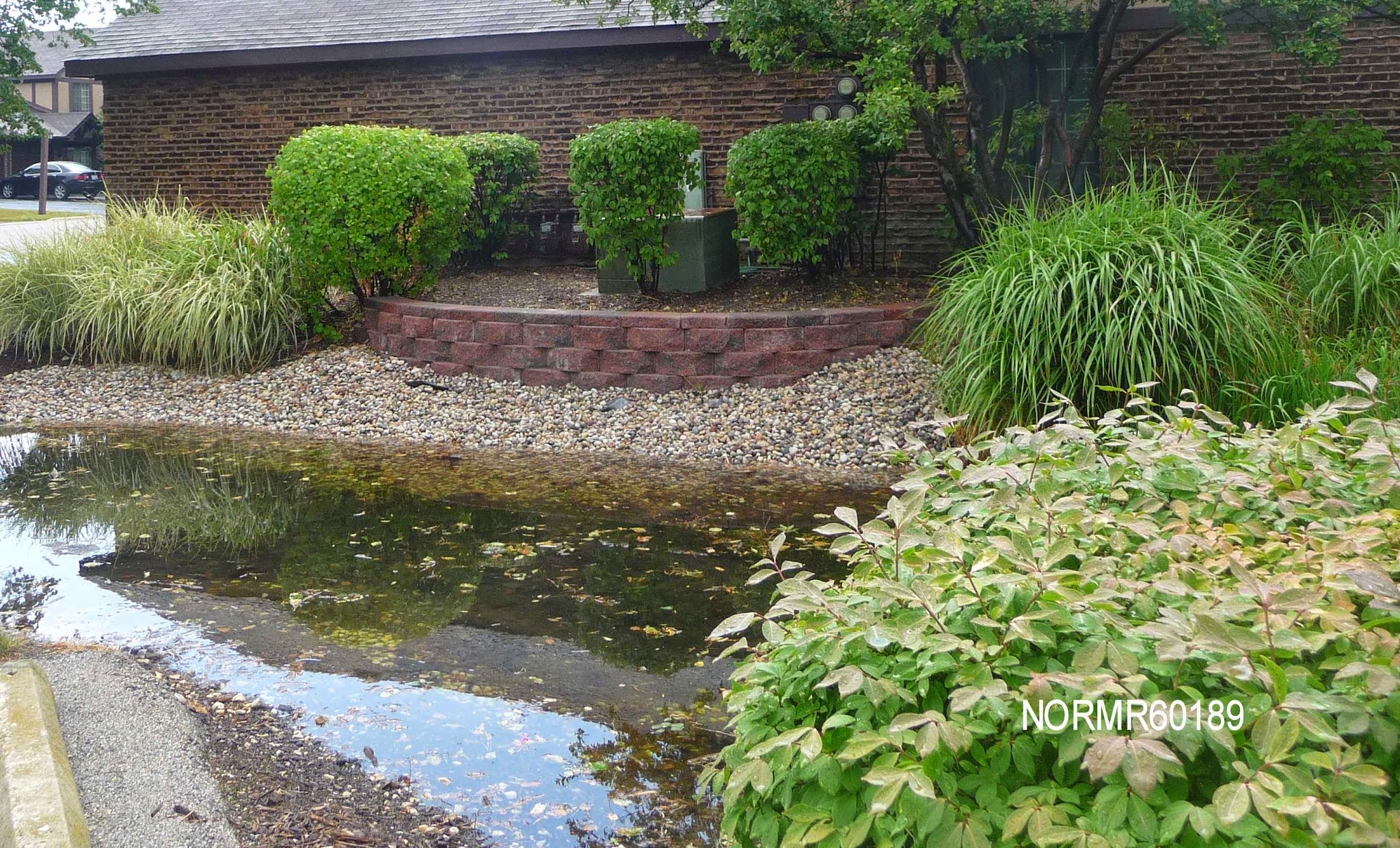
However, as we close out 2016 we are also addressing one of our "mudholes" on our grounds, and after nearly 6 years this is the final, major one. Back in 2010 I filmed the "mosquito glade" in our association. It took a few years to deal with this affirmatively, in two large steps. The first reduced the amount of standing water, and the project this year should eliminate it. But we had many, many other issues including rainwater handling problems at many other locations, and some of those resulted in ice on driving surfaces. And, of course, there was the problem with our major arterial street Lakecliffe.

 Here's my August 2010 video about the problem behind Harrow and Lakecliffe:

----> Mosquito Glade at BLMH

As I stated in the video "Where there is a will, there is a way." However, that "will" must include realistic financial planning. Only after we set in place the financial planning can we prioritize the problems, develop solutions,  and then, as the funds are accumulated we can look at our "problem list" and put these plans into motion.

This is precisely what I've been doing for six years. Yes, Virginia, it really isn't rocket science.