Updated Surplus Numbers

Updated Surplus Numbers
Updated Surplus Numbers: Actual surplus 2018 per audit was $85,163.
Boards 2011-2018 implemented policies and procedures with specific goals:
stabilize owner fees, achieve maintenance objectives and achieve annual budget surpluses.
Any surplus was retained by the association.
The board elected in fall 2018 decided to increase owner fees, even in view of a large potential surplus

Average fees prior to 2019

Average fees prior to 2019
Average fees per owner prior to 2019:
RED indicates the consequences had boards continued the fee policies prior to 2010,
BLUE indicates actual fees. These moderated when better policies and financial controls were put in place by boards

Better budgeting could have resulted in lower fees

Better budgeting could have resulted in lower fees
Better budgeting could have resulted in lower fees:
RED line = actual fees enacted by boards,
BLUE line = alternate, fees, ultimately lower with same association income lower had
boards used better financial controls and focused on long term fee stability
Showing posts with label A Better Way. Show all posts

Monday, October 6, 2014

The Groundwork and the Case for "A Better Way"

0 comments

Bookmark and Share


Summary
There is a tangible benefit to improved planning. We have more to do. The question remains who will do this? Will it be a board priority and will the board then allocate the necessary resources to get it done?  I say this HOA continues to operate from a planning perspective on a year by year basis. That is not realistic nor is it adequate. If we simply adjusted project schedules and collected an annual amount equivalent to the average fee required to support reserves for the next 10 years, I am of the opinion our monthly fees would actually decrease. We need to establish a new baseline for fees and we need better annual capital project cost accounting, including percent completed, percent remaining, dollars spent to date to achieve completion and dollars required to complete.

Hint: Click on images to enlarge

This post presents the problem and a solution. We need to establish a new baseline for fees and we need better annual project cost accounting, including percent completed, percent remaining, dollars spent to date to achieve completion and dollars required to complete. We also need to carefully monitor expenditure of Operations & Maintenance budget hours for capital improvements. Mis-allocation will result in higher or lower than necessary fees. Most likely higher. Why do this? We need fees that are realistic for the identified needs of the HOA and we need to avoid stressing owners.

Chart 1:

The chart above indicates the allocation of fees since 2002. It's readily apparent that a substantial part of the fee increases is attributable to funding of reserves. It wasn't until 2005 that the reality of the costs of the infrastructure replacement hit home at BLMH. Yes, the boards of 2000-2005 did increase annual reserve funding from $148,000 to $185,000. But in 2006 the amount collected and contributed to reserves hit $240,000 and that requirement did have a real impact on owner fees. To fund reserves, fees had increased about $23 per month.

For the first 26 years of this HOA the contribution for the "replacement fund" or "reserves" via fees was apparently less than about $35 per month per owner. In 2002 the average monthly fee for reserves had increased to about $36.73 per owner. It then increased with leaps and bounds at an average rate of about 10% annually from 2002 to 2014. After 12 years of increases the amount contributed by the average owner per month toward reserves has reached about $111.17.  Fees put into reserves has tripled since 2002. During that same time Operations & Maintenance budgets had increased only 39%.

Chart 2:

Annual Fee Increases For Reserves Have Not Been Stable
The above chart shows the annual fee increases attributable to Reserve collections from 2002 to 2014. Now, reserves are supposed to be a long term component of fees. In other words, reserves are supposed to accumulate over decades so that things such as streets, roofs and so on can be replaced. Many of these "things" have normal life spans of 15 to 25 years. In other words, it should be possible to predict the amounts to be collected each year so that the appropriate reserves can be saved and special assessments can be avoided. There are exceptions. It is difficult to predict the life span of certain aspects of infrastructure, such as water mains and sewers.

Considering that infrastructure replacement is a long term thing, it should be possible to smooth the amounts contributed to reserves. Reserve studies look ahead 30 years. Of course, if there is no reserve study collections are probably achieved via educated guesses. Another problem may be a reserve study that is truncated and incomplete. In either circumstance funding of reserves will also be incomplete. On the other hand, it's possible to over do it. There is a very real benefit to owners if the management and the board uses a well prepared reserve study and develops realistic, definitive plans from that study. That is precisely what I have been advocating.

Benefits of Long Term Planning and Stable Reserve Funding
One benefit is have the funds available to do the necessary work when the funds are needed. Another is the ability to communicate these plans to the owners, who are the shareholders in the HOA. Small incremental increases are easier for owners to manage via their personal finances. Another benefit is the lowest possible fees for all owners, today, tomorrow and 10 or more years into the future. The Illinois Condominium Act states that all owners are to be treated equally. I take that to mean current and future owners. In other words, fees should be smoothed and realistic so that everyone pays a fair share. Of course, some HOAs may prefer targeted special assessments in combination with modest annual reserve collections.

Unfortunately, BLMH has Not Experienced These Small Incremental Increases
Bear in mind that approximate 30% fee increase for reserves in 2006 resulted in a $13.64 monthly fee increase for the average owner at BLMH. That does not include any increases for Operations & Maintenance (O&M). That $13.64 has been collected each and every month for eight years.

The year before, in 2005, the amount of the increase for reserves was about 10%, or about $4.22 per month per owner. These increases add up. In 2008 owners were irate because of the fee increases. There was a lot of talk and hot air about using handymen to maintain the complex. They really missed the elephant in the room, which was the steady increases in reserve contributions.

I'm confident that some of our owners have been stressed because their income and personal budgets have not been able to compensate for 10 years of increases. Nevertheless, our overall fees have increased about 4.5% per year (2002 to 2014). Some would say that is a modest annual increase. Perhaps, but owners have had to allocate a larger portion of their disposable income to HOA fees each and every year.

Better Way - A Work In Progress
There must be a better way. We are part of the way there, but this HOA continues to operate from year to year. That is perfectly understandable for O&M which does react to fuel increases, insurance rates, water and electrical rates and so on. But reserve contributions? We can certainly determine long term reserve requirements, and we are doing a much better job at that. But are we using the information we are being given? Do we truly have a workable plan? I say this HOA continues to operate from a planning perspective on a year by year basis. That is not realistic nor is it adequate.

For example, does this HOA annually compare the amounts collected for reserve items to the percent completed to date and then recalculate the remaining sums to be collected to complete these projects? Our boards have always emphasized O&M planning. We are beginners at project cost accounting as applied to reserves.

There is a consequence to our new awareness. In 2014 more than 33% of the fees of the typical BLMH owner went into reserves. In 2002, less than 19% was allocated to reserves. That 14% increase required an additional $74.44 average monthly fee from each owner. Yes, that 14% reserve fee difference represents a large number. As I said, these things do add up over time.

The average allocation to reserves since 2005 has been more than 29%. This HOA has collected more than $3.8 million for reserves from 2002 to the present. Most of that sum, or about $3 million has been collected for reserves in the period 2006 to 2014. More than half of the total has been collected via fees in the last 5 years. Nearly 42% has been saved, but that will probably decrease by December 31 as the bills for all 2014 projects are paid.

There are certainly benefits. Our streets are projected to be replaced in 2020-2022. That project began this year and it did not require a special assessment. It is likely the south portion of Lakecliffe will be replaced in 2016 and that other work will be done prior to 2020.

Predicting the requirements for reserves and smoothing fees is a recent thing at BLMH. Returning to Chart 2 you will notice that in 2011 the changes are approaching zero percent. You will also notice that in the prior year there was a 0% increase. That was possibly an aberration by a new board. It is very, very difficult for anyone to be elected in September and then three weeks later attend an annual budget meeting and make a valid decision. I've commented that this HOA should shift to an annual budget plan spanning from March to February or some such. This would give the board time to get "end of year" financial data together, come up to speed, and then vote the new budget. Fees would be calculated for the period July through June. I don't ever expect to see this in my lifetime at BLMH; change can be difficult.

Returning to the chart it seems that the amounts required for reserves may be stabilizing. In 2011 there was a large increase to get our reserves up to where the most recent reserve study indicated they should be.

In fact, if we simply adjusted project schedules and collected an annual amount equivalent to the average fee required to support reserves for the next 10 years, I am of the opinion our monthly fees would actually decrease.

How can that be? In 2007 our management predicted that our requirements for reserves would eventually plateau. For planning purposes it is assumed that infrastructure costs increase at an average of about 2.2% per year. In other words, once the fees for reserves match the requirements of the infrastructure of a HOA, then the annual increase for reserves should not be more than 2.2% on average. Reserves being 1/3 of or annual fees implies our reserve fees should not increase by more than 2.2% in any year.

Of course, there is always the unexpected. That could include a large insurance premium increase, a significant or unexpected infrastructure failure, a new reserve study which identifies previously unrecognized capital items, and so on. There is also the possibility that we are doing a better job on some of the larger capital projects, such as the roofs. We could come in under budget. If so, the funds not spent could be allocated to other projects. That could have a beneficial impact on owner fess. With long term O&M budget increases of about 1.1 to 3% per year, it would be reasonable to expect fees to stabilize at a new baseline. I cannot state what that baseline should be. Will it be higher or lower than our current fees? Once established, its also reasonable to assume that there will be annual increases of between 1 and 2% per year.

There is a tangible benefit to improved planning. We have more to do. The question remains who will do this? Will it be a board priority and will the board then allocate the necessary resources to get it done?

A Possibility of Funding Overshoot
However, for a HOA such as BLMH which collects via 10% [reserve portion] annual fee increases there is also the possibility the HOA will overshoot and collect too much. In other words, there is a real possibility that a HOA can collect more than is required. That is precisely why I pressed for a reserve study update in 2014. We are nearing the end of a major capital project. It seems the roofs will come in under budget. That includes the roofs and drainage modifications.

If we do overshoot, that will relieve some of the financial pressure by the earlier street project. However, my charts include the period through 2024 which includes completion of all roofs, streets and entryway doors, mailboxes and intercoms. In other words, we seem to be funding reserves adequately [per the 2011 reserve study].

This HOA has been ramping up fees for reserves steadily for over a decade. How much each year? About 10% more each and every year, on average. This is how we went from a reserve balance of about $300,000 to over $1.7 million, while doing the roofs, driveways and about 20% of our garage floors. However, this is a moving target. We are within three year of the completion of the roofing project and we began a major street project this year. In other words, on January 1, 2015 this HOA will probably have about $1.2 million in reserves.

One thing our management and board can do to smooth fees is adjust completion schedules for streets, etc. We're supposed to replace all of the streets 2020-2022. We began in 2014. However, if we look closely at all of the projected reserves expenditures from 2014-2022 and then collect the average amount each year while closely monitoring expenditures, it should now be possible to collect an average amount each year for each and every of the next 10 years.

What would that look like? Here is a chart which includes annual Operations & Maintenance budget increases of 2% while meeting all requirements for reserves identified in 2011. It extends to 2024. It does not include a fully realized baseline fee adjustment because at the time I prepared this chart is was unknown.

Chart 3:
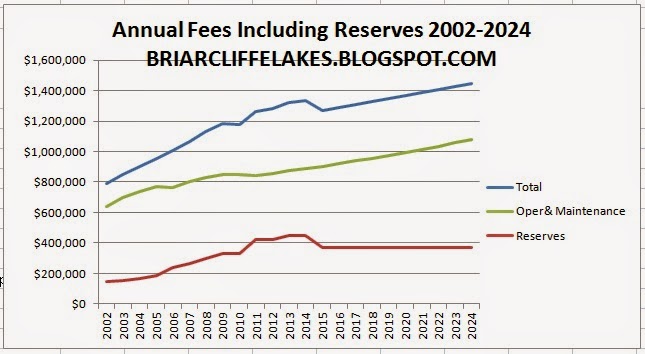
What would this mean for owner fees? Here's a chart 2002 to 2024 which includes 2% annual increases for Operations & Maintenance (O&M) . In fact, for the period 2009 to 2014, the average annual fee increase for O&M budgets was 1.1% per year. Assuming a 2% annual O&M increase would be reasonable, wouldn't it? It is important to point out to the reader that the O&M budget is arrived at annually. Only reserves should be accumulated from year to year. If there is a O&M shortfall, it is possible for the board to "borrow" from reserves. That money must be paid back, and I would think it should be repaid within one year. In other words, if the board miscalculates the O&M budget by 1/2%, that would require an adjustment in the next year. How much of an adjustment? In 2014 our O&M budget was $886,827. A 1/2% error would require a $4,434 adjustment. That's about $1.10 per month per owner. My point? A 1/2% error is not catastrophic.

Chart 4:

Note:
  1. I am aware of the prevaling wisdom that a fee increase of 0% is not a good idea. In general I support that. After all, we all know that costs do increase each year. Long term inflation for consumers may increase the price of goods and services by 3% or more per year. However, if a HOA becomes a "supersaver" and puts aside as much as 33% toward reserves, at some time a limit will be reached. At some point in time, that HOA will be saving more via reserves than might be required.  
  2. The reserve study update will be helpful in sorting this out. But it is not yet ready and the annual budget meeting is a few days away. What would you do? 
  3. I have the same information available as do many of our owners. I used the information of the published budgets to determine what was happening. However, I also added the information contained in the reserve study of 2011. I also walk the property and count such things as remaining roofs and driveways and note their condition. Anyone can also walk the property and count the number of completed roofs and driveways and so on. Most owners might not be aware of the details and intricacies of the reserve reports. These things are discussed openly at HOA meetings, as are bid selection, costs and so on. I also realize that it is impractical for owners to attend every HOA meeting and take notes. So I put the funding level information here. 
  4. There is no certainty; that is true. One of the very real fears for a HOA board is the possibility of undershooting the requirements of the budget and then either requiring a special assessment or a large fee increase in the next year. I am aware of the argument that " a 2% fee increase is better than a 0% increase followed by a 6% increase." However, I am of the opinion some of this fear is not grounded in current reality. Remember, in 2002 this HOA had about $222,000 in reserves. We were about to begin the replacement of all streets and the roofing project. The financial plan was clearly inadequate and the fears of the boards must have been real and palpable. This HOA had dug a deep, deep financial hole and it took years to fill it. "That was then and this is now." It isn't 1999. We do have reserves. We do have a bona fide reserve study and we have an update in preparation. Our current reserve study includes new entry doors for all buildings, completion of roofs, garage floors, streets, curbs, gutters and so on. All prior to 2024. 

Thursday, September 11, 2014

Owners and Boards - Part 5 - A Better Way

2 comments

Bookmark and Share


"Water Fowl at BLMH - Are We Sitting Ducks?" That's the caption for the photo on the masthead. 

.
This post looks at the finances and strategy behind a possible "bright future" for this HOA. This post suggests a better way to achieve our financial future while avoiding the "fee whiplash" which has been often imposed upon our HOA owners. I am of the opinion this "better way" will also achieve the "lowest possible fees" while avoiding the much higher future fees accomplished by past plans and it will maintain the property. When I say that I am looking specifically at 2014 fees compared to 2004 fees.

The work I have done in my four years on a board in this HOA has been simply what is necessary to create such a future. It has been for the specific purpose of setting in place a foundation; I had a plan in 2010. That plan is a long term plan, The real work, creating that future so that it can be realized, has not yet begun. What I have accomplished is merely the clearing of a space. The stakes in the coming HOA election are very high for the owners at BLMH. Much, much higher than most realize.

These charts from Part 4 indicate a possible fee approach. In fact, I could improve upon this, and I could do it without penalizing future owners or current owners. But it won't happen unless I get help for this very specific purpose. So what's more important? I do know what is easier. I can assure the reader that long term planning is far, far more difficult than being a reaction and chasing the PODs on the property. However, the rewards of good long term planning are real and will show up in the pocket book of every owner. That can be accomplished with improved infrastructure while avoiding such disruptions as occurred on Lakecliffe, or with 1000% fee increases to support our reserves. So what are the real duties and responsibilities of boards? Is it chasing stray dogs and picking up trash? Or is it managing this HOA?

I suggest that we really do need a change here at BLMH. I call it "A Better Way." Which approach will owners prefer? Will it be "A Better Way" or the "Old Way" and a continuation of "Fee Chaos?" With an election coming this month, we'll soon know.


The Alternative
"Water Fowl at BLMH - Are We Sitting Ducks?" That's the caption for the photo on the masthead. 

I suggest that if this HOA decides to avoid "A Better Way" then the owners and board have decided to be "sitting ducks." 

The current plan of this HOA cannot and will not accomplish everything set forth in my "Better Way" plan. Why is this? There has been no board consensus for this and therefor no directive to accomplish it. There has been insufficient allocation of resources and planning to accomplish it. Recent boards have not seen the possibility and I've been too damn busy with current projects, dealing with the clean up of the breakdowns created by other boards while being jerked around by some of the owners. The other reason is simply because most owners have been uninterested. Not interested that is, until there is a breakdown.

The fact is, if owners demanded that boards do this with as much fervor as they showed when they thought their dogs would be fined via a special fees, why, this would already be done.

A few years ago (2008) my spouse attended a HOA meeting wherein the board spent an inordinate amount of time deciding how best to change a light bulb. My spouse decided this HOA was nuts and prefers not to attend HOA meetings. In the past year, this HOA board has spent an inordinate amount of time attempting to decide how to deal with "doggy bags" on the property. Some things may never change.

Current and recent boards have been very busy dealing with dog poop, light bulbs and simply keeping this behemoth running while avoiding larger disasters and keeping certain disruptive owners at bay. I extend the definition of "disruptive" owners to include foreclosures, delinquencies and any owner who repeatedly breaks the rules.

Some are of the opinion that "a better way" isn't necessary. Their position is "What we did worked before." No it didn't, and it doesn't. How anyone can say that with our current fee levels is beyond my comprehension. I assert there was a facade of work-ability and our current fees are the proof.

However, some of our owners and that includes various members of boards are in complete denial about this. Some are so far in denial that they cannot and will not accept that there really is another way. That poses a real problem. If we are sufficiently incapable of admitting what didn't work and our roles in this, then I think we are incapable of making good decisions. This is the primary reason I have considered selling my unit. The other reason?  I have concluded I might be wasting my time here.  There really is a "Better Way" but if this HOA is disinterested and prefers the "old ways" and fee chaos, then I will "move on" if not literally, then figuratively.

Reserves - The Achilles Heel of BLMH
Our HOA is a PUD. We have streets, street lighting, water mains and sewers to maintain. In the 1990s a "kick the can down the road" fee plan gave owners until about 2004 much lower fees. This was accomplished by minimizing the fee contribution to reserves, which were called a "replacement fund." While possibly legal, as fiduciaries boards should not operate that way. Since 1990 the Illinois Condominium Property Act, Section 9(c)(2) provides that an association shall, under certain circumstances, allocate a portion of the assessments to capital reserves. There have been numerous books published for decades on the subject and even more articles. For example, “Reserve Study Guidelines for Community Associations, Planned Developments and Condominiums”, Richard Wyndhamsmith, Windhamhouse, Inc., 1989.

Boards, as fiduciaries must certainly realize the future will become the present. One of the primary financial reasons for reserve planning is to avoid special assessments and the necessity of bank loans. A secondary reason is to plan for capital replacements. In a PUD with streets and water mains this is even more important. It is vital to the financial health of the HOA and the well-being of owners.

As an afterthought, boards may consider the disruptive effect of large upward changes in fees caused by the collection of reserves.  Conceptually, various boards have understood that this HOA will be here "forever." In practice, boards have a great deal of difficulty translating that into the planning and decision making process required to support a HOA. 

I do really understand the position of many owners. Why should any owner put even a single nickle into something they may sell in one, five or ten years? The operative word is "may" and that is where most owners fail. Understanding the difference between "will" and "may" is all the difference between financial success and failure.  Wishful thinking is not indicative of reality. This is true for owners, boards and entire HOAs. Boards are held to a much, much higher standards than owners. Not all boards are capable of the level of achievement required. That's why each and every owner at BLMH is today paying about $600 more in annual fees than should have been required. Kudos to the past boards. You saved yourselves a lot of money. I'm sure you were popular at the time. Those owners who sold their units prior to 2007 are most grateful. Of course, they are not here today to pay the current fees. Did you do your fiduciary duty?

A Different Path Leading to A Better Way
Part 4 of this post looked at some of the underlying realities. That post and other recent posts looked at the facts behind both the recent financial successes, but also how this HOA experienced failures, the extreme difficulties required to alter that, and our consequentially higher fees today.

I look at the past for several reasons. It is in part to counter the argument "What we did in the past worked." Most importantly, it is to raise the awareness of HOA owners about the stark realities caused by the decisions made by owners and their elected boards. These decisions do make a difference, and there are both good decisions and poor decisions to be made. Making poor long term decisions will have serious financial consequences.  At BLMH we got to this place and time because of past financial and infrastructure maintenance decisions.

Currently, this HOA has taken the initial, tentative steps for a different path. The plan is not yet complete nor is it understood by most owners or the entire board. If you think it is "cast in concrete" then you are mistaken. Just as the owners are learning by this experience, so too are the boards. To get to this particular place on the path has been expensive and much of that expense has been born by recent owners from 2000 to the present. But we do now have true reserve savings. We do now have some financial "breathing room." I caution that current stability may be deceiving and temporary. We need to do more to achieve stability. I do not suggest higher fees. I suggest that boards do more work (planning and preparation) with the guidance of management and the support of the owners.  We all want to succeed. We all want improvement. It's stupid to spend one's time in a cage, like a gerbil, running in circles and doing the same stuff over and over and over. Yet, the gerbil may be totally oblivious to any other mode of existence. Our boards have frequently operated like the gerbil in the cage. Confined to a never ending treadmill with no apparent HOA future. That's the consequence of a lack of vision and it is a fact that boards had no vision.

Breaking the Treadmill
I think more planning and far, far less "knee jerk" reacting to events is not only desirable but achievable. It is the path to breaking the treadmill. Staging an annual budget meeting is not planning.

Planning however, goes hand in hand with preparation. Preparation requires knowledge. That is precisely why I have studied several decades of finances. It is also why I have studied and observed every driveway, every roof, darn near every foot of street, the streams, walks and so on. Not once, but over and over and over. Perhaps this HOA has become my private treadmill?

With this information in hand, I've provided hundreds of pages of reports to the board, constructed hundreds of spreadsheets, made hundreds of projections, life cycle studies, cost studies and so on. In 2010 I somewhat reluctantly made my own reserve study of the HOA. It was enlightening. I did publish a few of the charts that I constructed and I also provided many more to the owners and the board.

What Have I Learned Since January 2010? 
Our annual budgeting process should be improved. We currently have created a real opportunity. This window of opportunity is closing. A decision must be made to move forward or to stagnate and move backwards. For example, would you like to know what your fees will be three years from now?  Would you like to know what infrastructure work will be done in 2015, 2016 and 2017? I do know the answer to these questions. How is it possible I know this? I suggest owners ask why our past boards didn't know the answers. I also suggest that owners ask why have they not been provided with a formal plan about this? There are a variety of reasons. Past boards were unwilling to make a commitment.  The current board is not in agreement. Boards generally remain forever stuck in whatever the current year is. That "tunnel vision" includes this year only.

Because of the current process the owners and boards cannot see more than 12 months forward, and that is only in October when the annual budget session is held. After that each year is pretty much a planning free fall. We can improve this process, but we don't have to. No one can force us to do better. Some of us many not know how. These are the primary reasons we continue on our same, old, weary financial path.

Management will support the board in any worthwhile endeavor. Is such planning worthwhile? Here's are several examples. We now recognize "bad debt" in our finances. We now discuss a spreadsheet at each HOA meeting which indicates the current state of delinquencies and graphically indicates all important delinquencies since 2008. By "Important" I mean delinquencies above a specific numerical value.  An owner fine or a $.06 delinquency is not of any serious financial consequence to this HOA.  We have added a "contingency" item to the annual budget. That supports boards in addressing critical infrastructure failures, notably our water mains. I argued for this for several years. These things did not simply occur. There has been resistance. Management can prepare any chart or table the board wants, but cannot do it for free. So some of this is prepared by me. Some of this has been an uphill battle as are most things here at BLMH. The old, largely unsuccessful ways are really ingrained here. That's what happens in a nearly 40 year old apparently successful, but in reality what has been a financial disaster of a HOA. Am I being harsh? Not at all. We are each paying more than $600 annually in higher fees because of past decisions. I think I am being kind. I've had it with political buzzwords like "fees as low as possible" while boards act to the contrary and take actions which will guarantee higher future fees. Each and every owner should be wary of politics and simplistic phrases. If we haven't learned this by now, then I must assume we never will. A failure to learn from the past and put what we have learned into consistent action is the real rain on this parade.

Is Making Such Improvements Worthwhile? 
Is the security of knowing our HOA has a plan to address such a reoccurring problem a good thing? Is avoiding special assessments while addressing our O&M and infrastructure repairs a good thing? Or would our owners prefer to roll the dice each year? Not me. Every 13 year old Boy Scout understands the meaning of preparation. If they don't they will be taught and will learn. After all, "Be Prepared" is the Boy Scout motto. At BLMH we have those who can't or won't. It is what it is and all owners reap the benefits and the costs, including the higher fees. Know it or not, our owners are gerbils in a cage, controlled by our boards. Some on various boards have said "It worked before, so why should we now change?

If We Fail, Then What?
If we fail to shift then our future boards will have the benefit of the current savings and a very rough plan for replacement of much of the critical infrastructure of this HOA.  Driveways, roofs and drainage improvements should be completed in 2016-2017. After that? If we fail to improve our planning process then future boards will continue to be stressed and there will continue to be unnecessary disruptions for residents and more uncertainty about finances. We really can do better. What would you prefer?

Currently, reserves are accumulating for the completion of these projects and also for entrances, garages and the next phase of the street project. The reserve plan includes proper provisions for a more distant future including certain aspects of the next cycles. The first roof was replaced in 2002 and if it survives 20 years it will be replaced in 2022. Where will that money come from? If the reserve study is followed then we are gradually saving about 1/18 of the price of that roof each year. If future boards continue on that plan, then the money will be there when needed for this purpose. If they don't the it won't be there. This HOA will then face special assessments of monthly higher fees.

The plan is imprecise and the current board has made a commitment to the financial portion of the plan. There has been no commitment to adhere to the infrastructure goal of the current reserve study and plan. What the board has done is collect the money necessary for the plan and that is a good thing which is why we today have our fees.

The street project began in 2014, 7 years earlier than anticipated. Future boards will be faced with some difficult decisions. In 2015 it will be vital to look closely at the streets and decide how best to properly extend the life of the existing streets while avoiding disruption to owners. A plan must also be decided on how best to undertake the replacement and/or resurfacing of the remaining streets.

How to do this while maintaining financial stability? It will not be easy and there will be opportunities for failure. Failure will mean deferring projects such as the improvements to entrances. Failure will require higher fees than would otherwise be necessary. That is the real tragedy of the 2014 replacement of Lakecliffe. This post presents a better approach.

A Financial Foundation
The current plan establishes a financial foundation, a significant toehold. It is nascent and incomplete. This HOA has commissioned an engineering evaluation of the streets. It has also commissioned a reserve study update. These two things when combined will complete the foundation and will provide a powerful tool for the board of 2015.  This tool will be a significant aid to determine how to approach the infrastructure projects from 2015 to 2025. I hope the board and owners will properly and fully use it and incorporate it into a more thorough planning process. Many past boards have attempted to delay financial unpleasantness and made poor choices. Doing so was a mistake then; it would be a mistake now and into the foreseeable future.

I hope our HOA does not squander what it has been given or has taken from recent owners via those substantial fee increases. I have confidence in management and our other professionals. I have less confidence in our owners. Why? There will always be the desire to cut fees now and deal with the financial problems later. Some current owners will be inclined to say "I won't be here in five years and so why should I fund any of this?" Boards are comprised of owners. Enough said.

The Critical Five Years - A Radical Departure in Budget Planning
The condition of our HOA infrastructure and our immediate financial well being will be largely determined by how this HOA manages infrastructure projects and finances for the next 5 years. It will be determined by the quality of those plans. It is unfortunate, but the planning process continues to emphasize immediate, annual fees. This includes immediate Operations & Maintenance needs as well as identified and acceptable reserve requirements. It currently emphasizes fee collection while pushing longer term problems away for a future board and future owners to deal with.

The approach that has been taken is an extension of the tried and true BLMH budget process. Each year the board agonizes over the numbers for the coming year and then adds in the reserve requirement per the tables, or the dart board. That determines the fees of each owner for the coming year.

However, in 2012-2013 a subtle but radical change occurred. Radical for this HOA, that is.  I proposed the board consider the benefit of adjusting infrastructure replacement dates to smooth reserve collections. This was not "pushing things back as far as possible" for someone else to deal with and pay for.  It is the taking of a flexible approach for the commencement of certain infrastructure improvements, as dictated by infrastructure condition, reserves and current fees. I did include changes to the infrastructure costs, which I have determined from the actual costs of roofs, entrance walks and drainage improvements. Doing these things provided the board with a degree of financial control never before experienced in this HOA.

This shift in our budgeting process indicated our fees could be lower in 2014 than would otherwise be possible. It was a subtle change and the board agreed. If this had not been done your fees in 2014 would have been higher than they were.

Why do we really need a better way? In 2010-2014 we were caught in a vice created two decades earlier and promoted for 20 years. We are today replacing roofs after the end of their "useful life." This also what occurred for the north section of Lakecliffe Drive. Doing things that way affords no flexibility, puts management, the board and our budgets into a mode I describe as "no choice but to do it now at whatever cost." Owners of course bear the total brunt of those costs. Boards now struggle to get the job done while attempting to reduce the cost. We sometimes succeed. However, there is no flexibility.

My Proposal
I am proposing a more flexible and thorough, but very realistic approach to budget analysis. It does require a more thorough analysis than calculating the increase in contracts, electricity and so on and then deciding how much this HOA must collect. The approach I am advocating is one I have used. It is more difficult to achieve but it has real benefits.  Smoothing finances is something that is required. Doing so demands that boards have solid long term plans in five year increments. Such plans accomplish these things.
  1. The plan creates a series of glide paths to stabilize and smooth finances.
  2. The plan recognizes all O&M and infrastructure requirements. 
  3. The plan prudently spends money to uphold owner value.
  4. The plan prudently spends money so that the property is properly maintained in a fair and equitable manner for all owners. 
  5. The plan minimizes property disruption and resident inconvenience.
  6. The plan prudently spends money to avoid fee disruption. 
  7. Determine best practices for the HOA. At what point should infrastructure replacement occur? When does the annual cost to repair exceed the cost to replace? What about the hidden cost of owner disruption? Boards will be inclined to repair indefinitely because maintenance costs are hidden among the thousands of work orders this HOA processes each year. However, the real costs do increase year, by year, by year. 
  8. Establish project plans, set in place project management and minimize the disruption to the property manager(s). In this manner the HOA gets better quality. Better quality equates to lower long term costs and better results. 
These charts from Part 4 indicates a possible fee approach. In fact, I could improve upon this, and I could do it without penalizing future owners or current owners. But it won't happen unless I get help.