Updated Surplus Numbers

Updated Surplus Numbers
Updated Surplus Numbers: Actual surplus 2018 per audit was $85,163.
Boards 2011-2018 implemented policies and procedures with specific goals:
stabilize owner fees, achieve maintenance objectives and achieve annual budget surpluses.
Any surplus was retained by the association.
The board elected in fall 2018 decided to increase owner fees, even in view of a large potential surplus

Average fees prior to 2019

Average fees prior to 2019
Average fees per owner prior to 2019:
RED indicates the consequences had boards continued the fee policies prior to 2010,
BLUE indicates actual fees. These moderated when better policies and financial controls were put in place by boards

Better budgeting could have resulted in lower fees

Better budgeting could have resulted in lower fees
Better budgeting could have resulted in lower fees:
RED line = actual fees enacted by boards,
BLUE line = alternate, fees, ultimately lower with same association income lower had
boards used better financial controls and focused on long term fee stability
Showing posts with label Condominium Fees Increase. Show all posts

Wednesday, March 14, 2018

3.77% under budget is how we got a 0% fee increase in 2018

0 comments

Bookmark and Share


We do our annual budgeting in October, which can be difficult because we don't have year end figures.

In October 2017 we projected a significant budget surplus. In other words, our total expenditures for 2017 would be substantially under the projected expenses. We didn't "skimp" on anything or hold back expenditures for the next year. The numbers reflected the actual, real and true expenditures, to the best of the knowledge of the board.

Of course, there are always year end surprises. For example, a nasty December can push up snow removal costs for the year. Significant icing can push up maintenance costs as we clear ice from roofs. Last minute bills can also have an impact. So I am inclined to think of 1% as within the "noise band" which is about  $13,500. We have to do substantially better to consider holding fee increases at 0%.

BTW, the change in our painting schedule and approach in 2011 has saved this association nearly $9,000 each year. That's an example of how we've achieved these results.   These things add up. I'm always preaching incremental, continuous improvement, but not everyone on the board believes this. The long term results speak for themselves. There are lots of gimmicks that our boards have used to achieve short term results. Shame on them!

When our association is under budget, any surplus is put into reserves. However, this can also be used to the benefit of the owners.

In January 2018 we got the final numbers. We were 3.77% under budget for the year. In other words, our 1.50% fee increase in 2017 was unnecessary.  We can't turn back the clock and I certainly don't want to undershoot in any year. In fact, some seasoned board members continue to adhere to the unsubstantiated belief that we need fee increases of at least 3% each and every year.

However, during the budget discussions in October 2017 which I prefer to call "negotiations" it was apparent that an increase was unwarranted. Those present voted for a 0% fee increase based upon 2017 data and 2018 projections.

I want to point this out: what we saved by a lot of hard work over a period of years reduced expenditures in 2017 by an amount equal to a 3.77% fee increase.  I'll let that sink in.

There is micro-management and then there is effective management. I prefer to be effective, which is reflected in this chart. Blue are actual fees per month per owner and red is projected. I joined the board in 2010.


Sunday, December 17, 2017

A zero percent fee increase

0 comments

Bookmark and Share


Our board decided upon a 0% fee increase for 2018.

While preparing my article for the newsletter, I advised owners that "this is a rarity" and it is.  It is impossible to say what will occur in October 2018 when the next board meets to decide the budget for 2019.

Here are a few of my observations:
  1. It takes years to build large deficits or large surpluses.
  2. Recent boards have taken a pragmatic approach.
  3. Recent boards have take an approach supported by good data.
  4. Not all owners cooperate which is why legal costs for our fireplace fiasco hit more than $40,000 this year. That fiasco was entirely a consequence of builder error and City of Wheaton Building Inspector incompetence. Yet we were sued by the City of Wheaton.
The association board will be evaluating actual 2017 costs after the end of the calendar year. At that time we'll know how we actually did. We can't predict snowfall in November-December when we prepare the budget in September. Nor can be predict the total manhours required to maintain our nearly 40 acres. Yet, it seems we'll be within +/-100 hours for the year. 

I have completed my maintenance/project list for 2018. Staying ahead and performing proactive/preventative maintenance is one of the ways to keep costs to a real minimum. For example, we've proactively replaced about 300 feet of water main. Is it an accident that our water main failures are reducing? I think our maintenance efforts are paying off. 

We are now addressing maintenance issues ignored and "put under the bus" more than 10 years ago.


Friday, November 13, 2015

Reserves of $86,321- Assessments and Budgeting

0 comments


Bookmark and Share


This is another post in a continuing series on HOA budgeting.

"In 2014 the reserve contributions were 312.4% higher than they were in 2001. The Operations & Maintenance (O&M) budget in 2014 was 14.9% higher than it was in 2001."

In other words, in 2014 the average monthly owner fee for the O&M budget at BLMH was $28.56 greater than it was in the 2001 budget. In 2014 the average monthly owner fee for the reserve budget at BLMH was $83.68 greater than it was in the 2001 budget.

The above is why I pay so much attention to reserves at our HOA and why you should at your HOA. Our reserve contributions climbed nearly four times that of the O&M budgets.

".....we need to live in the present."

"I have made a general statement that I think it is a mistake for a HOA to move forward with 0% annual fee increases. However, the actual budget each year should be based upon the actual finances and not some general theory or knee jerk, emotional reaction. The problems at BLMH can all be traced to the condition of reserves. In recent years boards have dramatically changed the approach to this very significant component of fees at BLMH.  This change has had a profound impact upon our HOA finances."

In February 2010 I sent an email with five links to the Architectural Director of the Board of BLMH. These had to do with fees and budgeting at our HOA. Four of these links are contained in this post.

As I have stated elsewhere in this blog, I had been doing my own research about the finances of the HOA since considering a purchase in 2001. All I had at that time was the information provided by the various boards to each of the owners and the most recent newsletter; that information (excepting the 2001 newsletters) is adequate and included published budgets and balance sheets.  Some of my research had been completed prior to purchase, but there really isn't a lot of time to delve deeply into this prior to making a purchase commitment. Of course, back then it was a seller's market. Today it might be easier to take one's time to do sufficient research. I had legitimate concerns about reserves and fees.

The first budget I was given was the 2002. It showed a reserve contribution of $108,000 for the year 2001 and a 2002 budget with a $148,108 contribution for reserves.  However, I later discovered that the total reserves at BLMH in 1998 were $86,321. The average annual fee increase had been 2.59% over a period of 10 years. This changed when a new management firm came on board in December 1998. Commencing in 1999 there were large annual fee increases of 11%, 11%, 9% and so on. Owners had become accustomed to very low annual fee increases in prior years. But those budgets were inadequate.

At BLMH the Operating & Maintenance budgets (O&M) were not separated from Reserve requirements in the percent changes to fees provided in the "Welcome Packet." Nor were reserve fund balances provided year by year. I suspect that a few owners might have become alarmed had that information been provided in that form. But it was in the "Balance Sheets" for the HOA and not flagged. But then, as is the case today, owners are largely uninvolved in the affairs of managing this HOA. Today, most owners prefer to let another owner in a board position do the work. When things are not to their liking a few of the "owners' will show up to express their displeasure and make demands upon the board of volunteers. Boards will frequently be inclined to acquiesce. That's the way it was, and that is the way it is today in our "entitlement" society.

Returning to my financial concerns in 2001. This information was available in the prior balance sheets. This HOA had less than $100,000 in reserves in 1998 and yet would begin a multi million dollar roofing project in about four years, and a complete street replacement in four years. Simple arithmetic would indicate that there would be insufficient reserve funds to do these projects unless drastic action was taken.  Boards had no choice and so fees increased at an average annual rate of 7.41% during the period 1999 to 2008. Projects were delayed to allow the accumulation of funds to do the work. A significant amount of the money collected for these capital projects was spent as soon as it was collected.

But no one at this HOA read about this in any letter and any newsletter. So most of the owners were blindsided. They didn't know that the boards prior to 2008 had thrown us under the bus, spent money on a defective street project and, with about $250,000 had embarked upon a $2 million dollar roofing project commending with the building which housed the president of the association.

This history is why so many boards have struggled for nearly 20 years with annual budgets at BLMH. This history may also be why some board members have been so averse to 0% fee increases in recent years. They may remember the pain and the owner angst and they want to avoid it.

But as 2016 approaches it is important to realize that this HOA is not operating or being managed the way it was in the 1980s and 1990s. I am of the opinion each and every owner is better for it. Anyone who disagrees needs to state their case rather than simply gripe, or make derisive remarks under their breath during HOA meetings. A few probably prefer the "good old days" when we either didn't know what was going on, or we were fed "pap" with articles about architecture in England. Either way, ignorance may be bliss until reality sets in.  In HOAs the blissful hope they sell their unit before the reality sets in.

I do recall the newsletters of 2002. Back then the "big deal" was the winter tips. Reading those newsletters, one would assume the board had everything under control and we were in great shape. It was a sham and nothing could have been further from the truth. But one of the favorite expressions of the leader of the board back then was about "throwing people under the bus." And so they did. But for as long as possible boards and the board presidents of this HOA did what they could to keep up the facade. Reality intervened then as it does now. But today it is a different reality. The newsletter is no longer a facade or a "feel good" piece of paper. We do have reserves and we do know what they really intended to accomplish. The HOA is aging, but it is no longer falling off of a cliff.

I cannot go back in time and fix the past. We can and do address identified issues in the present, while planning a 30 year future. That is not the way it was, and those who participated in those years should take responsibility for their actions. That includes owners and former board members.

We today have owners who have lived here for 30 years and remember "the good old days" when annual fee increases averaged 2.59% and for many years the fee increases were 0%.  We also have one current board member who was on the board back in "the good old days" and experienced it all.

However, we need to live in the present.

I have made a general statement that I think it is a mistake for a HOA to move forward with 0% annual fee increases. However, the actual increases each year should be based upon the actual finances and not some general theory or knee jerk, emotional reaction. The problems at BLMH can all be traced to the condition of reserves and several projects began in 2002, including an incredibly costly roofing project.

In recent years boards have dramatically changed the approach to this very significant component of fees at BLMH. This change has had a profound impact on our HOA finances. These changes began slowly in 1999 but became more sophisticated by 2011. But until the roofing project is completed and the redo of the streets a lot of money will continue to be spent. Unfortunately our streets began less than 10 years after they were replaced in 2002 or 2003.

In 2014 the reserve contributions were 412.4% higher than they were in 2001. The Operations & Maintenance (O&M) budget in 2014 was 14.9% higher than it was in 2001.

The percentage of fees for reserve items has increased from about 0% in the 1980s and 1990s to about 31% or more in recent years. Reserve contributions via fees peaked at 33.9% with the 2012 budget. In 2011 there was a 7% increase in assessments to owners. All of it went to contributions for reserves. In fact, the budget for O&M items actually decreased that year by 1.1%. In 2012 the budget called for an approximate 3% fee increase. Of that increase nearly half went to reserves.

In recent years the boards temporarily shifted to a multi-tiered approach for reserves and very closely monitored requirements for the 10 year future period while also considering 20 and 30 year requirements. Had this been done from 1985 to 1998 there would have been no need for me to do the work to create the information contained in the links later in this post. I also probably wouldn't be providing about 450 to 700 hours of free services to the HOA each and every year.

The earlier approaches of low fees with minimal reserve contributions created the financial problems of the 2000s. The grandiose or poorly executed projects which began in 2002 sealed the fate of this HOA for the next two decades. It was the available funds that probably dictated the approach used for the street replacement project in 2002. That is understandable if a HOA lacks the funds to do it right. Understandable, but not excusable. However, for a time the HOA owners did get the low fees they wanted. This could not continue and owners from 1999 to 2008 paid for this and got average annual fee increases of 7.41%. That's 3 times the fee increases each and every year as compared to the earlier period 1982 to 1998. Most of the money for the annual increases after 1998 went into reserves and to pay for immediate capital projects including the 2003 street replacement and that $2 million roofing project.

It is only since 2010 that this HOA made the huge leap to more sophisticated and realistic reserve requirements. This has not been smooth, either. But boards are getting better at this. A lot of time has been spent by a minority of boards members since 2011 looking into reserve requirements and implications for finances. This was necessary because of the condition of Lakecliffe and other streets, which were not predicted for retopping until the 2020s. Instead we found we had to completely replace Lakecliffe Blvd. Other projects and surveys which had been delayed are finally being addressed. 2014 and 2015 have been very different years as compared to the preceding ones. This needs to be considered when preparing HOA budgets at BLMH.

Here are the links I mentioned at the beginning of this post. Yes, we can plan and prepare. Yet, it is true that some can't, some won't learn from the past, and a few expect a totally different outcome no matter what they do. Yet, boards are supposed to muddle through. History can be a great teacher if we are willing to learn the lessons it provides. The reader may not agree with all of the following, but it does include some eye opening information:

September 2008 - Assessment History


November 2008 - Where Our Fees Will Go in 2009


March 2009 - A Method for Arriving at Assessments


June 2009 - Unit Owner Budget

Monday, October 6, 2014

The Groundwork and the Case for "A Better Way"

0 comments

Bookmark and Share


Summary
There is a tangible benefit to improved planning. We have more to do. The question remains who will do this? Will it be a board priority and will the board then allocate the necessary resources to get it done?  I say this HOA continues to operate from a planning perspective on a year by year basis. That is not realistic nor is it adequate. If we simply adjusted project schedules and collected an annual amount equivalent to the average fee required to support reserves for the next 10 years, I am of the opinion our monthly fees would actually decrease. We need to establish a new baseline for fees and we need better annual capital project cost accounting, including percent completed, percent remaining, dollars spent to date to achieve completion and dollars required to complete.

Hint: Click on images to enlarge

This post presents the problem and a solution. We need to establish a new baseline for fees and we need better annual project cost accounting, including percent completed, percent remaining, dollars spent to date to achieve completion and dollars required to complete. We also need to carefully monitor expenditure of Operations & Maintenance budget hours for capital improvements. Mis-allocation will result in higher or lower than necessary fees. Most likely higher. Why do this? We need fees that are realistic for the identified needs of the HOA and we need to avoid stressing owners.

Chart 1:

The chart above indicates the allocation of fees since 2002. It's readily apparent that a substantial part of the fee increases is attributable to funding of reserves. It wasn't until 2005 that the reality of the costs of the infrastructure replacement hit home at BLMH. Yes, the boards of 2000-2005 did increase annual reserve funding from $148,000 to $185,000. But in 2006 the amount collected and contributed to reserves hit $240,000 and that requirement did have a real impact on owner fees. To fund reserves, fees had increased about $23 per month.

For the first 26 years of this HOA the contribution for the "replacement fund" or "reserves" via fees was apparently less than about $35 per month per owner. In 2002 the average monthly fee for reserves had increased to about $36.73 per owner. It then increased with leaps and bounds at an average rate of about 10% annually from 2002 to 2014. After 12 years of increases the amount contributed by the average owner per month toward reserves has reached about $111.17.  Fees put into reserves has tripled since 2002. During that same time Operations & Maintenance budgets had increased only 39%.

Chart 2:

Annual Fee Increases For Reserves Have Not Been Stable
The above chart shows the annual fee increases attributable to Reserve collections from 2002 to 2014. Now, reserves are supposed to be a long term component of fees. In other words, reserves are supposed to accumulate over decades so that things such as streets, roofs and so on can be replaced. Many of these "things" have normal life spans of 15 to 25 years. In other words, it should be possible to predict the amounts to be collected each year so that the appropriate reserves can be saved and special assessments can be avoided. There are exceptions. It is difficult to predict the life span of certain aspects of infrastructure, such as water mains and sewers.

Considering that infrastructure replacement is a long term thing, it should be possible to smooth the amounts contributed to reserves. Reserve studies look ahead 30 years. Of course, if there is no reserve study collections are probably achieved via educated guesses. Another problem may be a reserve study that is truncated and incomplete. In either circumstance funding of reserves will also be incomplete. On the other hand, it's possible to over do it. There is a very real benefit to owners if the management and the board uses a well prepared reserve study and develops realistic, definitive plans from that study. That is precisely what I have been advocating.

Benefits of Long Term Planning and Stable Reserve Funding
One benefit is have the funds available to do the necessary work when the funds are needed. Another is the ability to communicate these plans to the owners, who are the shareholders in the HOA. Small incremental increases are easier for owners to manage via their personal finances. Another benefit is the lowest possible fees for all owners, today, tomorrow and 10 or more years into the future. The Illinois Condominium Act states that all owners are to be treated equally. I take that to mean current and future owners. In other words, fees should be smoothed and realistic so that everyone pays a fair share. Of course, some HOAs may prefer targeted special assessments in combination with modest annual reserve collections.

Unfortunately, BLMH has Not Experienced These Small Incremental Increases
Bear in mind that approximate 30% fee increase for reserves in 2006 resulted in a $13.64 monthly fee increase for the average owner at BLMH. That does not include any increases for Operations & Maintenance (O&M). That $13.64 has been collected each and every month for eight years.

The year before, in 2005, the amount of the increase for reserves was about 10%, or about $4.22 per month per owner. These increases add up. In 2008 owners were irate because of the fee increases. There was a lot of talk and hot air about using handymen to maintain the complex. They really missed the elephant in the room, which was the steady increases in reserve contributions.

I'm confident that some of our owners have been stressed because their income and personal budgets have not been able to compensate for 10 years of increases. Nevertheless, our overall fees have increased about 4.5% per year (2002 to 2014). Some would say that is a modest annual increase. Perhaps, but owners have had to allocate a larger portion of their disposable income to HOA fees each and every year.

Better Way - A Work In Progress
There must be a better way. We are part of the way there, but this HOA continues to operate from year to year. That is perfectly understandable for O&M which does react to fuel increases, insurance rates, water and electrical rates and so on. But reserve contributions? We can certainly determine long term reserve requirements, and we are doing a much better job at that. But are we using the information we are being given? Do we truly have a workable plan? I say this HOA continues to operate from a planning perspective on a year by year basis. That is not realistic nor is it adequate.

For example, does this HOA annually compare the amounts collected for reserve items to the percent completed to date and then recalculate the remaining sums to be collected to complete these projects? Our boards have always emphasized O&M planning. We are beginners at project cost accounting as applied to reserves.

There is a consequence to our new awareness. In 2014 more than 33% of the fees of the typical BLMH owner went into reserves. In 2002, less than 19% was allocated to reserves. That 14% increase required an additional $74.44 average monthly fee from each owner. Yes, that 14% reserve fee difference represents a large number. As I said, these things do add up over time.

The average allocation to reserves since 2005 has been more than 29%. This HOA has collected more than $3.8 million for reserves from 2002 to the present. Most of that sum, or about $3 million has been collected for reserves in the period 2006 to 2014. More than half of the total has been collected via fees in the last 5 years. Nearly 42% has been saved, but that will probably decrease by December 31 as the bills for all 2014 projects are paid.

There are certainly benefits. Our streets are projected to be replaced in 2020-2022. That project began this year and it did not require a special assessment. It is likely the south portion of Lakecliffe will be replaced in 2016 and that other work will be done prior to 2020.

Predicting the requirements for reserves and smoothing fees is a recent thing at BLMH. Returning to Chart 2 you will notice that in 2011 the changes are approaching zero percent. You will also notice that in the prior year there was a 0% increase. That was possibly an aberration by a new board. It is very, very difficult for anyone to be elected in September and then three weeks later attend an annual budget meeting and make a valid decision. I've commented that this HOA should shift to an annual budget plan spanning from March to February or some such. This would give the board time to get "end of year" financial data together, come up to speed, and then vote the new budget. Fees would be calculated for the period July through June. I don't ever expect to see this in my lifetime at BLMH; change can be difficult.

Returning to the chart it seems that the amounts required for reserves may be stabilizing. In 2011 there was a large increase to get our reserves up to where the most recent reserve study indicated they should be.

In fact, if we simply adjusted project schedules and collected an annual amount equivalent to the average fee required to support reserves for the next 10 years, I am of the opinion our monthly fees would actually decrease.

How can that be? In 2007 our management predicted that our requirements for reserves would eventually plateau. For planning purposes it is assumed that infrastructure costs increase at an average of about 2.2% per year. In other words, once the fees for reserves match the requirements of the infrastructure of a HOA, then the annual increase for reserves should not be more than 2.2% on average. Reserves being 1/3 of or annual fees implies our reserve fees should not increase by more than 2.2% in any year.

Of course, there is always the unexpected. That could include a large insurance premium increase, a significant or unexpected infrastructure failure, a new reserve study which identifies previously unrecognized capital items, and so on. There is also the possibility that we are doing a better job on some of the larger capital projects, such as the roofs. We could come in under budget. If so, the funds not spent could be allocated to other projects. That could have a beneficial impact on owner fess. With long term O&M budget increases of about 1.1 to 3% per year, it would be reasonable to expect fees to stabilize at a new baseline. I cannot state what that baseline should be. Will it be higher or lower than our current fees? Once established, its also reasonable to assume that there will be annual increases of between 1 and 2% per year.

There is a tangible benefit to improved planning. We have more to do. The question remains who will do this? Will it be a board priority and will the board then allocate the necessary resources to get it done?

A Possibility of Funding Overshoot
However, for a HOA such as BLMH which collects via 10% [reserve portion] annual fee increases there is also the possibility the HOA will overshoot and collect too much. In other words, there is a real possibility that a HOA can collect more than is required. That is precisely why I pressed for a reserve study update in 2014. We are nearing the end of a major capital project. It seems the roofs will come in under budget. That includes the roofs and drainage modifications.

If we do overshoot, that will relieve some of the financial pressure by the earlier street project. However, my charts include the period through 2024 which includes completion of all roofs, streets and entryway doors, mailboxes and intercoms. In other words, we seem to be funding reserves adequately [per the 2011 reserve study].

This HOA has been ramping up fees for reserves steadily for over a decade. How much each year? About 10% more each and every year, on average. This is how we went from a reserve balance of about $300,000 to over $1.7 million, while doing the roofs, driveways and about 20% of our garage floors. However, this is a moving target. We are within three year of the completion of the roofing project and we began a major street project this year. In other words, on January 1, 2015 this HOA will probably have about $1.2 million in reserves.

One thing our management and board can do to smooth fees is adjust completion schedules for streets, etc. We're supposed to replace all of the streets 2020-2022. We began in 2014. However, if we look closely at all of the projected reserves expenditures from 2014-2022 and then collect the average amount each year while closely monitoring expenditures, it should now be possible to collect an average amount each year for each and every of the next 10 years.

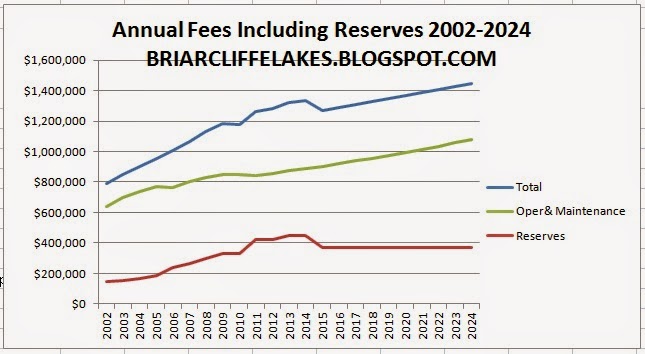
What would that look like? Here is a chart which includes annual Operations & Maintenance budget increases of 2% while meeting all requirements for reserves identified in 2011. It extends to 2024. It does not include a fully realized baseline fee adjustment because at the time I prepared this chart is was unknown.

Chart 3:

What would this mean for owner fees? Here's a chart 2002 to 2024 which includes 2% annual increases for Operations & Maintenance (O&M) . In fact, for the period 2009 to 2014, the average annual fee increase for O&M budgets was 1.1% per year. Assuming a 2% annual O&M increase would be reasonable, wouldn't it? It is important to point out to the reader that the O&M budget is arrived at annually. Only reserves should be accumulated from year to year. If there is a O&M shortfall, it is possible for the board to "borrow" from reserves. That money must be paid back, and I would think it should be repaid within one year. In other words, if the board miscalculates the O&M budget by 1/2%, that would require an adjustment in the next year. How much of an adjustment? In 2014 our O&M budget was $886,827. A 1/2% error would require a $4,434 adjustment. That's about $1.10 per month per owner. My point? A 1/2% error is not catastrophic.

Chart 4:

Note:
  1. I am aware of the prevaling wisdom that a fee increase of 0% is not a good idea. In general I support that. After all, we all know that costs do increase each year. Long term inflation for consumers may increase the price of goods and services by 3% or more per year. However, if a HOA becomes a "supersaver" and puts aside as much as 33% toward reserves, at some time a limit will be reached. At some point in time, that HOA will be saving more via reserves than might be required.  
  2. The reserve study update will be helpful in sorting this out. But it is not yet ready and the annual budget meeting is a few days away. What would you do? 
  3. I have the same information available as do many of our owners. I used the information of the published budgets to determine what was happening. However, I also added the information contained in the reserve study of 2011. I also walk the property and count such things as remaining roofs and driveways and note their condition. Anyone can also walk the property and count the number of completed roofs and driveways and so on. Most owners might not be aware of the details and intricacies of the reserve reports. These things are discussed openly at HOA meetings, as are bid selection, costs and so on. I also realize that it is impractical for owners to attend every HOA meeting and take notes. So I put the funding level information here. 
  4. There is no certainty; that is true. One of the very real fears for a HOA board is the possibility of undershooting the requirements of the budget and then either requiring a special assessment or a large fee increase in the next year. I am aware of the argument that " a 2% fee increase is better than a 0% increase followed by a 6% increase." However, I am of the opinion some of this fear is not grounded in current reality. Remember, in 2002 this HOA had about $222,000 in reserves. We were about to begin the replacement of all streets and the roofing project. The financial plan was clearly inadequate and the fears of the boards must have been real and palpable. This HOA had dug a deep, deep financial hole and it took years to fill it. "That was then and this is now." It isn't 1999. We do have reserves. We do have a bona fide reserve study and we have an update in preparation. Our current reserve study includes new entry doors for all buildings, completion of roofs, garage floors, streets, curbs, gutters and so on. All prior to 2024. 

Tuesday, May 13, 2014

How the Illinois Association of REALTORS and your Illinois Senate are conspiring to increase your fees - SB2664

1 comments

Bookmark and Share


Update January 2015
This Bill was vetoed by governor Quinn. However, it was possible to amend it and then reintroduce it in the 2014 legislative session. That did not happen and so this particular bill is dead. HOWEVER, it is possible this will be reintroduced as a new bill in 2015. So condominium boards, owners and management need to remain vigilant.

Original Post, May 13, 2014
There is a bill passing through the Illinois General Assembly which is vigorously supported by the Illinois Association of Realtors and which will raise the fees of condominium owners. A link to the text of this bill is included in this post.

The bill, sponsored by Democrats Hastings and Yingling in the General Assembly will force other owners in Condominium Associations to pay higher fees so dead beat owners and banks can sell distressed properties while purchasers can avoid paying fees accrued in past due accounts. It will result in higher condominium fees.

This number of this bill is SB2664.

It has the primary purpose of limiting the ability of the owners in condominium associations from collecting past due fees. In other words, these past due accounts will become noncollectable under law. These noncollectable amounts will pass to the other owners in the condominium association who will pay higher fees to make up for these dead beat accounts.

The Illinois Association or REALTORS (r) is overjoyed!

I quote the National Association of REALTORS website, which is thrilled to pass these past due fees to other owners so your friendly, neighborhood REALTOR(r) can make a sale:

"Senate Bill 2664 stops the current practice in which purchasers of distressed condominium units are stunned to discover at closing that they owe back assessments to the association—sometimes in sizable sums. These back assessments may also be loaded up with special assessments and attorney’s fees incurred and unpaid by the previous owner. Senate Bill 2664 protects innocent owners from being put in this position and eliminates the ambiguity that is causing sales of distressed units to be impeded or delayed, often resulting in litigation or a threat of litigation."

No mention of you or I or any of the other owners who have to cover the unpaid fees of these dead beat owners. Apparently the "victim" here is the poor, hapless REALTOR(r) who can't make a sale because the potential buyer isn't willing to cover these debts. How to solve this? No problem, we'll simply change the Illinois Condominium Act and pass these costs on to the other owners. Of course these other owners have empowered their management and boards to aggressively and properly collect these past due fees which are a legitimate obligation. I don't think most owners want to pay their neighbor's fees for them. But the Realtors(r) think a change to the Illinois Condominium Act which takes these costs and places them upon the owners who do pay their monthly fees is a good solution. This is all  to get a quick sale. I also think most condominium owners would agree it's preferred to have all owners pay their fees and obligations rather than walk and pass the bills to the other owners. But that apparently interferes with sales which in turn reduces annual commissions for the Realtors (r). 

The Realtor's and the Democrats have decided that it's better to stick the "innocent" owners who pay their fees with these costs which include the unpaid fees of the deadbeats. Yes, someone else will have to pay to keep the association maintained, pay for that new roof, keep the lights on, the streets plowed, the water running, etc. etc. Of course, even should this terrible bill be passed by the Illinois legislature, all of the remaining owners will share in these higher fees and that includes the new buyers. 

And some of our owners ask "Why are my fees so high" and "Where does the money go?" 

Do you want to pay the legal costs and fees of dead beat owners so a Realtor(r) can ring up more sales? If not, then do the following:


CONTACT YOUR REPRESENTATIVE AND SAY "NO" TO THIS TRANSFER OF WEALTH FROM CONDOMINIUM ASSOCIATIONS TO REALTORS(r).


Here is my suggestion:

If Realtors(r) really want to remove an impediment to a sale, they should back a bill in which a portion of their fees goes toward paying these past due accounts. they would then be helping the truly "innocent" owners who are being financially screwed by these dead beats. 

How is that? The other owners pay higher fees to make up for the fees which cannot be collected from the dead beats under current Illinois statute. This bill would easily raise condominium fees by one or more percent per year. It would also make it far easier for potential buyers to make really stupid decisions. Can the buyer afford the cost of the loan, fees and future fee increases, real estate taxes as well as the cost of updating and maintaining HVAC systems, etc.? These details escape the majority of Realtors(r) with whom I have had a conversation. It is all about the sale and extracting the highest possible fees. Let the other owners hold the bag!


Think about that!


Clicking will open a  New Window> Text of Illinois SB2664