Updated Surplus Numbers

Updated Surplus Numbers
Updated Surplus Numbers: Actual surplus 2018 per audit was $85,163.
Boards 2011-2018 implemented policies and procedures with specific goals:
stabilize owner fees, achieve maintenance objectives and achieve annual budget surpluses.
Any surplus was retained by the association.
The board elected in fall 2018 decided to increase owner fees, even in view of a large potential surplus

Average fees prior to 2019

Average fees prior to 2019
Average fees per owner prior to 2019:
RED indicates the consequences had boards continued the fee policies prior to 2010,
BLUE indicates actual fees. These moderated when better policies and financial controls were put in place by boards

Better budgeting could have resulted in lower fees

Better budgeting could have resulted in lower fees
Better budgeting could have resulted in lower fees:
RED line = actual fees enacted by boards,
BLUE line = alternate, fees, ultimately lower with same association income lower had
boards used better financial controls and focused on long term fee stability
Showing posts with label Water Problems. Show all posts

Wednesday, June 6, 2018

Project Update

0 comments


Bookmark and Share


Projects continue to move forward at BLMH. These include repairs to streams and waterfalls, gazebo replacement, landscaping, decks, drainage, streets, storm sewer basins and so on.

My challenge is to deal with all sorts of infrastructure issues while preparing for the future. It's been a 10 year mission while on the board for eight years.  But we don't live forever, and so who will take up the challenge in the future? That's a real question which I cannot answer. I am pragmatic and so I assume it will be up to me to get the critical things done, enroll others, and deal with the party people who do nothing. Ergo my approach in which "urgency" is the operative word. I won't be here forever and so I have a very limited amount of time to make a  very needed difference.

We're currently addressing a stream issue which has existed for about 20 years. It wasn't dealt with because the association lacked the funds to do so. How is that? Well, owners wanted "low fees" and boards accommodated them. So the association could barely meet the requirements of roofing replacements, let alone street work and landscaping issues. Everything else was put "on the back burner" as we say in the kitchen.

In 2018 the board has taken up the challenge, yet again, and again, and again. We'll finally complete the stream and waterfall maintenance issues which have languished. We'll replace the asphalt pavement on another two cul-de-sacs. We'll repair storm water basins and curbs on those streets, too.

Yes, it really is a race. Or, I could simply sit back, and let future boards deal with this and so many other issues. But that's not the way I approach life. We can either make a difference, or amount to no difference.

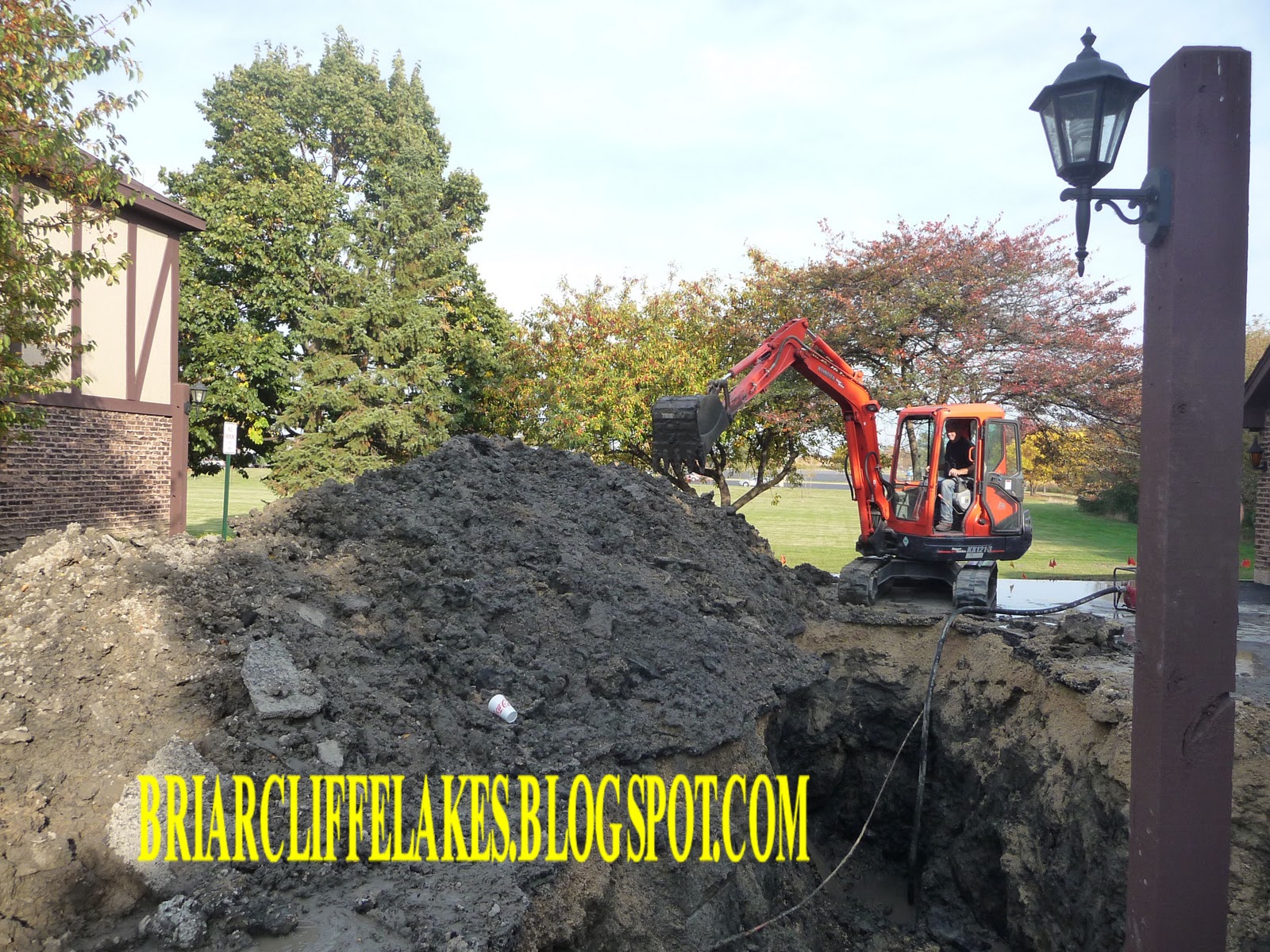
After a recent water main failure the City of Wheaton intervened in our association's water main replacement.  This was the direct consequence of a water main break which was dealt with as soon as possible on an emergency basis. Because the break occurred under a 4-car driveway the association board agreed on an emergency basis to replace the entire main section under the driveway, about 90 feet, to avoid future interruptions to owners at this address and others on this section of water main, about 20 homes in all. This would also avert near future repairs to this driveway because of any water main issues.


With initial approval by the city of  Wheaton employee who came onto the property because of the break to ascertain the nature of the problem and provide City input, the association plumbing contractor put about 40 feet of main into the ground.

However, at that point a City of Wheaton employee arrived on the scene and demanded that the replacement cease. It was stated that the type of pipe used for this replacement was not acceptable. (This approach has been approved by the city for recent replacements, including 2015). Apparently the EPA is now the determinant for water main replacements! Another benefit to owners as a consequence of the Obama Administration's intrusion into all aspects of one's life.

With no alternative, the 40 feet of NEW main was removed, and replaced as mandated by the City of Wheaton.  This increased the replacement cost by $10,000, delayed water main repairs and disrupted water for 20 resident units for another two days.

Here's the official Wheaton  video of the May 21st City Council meeting in which I attempted to get this sorted out. The interesting part begins at about 17:30.

https://player.vimeo.com/video/271192290


Most residents are oblivious of the issues. Of course some things don't change. After all, service "is what I pay my fees for."


Sunday, April 30, 2017

April Showers and May Flowers

0 comments

Bookmark and Share


Well, it's been a bit wet and cool lately. Currently 100% humidity, raining lightly and 44F. But I see that the humidity is dropping and now is only 97%.

We've received about 1.8 inches of rain in the past 24 hours according to the National Weather Service. Some standing water, but no flooding nearby.  Currently, it is predicted that we'll get another 0.9 inches by  7am tomorrow morning.


The 10 day forecast indicates mild weather ahead:


So what are the consequences here at BLMH? We do have some standing water. Most notably at a few of the curbs. As for the "mosquito glade" which was repaired last year, we no longer have a large, muddy area and while there is some standing water on the walk, it is minor and I expect it will dry quickly once the rain stops. I donned my Marmot rain jacket, stood in the middle of that wet walk in my gym shoes and put up a couple of flags; I'll check the actual condition tomorrow. However, this is an old section of walk and we do get about 1/4 inch of water at a variety of sections.

Could we eliminate all standing water? Possibly, but at what cost, and to what purpose?


Monday, June 15, 2015

Rain, Rain Go Away - Ducks and Mosquito Glade, Revisited

0 comments

Bookmark and Share


The photos in the previous post show an area that was more water prone 5 years ago. One board replaced a portion of the walk, but one of the tasks I took upon my self was to have the area thinned. It was overgrown with trees, which had intertwined and created a small glade of perpetual dusk. Rainwater would stand, or the area would remain damp for days after heavy rainfalls. There was simply insufficient sunlight striking the ground to grow grass or dry the area out.

There is a plan to improve the drainage in this location, but there are so many tasks. With the removal of a large (dead) ash to the south last year, improving the drainage may be a real possibility. However, there are about 50 other areas which also require remedial work, after the removal of ash trees, or new roofs and drainage.

Here is the "before" video, taken in August 2010.


Here's another view of the area, this video from May, 2010:


Rain, Rain, Go Away?

0 comments

Bookmark and Share


Update 4:35pm
We continue with intermittent rain and that is the prediction for the entire week. Now, this might seem to be a lot of rain, but NOAA.gov provides the following for this storm. These are the storm totals and current conditions. For my immediate area, the total rainfall for this storm is about 2 inches, with more to come. At this rate, we won't get to 1% (100 year) conditions; the NOAA is predicting an additional 1/4 inch late this afternoon and tonight. However, there are flash flood warnings. I provide this to document this storm, which is not an unusual one for this area. It will produce standing water and some inconvenience:


Here's the current radar:

Original Post:
We've had a rash of rain storms move through the area in recent days. Today is another thunderstorm with locally heavy rain, This is the NOAA radar current image:


Meanwhile the rain settled in some low areas and the ducks were really enjoying Sunday's storm:

The puddle above quickly drained into the soil, but today's new storm created another puddle.  As the rain saturates the soil, the time to drain will become longer. We know this, and the area in the photo is on the list of problems and issues to deal with. However, as this area drains in a few hours, it isn't considered an "emergency" by me. Of course, a very few owners who are annoyed by paying their monthly fees have a different opinion.


Sunday, June 12, 2011

Rain and Water Cause Minimal Disruption at BLMH

0 comments
We've had some unusually heavy rainfalls. This has caused some disruption on local streets in Wheaton and Glen Ellyn. Within the boundaries of BLMH, we have been very fortunate. This provided another opportunity to observe how drainage systems are handling the situation. I delayed my visit to my office the morning of June 9 and walk the property at 6:15AM to inspect a few areas which were of concern to me.

Heavy rains can sometimes result in leaks on roofing systems, including the shingles, flashing and chimney caps. As I expressed to unit owners who attended the most recent association meeting, I'm collecting additional information from work orders and adding this to the existing lists from previous surveys conducted by roofers and by maintenance, and my own observations. All "problem" roofs are being photographed and cataloged, this information to supplement rooftop inspections. All of this, of course, is to support the board in making good decisions.

One of the issues is getting to some of the areas on our roofs, which are not readily visible from the ground. Climbing atop 42 buildings is both time consuming and expensive. I am in the early stages of an experiment with a remote control helicopter equipped with video. This would be useful. Here's a view of a typical roof, and you can see there are complex surfaces with features not visible from the ground:


Here's one of the more severe water problems encountered at BLMH during the storms. This photo provided by a unit owner. The extreme edge of a driveway was temporarily "under water" during and shortly after heavy downpours.

This photo was taken about 8:00AM on June 9:


Once the rains stopped the water receded. This is a photo taken later:


While the first photo above might seem like a lot of water, in downtown Wheaton, things were much worse, as shown in the photos on this website:

Wheaton Main Street Closed June 9

I received an email from a concerned unit owner which included several photos, one of which is above. I responded on June 10 as follows:

"Thanks for the photos. Our Landscaping Director is away, but I’ll see that he is made aware of these. Solving problems of this type requires the cooperation and coordination of landscaping and maintenance.

This area was one of the subjects of two walk throughs on April 13 and 20. The second walk included myself, the [LD and maintenance]. A question then was what specifically to do with this area, which is unfinished. We discussed several solutions. The problem includes the grassy area behind the corner of the driveway. Any water which flows off of the driveway in that direction must by handled by whatever water conveying system is installed downstream. Otherwise, we simply create a lake or a larger problem, or a problem for someone downstream.

As you may be aware from recent newsletter articles, “drainage” is a priority item.....there are many driveway [with] slopes which are marginal in pitch....the problems are being handled one at a time, and using the best...methods available. “We can do anything all it takes is time and money” is a saying but I don’t have those options. This association is comprised of a volunteer board which has limited time, and we obviously have limited funds. The problem in your photo was identified in 2008/9.....with the completion of the driveway it is possible to proceed. The location of electrical utilities, which you can see in your photos, makes grading or digging and expanding the swale somewhat difficult, but not impossible.....This specific problem is on my and [maintenance's] task agenda for a [meeting] the week of June 20.

For your further information, I submitted a brief report to the board in April and a much more detailed one in May. The area in the photo was included in a description of problem areas.... [which can benefit from drainage modifications and improvements]. Your photo shows the large gouge in the land adjacent to the parking lot at 1604..... This is a temporary swale. It’s a partially installed solution. In my May report to the board I stated that “Water flows….and collects in the corner of the parking lot. This needs to be incorporated into the solution at 1604....”

I’ll let you know what develops. However, it’s my approach that whatever we do is to be permanent, or as permanent a solution as possible. I am of the opinion, which is shared by experts, that we can solve about 80% of [problems of this type] at BLMH with the means in hand. It will take time and a committed board. There will continue to be problems. Unforeseen circumstances, such as the water main break on May 14, can create water problems which can overpower any program.

Here’s a link to a few videos of that break:

Water Main Break May 14

I’d suggest you begin thinking about how to assist me in assembling a board in 2012 which will support me in handling problems such as this one. If [such a ] board does not exist, then work will again grind to a halt, or slow down. This will all be the choice of the owners of this association."

Comments, Corrections, Omissions, References
Note 1. While this has been going on, other owners are of course, complaining about issues which they see as "more important." A work order was made on May 16 for the repair of the pumping system for the Stream #1. That work is progressing well and is scheduled to be completed in another week. There are 24 units in close proximity to that stream. An owner attended the May meeting to complain that "their stream" was not in operation. It was explained that the method of repair had been decided. That wasn't good enough for them. So on June 2 I received a telephone call, at work, in which they expressed their extreme displeasure and threatened to call the city to complain about mosquitoes. I told them I did not agree with their approach. After disconnecting I checked with management and the mosquito control consultant. That stream and pond had recently been treated and I was assured by the consultant that no mosquitoes were living in that pond and stream, and that the type of chemical used would assure no mosquitoes for another couple of weeks. 


I called the owner back about an hour after their first call and explained the situation. I was then informed that there were a lot of tadpoles in the water. Well, tadpoles eat mosquito larvae, so that would be a good thing, wouldn't it? I was thanked for providing my information, but this apparently wasn't sufficient. 


On June 9 that same owner contacted management, attempted to contact at least one other board member and did carry out their threat to contact the city. 


I would think that owners would realize it's their money they are wasting. This is supposed to be a "community" and this particular owner has chosen to lecture on this from time to time. They have also complained "what do we get for our money!" So I guess they want it both ways. Or perhaps they are interested in only supporting "their community?"


In walking the grounds, it would be obvious "what they get." In fact, last year they got a new roof. I think they are part of a sub group here with is always attempting to manipulate the board and management to get money spent in their direction. I am of the opinion they spend time coaching others on the methods to be employed. A new owner recently called to complain about "their view."  I would think they would understand that the money they provide to the association as their fees is not earmarked for "their" building and for "their" landscaping. But apparently not. I took the time to explain how it works as an "owner" at BLMH including the volunteer board, professional management and maintenance and other professional vendors, the utility bills (owner and association), street repairs and maintenance, how fees are allocated to reserves, operations and maintenance and that means, to a "kitty" which funds all of the maintenance programs here at BLMH and on the approximate 40 acres of this association. I asked this new owner if they had walked the grounds. They said "no."


I continue to press owners and the board to operate in the spirit of community and for the board, specifically as fiduciaries. The new board seems to have a better understanding of what this really means.


I'll continue to promote more owner involvement. I'd like to see at least 33% of our owners actively participate as "owners" at BLMH, and "walk the talk." To faciltate that I was promoting a "spring cleaning drive" but the board in existence earlier this year nixed my request and did not support it. Parties are great social events. They are not a sign or mark of ownership. 

Saturday, October 16, 2010

Water Main Break - An Affected Owner's Request - Photos

0 comments
Here is an update. I added some photos the evening of October 16

I received an email from an owner, and in it she asked if I could provide additional information on the water main break on Gloucester. She stated that "Do you know when the work will be completed or when we can drink the water safely if we have it? Yesterday I called FUPM, and [I was told] there was another break, and there could possibly be more troubles.

On Sunday I went to the site several times and never saw anyone monitoring it. I asked the workers Sunday evening when they were going down into the large and deep hole if they were going to shore it first or use a trench box, and they said they did not have time; so, I am happy to hear they are now in accordance with OSHA rules.

Anyway, Norm, if you can shed more light on the situation, please do. I would appreciate knowing when the problem will be officially fixed."

Here was my emailed response, slightly edited for posting:

I am sorry for the delay in responding. This is my personal response to you, as a resident. Yes, I am a board member, but I am speaking for myself here and I have not been given a formal statement by the board and its position in this matter. So this is not an official statement of the board. 

I believe a notice has been posted on the quality of the water. The board is attempting to provide frequent information to the affected owners.

It's my understanding that notices have been posted in the foyers, providing affected residents with updates. I also understand that emails have been issued to affected residents, who have provided their email addresses to the association. I believe all of this is being coordinated by our president. Several board members have assisted in distributing these notices. 

I am not provided with this information in a timely manner. I'm not sure why, but most likely it is because this blog is not considered a source of "news"  in the association. For my part, I have not asked for frequent updates. So "up to the minute" information is not available on my site. It is not the part of any BLMH emergency notification system. Our official BLMH.org web site is apparently not structured for use as part of a "current events" news system. It is currently under the direction of our Communications Director and the board.

I understand this repair is almost complete at this time. Officially, it was not possible to provide you,  I or anyone with details about exact "fix date" because no one could, with any certainty, predict when the pipe would stop rupturing. Here is some info, which I can't yet verify. Multiple breaks, or ruptures occurred on several dates and in different locations on the same water main. I have been told there were a total of 5 breaks! This is unusual, but is no one's fault.  I am sure that is little consolation to you or any other owner living on Gloucester or Dover and affected by the failure.

It was the decision of the contractor to bring in an OSHA required [or mandated] box, and subsequent failures required a larger box, actually two. These boxes are costly to use and to transport, and require time to construct and position. However, the ultimate goal is to do repairs of this type as quickly as possible and at the most reasonable cost, to the association and the owners, and with a minimum of disruption to you and anyone else. While the association values the fees we so carefully collect and save, I see no attempt to penny pinch in this matter, and I believe the ultimate cost will reflect that.

As to the nature of the delays, it takes, for example, digging to determine what the problem is, beyond the obvious "it's a broken water main." Exactly where was it broken, what is the depth, the condition of the line, etc. is not obvious until the ground is broken and a hole is made. At the time of the break, the contractor estimated the type of equipment required on site and then got it here. The contractor is very experienced and is, I understand, one of the more proficient at this type of work and has much experience on our property with these types of problems. 

I'm sure the board will be looking closely at what failed, at the response of the contractor and also of FUPM, and of the communications issues raised by this water main failure. I would hope the purpose will be not to spread blame or point fingers, but to better understand how the association can better respond to this type of failure, so that communications system can improve. Believe me, your president takes all of the quite seriously, and so do I and the other members of the board. She has directed that you and others in the immediate area of the break get frequent notices posted. I believe the architectural director posted the notices you saw this morning (October 15) and that was after a late night budget workshop!

I wish I could tell you more, but that is what I know at this time (Friday morning, was my last communications with anyone and that was one of your affected neighbors). 

I have suggested a phone tree or similar for the future. That does not currently exist and would require the cooperation of owners, who would have to release their phone numbers for this use. Certainly other techniques will be considered. One of the issues with this type of problem is the infrequency. That makes emergency preparedness more difficult, but certainly possible. What would be the best method of communication? I suggest [you] make specific recommendations because you were one of the owners affected. You could direct that information to our Communications Director. 

Looking at this piping failure, I have been told that the last time a failure of this type occurred on Gloucester was 2002. Most of the other breaks on the property have been a single break, which was very easily repaired. My personal concern at this time is the question "is this indicative of the types of water line failures we can expect, in the future, as the infrastructure ages?" That is a serious question. I have been told by relay of information attributed to the contractor, that a part of the problem is that the soil composition as they moved east was that of a "peat bog." I assume that this is not typical on our property. But we'll have get more information on that. 

Norm


Some Additional Photos

Here are a few photos of the "dig". The hole is not quite filled, but the multiple breaks have apparently been fixed. I understand this stage of completion was reached on Friday. However, I first want to show this photo, taken on October 14. This shows a stack of two OSHA safety boxes. They are two high. Each box is about 8 ft. tall, so the stack shown in this photo is 16 feet in height! That gives some idea of the depth of the hole. However, I should point out that the initial hole was shallow. As the break, or breaks "progressed" the hole became both longer and deeper. This photo depicts what might have been the maximum depth.


The OSHA boxes were removed and these photos were taken Saturday afternoon:


Equipment waiting for transport and a partially filled hole.


A partially filled, barricaded and safety-taped hole:


Thursday, October 14, 2010

A Hole Grows In Wheaton

5 comments
And what an expensive hole it is! The water main break on Gloucester is growing. Temporary patches have been installed, but on October 12/13 another break or multiple breaks occurred. The hole is getting longer, an OSHA mandated protective box has been installed, and even larger mechanized equipment is now on the site.

Tomorrow with be day number 5. This will be quite an expensive repair. Possibly equivalent of $125 per owner. Of course, some may quibble about my numbers. Some always do. However, I'm including my estimates of the repair, crushed stone fill, driveway and landscaping, and a tree or two that have been removed. Why include all of that? From a cost accounting perspective, none of these costs would have occurred at this time if it were not for this break. So in my book, these are the contributors to the full cost of this repair. Another way to look at it is this; if this break had never occurred, this money never would have been spent. Some of this may be common sense, or, to paraphrase another board member, who has used this term during association meetings, "that's only logical", isn't it?

There are two sides to this. These types of problems are inevitable; they will occur. The only thing we don't know is precisely when they will occur. So it's only responsible to financially prepare for the inevitable, isn't it? This association does plan and prepare, and it raises fees in an orderly way, to assure that it has sufficient reserves and funds for operations. Well, OK, most of the time it does. And it does so because some of those "hard" people are alway pressing to adequately fund our association. People like me.

The alternative is, the board can vote for very low fees, and it will be entirely up to the owners to plan and prepare. That means, leave it entirely up to the owners to manage their finances in such a way as to save a few dollars each month, to be available for problems and special assessments. Then, when we have a problem, such as this, the association can simply "pass the hat" to the owners. Those owners will then willingly and cheerfully dig into the cookie jar and pull out a wad of bills they have saved explicitly for this moment!

Dream on, Norm! What planet am I on?

Last year, our board voted a 0% fee increase. They did so with management's input. Did they jump at the opportunity of a 0% fee increase because that is what they wanted to hear? Or did they do a little bit of independent analysis so they could come to an informed decision? I don't know what they did, because they didn't tell us, the unit owners. But in the end we did get a 0% fee increase. (Note 5).

I had done my research, which included some simple things like the ultimate cost of our roofs and driveway projects. You will recall, the board had voted to proceed with those and if it weren't for delays by supposedly external forces, we would have had 7 driveways repaved last year, in addition to two roofs.

My arithmetic indicated some funding problems with these programs and I did discuss this with some board members. To others, I was and probably still am "persona non grata." (Note 2).

So I began a public campaign to encourage all owners to save the difference between that 0% fee and a small fee, in a cookie jar each month, because I knew we would need it. I "knew" that it would be inevitable for a fee increase at some point in the near future. I was advocating that a prudent owner prepare for it. So, anyone who heeded my words has been doing this and will, I hope, continue to save a bit each month in preparation.

The real point of stating that here and now is I want to use it as an example of my position about unit owner preparedness. I suspect many and perhaps most owners didn't hear my words, or if they did, they simply didn't heed them. I wouldn't  be surprised if some of the board at that time reassured owners and told them to ignore me.  That's conjecture on my part, but I suspect we are dealing with individual belief systems here. (Note 3).

To return to reality, the question is, which is better? Having the owners each use their own best judgement and save and be prepared, or have the association manage these financial affairs. Some here are arguing that the association is doing a poor job, and the owners would do a better job. A few, I suppose would. But would all? I say they wouldn't and for that reason I disagree with the naysayers. To support my position, I suggest we check the number of owners who are late paying their fees each month. And by how much? Who or whom is late is considered "personal information." However, the amounts are in the monthly accounting records and are available to all owners.

Returning to the immediate issue, there will always be problems of this type. Breaking pipes, falling trees, the occasional unit fire, or roof leak; it's all a normal part of ownership. Rational board members have been arguing for years that we need to adequately fund for these types of breakdowns. Management, for its part added a "contingency" reserve category. That's to allow the board to have somewhere to fund for these  problems.

Will there be other failures? Of course there will, and probably more frequently. Why? Because our infrastructure is aging. That's not a big deal, unless our board decides to stick its head in the sand and pretend that we don't need to adequately fund for driveway replacement, garage floor replacement, new trees, roofs and of course, the occasional breakdown. Believe me, it's easy to fall into the trap. All one has to do is listen to their neighbors. The ones who complain about our "high fees." That's "diversion speak" for "we don't need to save or fund our reserves," or "I'd rather spend my money elsewhere and I don't want to put it into this association."

The next time someone tells me that they think they can do it better than the association does, I'll should ask them a few questions:
  1. Do you currently have $5,000 set aside for a new furnace to replace that 30 old one in your unit?
  2. Do you have $400 for a new hot water heater to replace that 15 year old one in your unit?
  3. Do you have at least one month's cash saved up in advance to cover next month's bills, including your association fees?
  4. Do you have a 6-month "emergency fund" which financial planners recommend, should you suddenly experience a loss of income?
  5. Are you funding your Roth IRA 100% each year?
  6. Is your 401K or retirement plan fully funded?
If you can answer "yes" to each of these, then you and I can have a conversation about how you probably are financially prepared, and you are capable of independent financial planning. However, I suggest that most of us are not as prepared as you, and we need a responsible financial plan for this association, and we also need a reliable means of collecting the fees required by that plan.

That plan includes realistic data on the condition of infrastructure, including its age and condition, and a companion document to fiscally and responsibly fund the association in accordance with these plans. Earlier this year the board authorized and paid for a "Reserve Study." It was expensive, but it was decided to be necessary by the previous board. Some of us are now analyzing it and determining the relevance of its merits and conclusions. (Note 1).

Here are a few more photos take at dusk on October 13. 


Comments, Corrections, Omissions, References, Miscellaneous News
Note 1.  I was elected to the board and since approximately October 1 I have been doing a serious analysis and review of the "Reserve Study." I have provided two documents to the board, including one of about 3,000 words and another of about 4,000 words, and several spread sheets. I'll be posting more here tomorrow.

Note 2. As the newest and most junior member of the board, I am bound to keep some things in confidence. However, I am also bound to act in accordance with my fiduciary duty. I'll do my best to earn the trust of the board, but some will probably never trust me. I suspect some are simply counting each and every one of my missteps, because this will support any such position regarding my un-trustworthiness, my lack of accuracy, etc. In politics, if you can't discredit a person's position, and the information they present , then one does their best to discredit the person. This is Illinois, after all and most of us have had the opportunity to observe political corruption and incompetence. We'll see what develops here at BLMH.

Note 3. I will be doing my own analysis and I will continue to publish my views here. As a board member, I have some constraints. I don't want to publish all information and in particular, financial information here. It would be inappropriate and won't serve the association on the manner in which I do intend to serve it. I have observed and scrutinized  boards here for the better part of three years, I have made some conclusions about individuals because of their arguments and also because of what is not stated to unit owners. I have concluded that in recent years, some board members truly believed our fees were too high and unnecessary. They also believed our professionals were not to be trusted and were doing a poor job. They then began to act out of those personal beliefs, and some board members may continue to do so.

From the perspective of information, a case in point is our association newsletter. It is greatly expanded, but does it really provide more information? Does it prepare owners at BLMH for some of the responsibilities of ownership, for our finances, for the realities of some of this association? I think it could do better. Owners have called for more transparency on the board. The news letter is the perfect vehicle for that. I think some owners would like much more information about the decision making process. I will provide that here, in a responsible way, but I can only go so far and I can't reveal all. I will discuss various sides of the arguments, such as financial planning, project decisions, and so on. However, I can't quote individual board members unless they permit it.

Note 4. Because of the realities of being a member of the board, I will be restrained slightly. So I'll use my best judgement about what is printed here and what is not. I pressed forward with my independent analysis of the reserve study, and produced two letters to the board. That wealth of information was prepared by me and I claim the right to use it in any, prudent manner to the benefit of the association. Some of it will be printed here. I would hope the board also uses it to good purpose.

Note 5. When the time came for a vote, the Treasurer voted "no" for a 0% fee increase. As I recall he was the only "nay" vote. As I also recall, the minutes did not accurately reflect that. The minutes recorded the quantity of votes but did not indicate who, by name, had registered that "nay" vote. This came to my attention later, as I was not present at that particular meeting when the minutes were read and approved.  This is a serious oversight. Why? because when the time comes, there will be no accurate historical record of who specifically voted "ay" and who voted "nay." It is possible one or more board members will one day claim that they were the caster of that "nay" vote. 

Monday, October 11, 2010

Water Main Break

6 comments
A water main break occurred on Gloucester early Sunday morning, October 10. One of our professional managers was on site at 4:00am Sunday morning to determine the extent of the problem and coordinate with the city water department and our crew's emergency response.

This post was expanded the morning of October 11 and additional comments added.

According to the Water Management Contractors who responded, this would be the procedure:
  1. Facilitate Emergency Repairs as soon as possible and restore water.
  2. Return the next day and complete normal repairs. This will include possible further inspection of the water line to determine its condition and how much pipe to be replaced. Then make a determination of the extent of repair and with approval of management, do that. 
After the repairs are complete, the association will have other tasks to complete:
  1. Clean up.
  2. Repave the driveway at 1782.
  3. Repair damaged landscaping.
It's unfortunate, but the new asphalt driveway was lifted by the surging water and another large area was, of course, dug up. A neighbor, when informed of this problem, stated to my spouse "no problem, the city will take care of it."

This person has been on the property for at least 15 years. She is very uninformed in this case. Our association owns the street and the water pipe below it. We'll be responsible for any and all costs.

Another neighbor suggested that we should "sue sombody" (I think the term that was used was to "legally subjugate").  That would be ourselves, I guess, since we, which includes you and I, are the owners of the property and the water lines below, etc. I guess she is suggesting we sue each other and then the board could vote a special assessment to pay for any legal fees and judgements. Sorry, I can't support such ideas. As owners, our money needs to be spent on roofs, driveways, various concrete projects and daily operations and landscaping.   

It will be interesting to see the entire bill, which will include:
  • Sunday emergency work for most of the day (last photo I took was at about 4:30PM and they were still digging! I assume that this is overtime rate, possibly double and triple time?
  • Permanent repair.
  • Clean-up.
  • Grading and new asphalt drive and entry.
  • Landscaping repair.
In the following photo, you can see the lifting of large sections of the driveway by the pressure of the water exerted below it. If you click on this picture and any of the others, it will open and you will have a greatly enlarged image. 
Here's an enlarged section with the worker stepping gingerly on the raised section.

There was so much water, under such pressure, that it was being ejected and literally shooting out along the edge of the driveway along its length. With it were large quantities of muck (that's slang for very wet soil and clay). Here is one such spot, after the water was turned off. This driveway was severely damaged. The good news, is from outward appearances, all water moved away from the nearby buildings.


This photo was taken after the flow had been greatly diminished, immediately after the main valve to this section of pipe had been completely closed. The residual water is flowing into the sewer

With the water off, and the immediate emergency averted, the crew dug while various neighbors looked on.
The resulting hole was immense!

Six hours later, they were still digging! This is, of course a slow and laborious process. Digging commences in the possible area of the break. It continues until the water main is uncovered, and then digging progresses horizontally until the source of the break is revealed. This requires periodically "cracking" the water valve so that the source of the leak can be seen. Of course, all that is revealed is some spinning or shooting water which points in the direction of the damaged section. Not a fast or easy job.


The morning of October 11, work resumed to make a permanent repair. Additional equipment was brought in and soil was moved out of the way. Management informed me that they were getting repair costs estimates and would proceed with soliciting a bid for repaving of the ruined driveway. Management informed me that the hole will be expanded to beyond the driveway and pipe replaced, to assure that a future break in this area, should it occur, will not damage the driveway. That's the plan, of course, but in the real world, things do sometimes go wrong. All that we can do is attempt to anticipate these problems, plan accordingly and of course, accrue funds so we can financially handle these when they occur. Or, the board can simply levy "special assessments" each and every time these events occur. That's not a option in my book. I prefer "prix fixe" menus at restaurants, where I pay one price for a complete meal of several courses, at a fixed price for the meal.


Comments, Corrections, Omissions, References, Miscellaneous News
Note 1.  This will be an expensive repair. Extensive hours and equipment on a Sunday, which is most likely at overtime rates, permanent piping repairs on a Monday,  a new driveway and landscaping. I suppose the only saving grace is it happened before the annual board budget meeting and no buildings appear to have been harmed.

Note 2. Comment added October 11: The city was not directly involved, but has access to shutoff valves outside the property and also maps detailing the location of the various major shutoff valves on the property.

Note 3. In response to a reader's question "Any chance this could have been exacerbated by the previous driveway repair?" I would say this. I would guess, from visual observation that the water line is 8 to 10 feet below the surface. I never saw the pipe line! They were 8 feet down and still digging when I snapped the last of those photos on Sunday. Even with the removal of several feet of old asphalt and crushed stone, at such a depth, the 8 feet or so of soil remaining above the pipeline would provide substantial distribution of any forces exerted by the paving equipment. Our management is looking into some of the possible causes. However, this was a major break. Not a "pinhole." I think we just experienced our own version of a Deepwater Horizon blowout. Fortunately, this was fresh water. 

Sunday, August 15, 2010

Mulching and Water Run-Off Problems

0 comments
Here's a video which is an example of some of the water flow and drainage issues, which are compounded when mulch is used as fill. Mulch in itself is not a problem. However, if mulch is used to fill "low spots" then what you see in this video is the result.

When there are low spots filled with mulch, rainfall will wash away some of the mulch or re-distribute it, because the mulch is lighter than water and will float. The mulch then flows with the water downhill, and will create multiple dams, which further impede or prevent the proper run-off of water.

Water always flows downhill. In the example, the water found it's way into the garage and then to the driveway. Due to the nature of the garage floor, there is about one-half inch of standing water in some parts of the garage. Most but not all of the water flowed out of the garage and onto the driveway. Some water was left standing.

How to solve this problem? Add fill to properly elevate the low areas and if necessary, sculpt the landscape to avoid low areas, instead of filling the low areas with mulch.

I have sent a link of this video and blog to various members of the Board of Managers of our Association. Specifically in an email to our board president:


Hi [Madame President],

Here is a video of standing water and runoff problems along the side of the garage at [nnnn] Harrow Court. The water enters the garage during most rainstorms. This is due to an opening in the wall of the garage and the low area along the garage, which has been filled with mulch. With the recent mulch addition, the problem is aggravated.


I think this highlights one of the possible problems that can result, when mulch is used as fill.


Please forward this to other board members, for their information and action.


I will also send a copy of this email to management.


The following video does include an audio commentary. You may find it necessary to increase the volume on your PC  audio and also the audio control embedded in the video.


Comments, Corrections, Omissions, References
================================

1. The specific address was removed from this post. 

Tuesday, September 16, 2008

More Water Problems!

0 comments
We have also had water in the garage. We share this with other unit owners and we each have a seperate overhead door. Last fall, I noticed that the asphalt had disintegrated at the base of the downspout. I took a couple of photos, including this one, and forwarded them with a letter to the management office. They responded with a "cold patch" of concrete.

That had a side effect. If the driveway is not kept clear, and for example, ice and/or slush collects at the downspout, it can prevent water from flowing downhill and we can have water in the garage. I have reported this to the management office. The same situation occurs if we get very heavy rain and wind from the proper direction. Water is then blown against the overhead door and flows under it. Sort of a miniature "storm surge".

Here are a couple of photos of this event. The water normally stands within about 4 inches of the garage floor. If the wind is from the proper direction, then the water is pushed against the doors and into the garage:


Rain, Rain "Go Away"

0 comments
Interestingly, most of the "breakdowns" involving our unit have involved water. Fortunately, problems have been few and far between, and the management company and board are usually responsive. A roof leak incident was probably the "perfect storm". Oops!

From my experience, one of the things I do not like about being a unit owner, is the need for coordination and cooperation between management, contractors and neighbors and the lack of power in that process. As a home owner, I was accustomed to making decisions in which I had purchase authority. As a unit owner, I have no such authority or power with contractors or my neighbors. As a result, some simple problems can, and do become much larger ones.

I have kept copies of the letters I use to resolve these and other issues at the unit. I also have a "diary" and a task agenda. The "diary" keeps track of names, dates, conversations and so on. It's simply a day planner with notes. These get rotated out each year. The task agenda is used to establish priorities. I prefer to use letters as follow-up for conversations because they document what is going on. A letter is also a means of controlling what I say; conversations are less rigorous and it's easy to make verbal promises and agreements and then promptly forget about them. Then there are those dreaded "senior moments" that people keep warning me about. Letters are a form of documenting who promised what to whom, etc. I am also very careful that what I write is accurate. Of course, in the end you could say it is all my opinion. I prefer to view these as my "assertions". There is evidence to back up what I say. However, I do agree that this is from my point of view.

I have found that conversations can be very, very sloppy. That said, here's a couple of "water incidents".

A Leaky Water Heater

In April of 2002, our hot water heater's valve developed a minor problem and a drip. Not all of the water went down the drain in the utility room, which was only about a foot away. Unfortunately, a flaw in the floor caused some of the water to find it's way into the unit below, rather than into the drain per se. Our neighbor alerted us to the problem, which after inspecting their utility room, I was able to confirm. This was not easily resolved. I "capped" the hot water valve to stop the water "drip". I also called the general maintenance company recommended by our association and asked them to contact my neighbor to gain access to their unit and to provide me with an estimate of repairs. I'm reasonably "handy" but for liability reasons, I decided not to do the work in my neighbor's unit.

It took a while to figure out how the water was getting into the unit below. It was a very small trickle which did make it to the drain in the floor. After a few inspections from below, it was determined that water was running along the outside of the drain pipe. I stripped the tile from the floor above and determined that the cementatious underlayment had a crack. Water apparently found this path and ran along the outside of the drain pipe and into my neighbors unit. The contractor confirmed this from below.

I decided to cut the lip of the drain pipe, which was extended slightly above the level of the floor, patch the crack and the seam along the outside of the drain pipe where it passes through the floor, using epoxy cement. I then replaced the tile. I also extended the tile into the drain, so that water hitting the floor would be guided into it. However, to do this "right" would require replacement of the entire floor of 12 x 12 tiles with a single sheet of plastic vinyl. To do so would require a new hot water heater. The repairs to my neighbors ceiling were completed and they confirmed that the repairs were "satisfactory". Accordingly on May 16, 2002 we issued our check #1056 to the contractor, in the amount of $700. This was an expensive repair, in part because it took multiple visits by the contractor who stood on a ladder below with his head in my neighbor's ceiling and with me above pouring water from a bucket onto the floor. We eventually determined exactly what was happening and how the leak was getting into the unit below. I was then able to make repairs above, and that had to be completed before the contractor could replace the ceiling.

We decided to postpone replacement of the hot water heater until such time as I could also do the repair to the floor and install the vinyl waterproof floor. This was finally done in January 2007. At that time I replaced the floor with a single sheet of vinyl, put an aluminum pan under the new hot water heater, and sealed the entire edge with a vinyl cove base and generous amounts of silicone sealant. The vinyl floor was installed so that it extends over the edge of the drain. Any leaks in that room should not reach the unit below.

A Leaky Roof

In 2004, we developed a leak on the roof. It was traced to a missing cap on the chimney. However, the repairs took some time and my neighbor was very unhappy with me. It took quite a number of telephone calls, coordination with a contractor, and ultimately a letter to the management office. There was more than enough frustration to pass around and for a time we were not on speaking terms with one of our neighbors. This is the letter that finally got the problem resolved. I have deleted names, etc. but otherwise, this is the exact letter, spelling and grammatical errors included. On re-reading this, I was struck by a similarity to the premise of that movie "groundhog day":

July 21, 2004

To: Director of Management

Dear Sir:

This is to advise you in writing, of the UNSATISFACTORY and UNRESOLVED status of a problem at BLMH. What should have been a relatively minor problem, speedily repaired, has been anything but. I suppose I should be thankful this was not a major problem. However, this has gone beyond a simple nuisance and my neighbor below is a problem, as [he] would like to believe that any water entering [his] unit from above is my problem, my responsibility and can be controlled by me and that any resulting damage is my financial responsibility.

This was reported over 30 days ago to [the management company] (on June 16) but as of today has not been resolved. There is ongoing and spreading water damage to two units and a significant amount of water is collected in [my unit] each and every time it rains, with continuing and spreading damage to the utility room ceiling of the unit below. On June 21 and again on July 15, we were told by [the contractor] that this was a chimney cap problem. The parts were supposedly ordered after the June 21 inspection but in a second inspection on July 15 my spouse was told that the required parts had not been ordered. This morning I spoke with [so and so at the contractor] and he said that the proper cap is not immediately available and that he would attempt to make temporary repairs. However, I don’t know if this will be successful and prevent water entering the building.

I appreciate [the contractor's] efforts; I don’t know precisely why it has taken this long to solve this problem. My work requires extensive travel and so my spouse has been attempting to coordinate this to the best of her ability, with minimal success. As a consequence I have altered my business to permit me to be in the area for the next week or so. My neighbor below has requested that I pay for repairs to [his] utility room.

The bottom line is this. 35 days for minor repairs is excessive. It is my understanding the roof, chimney and caps, and flashing are the responsibility of [the association], not the unit owners. However, I am absolutely capable of orchestrating the necessary repairs and therefore, if this is not resolved by 5:00 pm on July 28, then on the morning of July 29 I will at my own expense hire the necessary contractors and make any and all necessary repairs to the roofing and/or chimney and related structures at [my address].

If I do have to bring in a contractor I will backcharge [the association] for the work. If, after issuing a backcharge I am not reimbursed within 30 days I will then deduct the amounts from my assessments until I am fully reimbursed. Further, and to avoid any confusion in this matter, I am a responsible owner not a renter and I do understand the difference and I believe I am acting accordingly.

To give you the complete story, the problem involves one or more roofing and/or chimney water leaks above [my unit] at [my address]. This has resulted in damage to both [my unit] and to the unit below it. However, I understand the damage to the unit below [my unit] is more extensive and includes bubbling of the utility room ceiling. Photos of [my unit] are enclosed and includes both the utility room and the adjacent bathroom ceilings in [my unit]. I do not have photos of the unit below, which is owned and/or occupied by [my neighbor].

Chronologically, this event began on Wednesday, June 16, 2004. As I stated, my work requires significant travel on my part and I was away that week. In fact, in one recent month I was on the road 29-1/2 days. This makes my involvement difficult and puts an additional burden on my spouse. However, I have altered my business for the next week or so, even though I should be at several clients out of state, so that this problem is fully and completely resolved. I digress.

On June 16, my spouse, reported to me that [my neighbor] knocked on our door at about 10:00pm to report water leakage in [his] utility room. My spouse investigated our utility room and found evidence of water leaking from above. She called me long distance about this. At 10:30pm [my spouse] called the night Operator at [your office] and reported the problem and requested assistance. [My neighbor] also promised [my spouse] that [he] would call [the management company], but we are unaware that [he] in fact, has ever done so, and according to [your contractor] they have no current work orders from [my neighbor].

On Thursday June 17, we had not received any response from [your office] so on Friday June 18 [my spouse] called [your office] during normal business hours and was told “there will be someone soon”.

On Monday June 21 [so and so] of [your contractor] arrived and investigated. [My spouse] advised him of the problem and after an inspection he advised [my spouse] that the leakage is occurring in the ductwork leading from the roof (this ductwork is compartmentalized, with inner and outer ducts, and according to [the contractor] there was water moving between the inner and outer). While he was in our unit I spoke with him via long distance telephone and he informed me of his findings and advised me that a chimney cap was missing. However, he declined to enter the attic and confined his inspection to the exterior of the roof and the utility room and bathroom. He advised [my spouse] that this would be corrected quickly, but that a chimney cover would be placed on order and so repairs could not be done immediately.

Upon return from my business trip, I made an inspection of my own. I entered the attic and looked for evidence or water leakage. Beneath the ductwork leading from the roof I installed an aluminum pan under a seam at a 90 degree elbow, in the area above the bathroom ceiling which is stained as indicated in the photo. At the time the duct was dry, but there was evidence of water (water marks) in that area of the duct. Also, it is possible that more than one section of ductwork is affected. However, the major leak is in the duct which goes through the utility room of [my unit] and to the unit below, and which I understand is causing bubbling and damage to the utility room ceiling in [my neighbor's] unit. I inspected that duct in my utility room in [my unit], but the water appears to be running vertically within the duct and is beyond my control. I also inspected the appliances in my utility room, including the HVAC unit, water heater, humidifier, washing machine and water and drain piping. The underside of the water heater and the entire floor was bone dry. There was absolutely no evidence of any internal leakage in the utility room. The nylon tubes which convey condensation from the HVAC exchanger to the drain and from the furnace humidifier were properly inserted into the floor drain. The humidifier tube was internally dry; the HVAC tube and had typical “scum” inside of the tube, but was freely conveying condensate into the drain.

I do understand there are several possible sources of water. These include and are not limited to:
1. Water from appliances and HVAC situated inside the utility room.
2. Faulty plumbing or drain piping within the utility room.
3. Roof leaks.
4. Faulty floor drain including cracked piping above the ceiling of the unit below.


Now, when the unit was purchased about 2 years ago, we discovered a faulty hot water heater drain valve. At that time we also discovered a crack in the cementatious floor of the utility room, and a defective drain which had a lip about 1/8” above the floor level. These all combined to channel water into the ceiling of the utility room below. A work order was issued to [your contractor] for which I paid $700. Work done at that time included removing floor tiles and sealing the cracks in the cementatious floor of the utility room, cutting the 1/8” lip off of the drain and sealing around the drain and floor opening with vinyl cement patch, installing a cap on the hot water heater drain to prevent any leakage, and repairing the drywall of the ceiling of the unit below. Since that time, there have been no further problems, until now.

To continue with the chronology, during and following rainstorms the week of July 5 we did collect water dripping from the ceiling above the utility room in [my unit]. Depending upon the severity and duration of the rain, each storm has resulted in about ½” to 1” of water accumulating in a utility pail I installed under the stained area of the ceiling. On July 5 [my neighbor] complained to [my spouse] about water dripping from the ceiling of the utility room in the unit [he] occupies.

[My spouse] again explained to [my neighbor] the cause of the problem and the status, and again and repeatedly suggested that [my neighbor] contact [the management company] directly for assistance in dealing with this problem.

On July 8 [my spouse] called [the management company] to determine the status of the chimney repair. She was advised that [the contractor] needs to be contacted by [us] directly as [the management company] was unaware of the status. [My spouse] left a voice message with [the contractor] and telephone tag ensued with [the contractor].

On July 13 a second appointment was scheduled with [the contractor] to occur July 15.

On the night of July 13, [my neighbor] again complained to [my spouse] of water dripping from [his] utility room ceiling. [He] insisted it must be an internal problem and convinced [my spouse] to have another contractor look into the problem.

On July 14 a contractor, “Mr. xxx” the handy man from [some company], arrived at our door.


According to [my spouse], Mr. xxx inspected the utility room and bathroom, and blows on the nylon tube existing the HVAC unit. He tells [my spouse] that he might have fixed the problem! From our unit, [my spouse] telecons [our neighbor] at [his] work as requested to give [him] a report and Mr. xxx gets on the phone and tells [my neighbor] that “he has solved the problem – it was the air conditioner”. At that point [my spouse] interrupts, but [my neighbor] refuses to discuss this with [my spouse].

I think [my spouse's] allowing Mr. xxx into the unit was a lapse of judgment, Mr. xxx apparently ignored the stains on the ceilings and would not check the attic. While he was there he offered to fix other miscellaneous problems and for whatever reason, [my spouse] assented. He look into a leaking flap valve within the bathroom toilet (ignoring the stains on the ceiling) and also tightened some of the handles on the bathroom water valves. Of course, all of this does absolutely nothing to resolve the problem of the leak(s) from above. It’s just a lot of cosmetic touches. For his service, Mr. xxx presented a bill, for which my spouse signed a check!! [My spouse] was quite upset that Mr. xxx told her that the AC might be the problem but then told our neighbor that it was the problem and he has fixed it!!

I have telephoned [the handyman company] and talked to Mr. xxx regarding [his] involvement. On July 20, 2004, I discussed my issues with Mr. xxx. I advised him that I completely disagree with his statement made to [my neighbor] that the HVAC in my unit is the cause of the water damage. I told him that I believe his statement was both incorrect and misleading. He attempted to say he did not place the blame on my air conditioner. I believe he did a disservice and in my telephone call I told him so. I told him I will not allow him or his firm into my unit in the future and have so instructed my spouse. His response was to hang up on me.

To support my position, during two inspections related to this problem, [your contractor] has not found any evidence of water damage from my air conditioner, or for that matter, from any of the other appliances in the utility room. Of course, it is always a possibility for an air conditioner to leak but in this particular case, it is not doing so. It is also possible that the piping from the floor drain is cracked and this is an additional source. However, Mr. xxx didn’t check this! YOU CAN CONSIDER THIS LETTER A FORMAL COMPLAINT AGAINST [MR. "XXX" THE HANDYMAN].

When this problem began I inspected the air conditioning system, the water heater, and the washing machine, etc. All were and are bone dry. The floor, top of the HVAC unit and interior of the bottom of the furnace were and are all bone dry, with absolutely no evidence of any water leakage, condensation, etc. etc. I want to point out that the HVAC system is not the original unit and is in EXCELLENT condition. Two years ago it was thoroughly inspected by a professional and some minor repairs were made at that time.

Returning to the chronology, on July 15 [your contractor] arrived and re-inspected [my unit]. Prior to his arrival, [my spouse] telephoned [my neighbor] and advised [him] that [the contractor] is available to inspect [the] unit but [was] declined. He performed the same check that [his predecessor] did a month ago. He checked the interior of the [my unit] and the water stains in the ceiling of both the bathroom and the utility room. He went further however, and entered the attic from [above my unit] and he advised [my spouse] that there are moderate water stains on the ductwork leading from the roof. Prior to mounting the roof he stated to [my spouse] that he suspected a chimney cover may be missing. After inspecting the roof he confirmed that a chimney cover was missing. He advised that [his company] needs to acquire one and install it. This is the same thing we were told nearly a month earlier!!! Obviously, [my spouse] was not happy to hear that it had not yet been ordered. [My spouse] discussed the issue of the air conditioner and he stated that that is possible, but that the evidence of water from above and the extent of damage described to the unit below, is more substantial than that possible by an air conditioner problem, for which there was no evidence, and was consistent with the leak from the roof, above.

[The contractor] also advised [my spouse] that he is in charge of work orders and that he never received work orders from or regarding this problem and [my neighbor's] unit. So I must conclude that [my neighbor] has never called [the management company] to report the problem in [his] unit.

At present and to the best of our ([my spouse] and my) ability we have been collecting water dripping from above in a bucket. However, any water running inside the duct or walls and entering the unit below is beyond our control. It is my opinion that “Mr. xxx the handyman” performed a disservice and should not have been paid by [my spouse]. However, I was not there to prevent this from happening.

I must conclude that [my neighbor] will not assist us in resolving this problem by contacting [the contractor] and [the management company]. So be it. However, I will not accept financial responsibility for damage done by roof and or chimney leaks to my neighbor’s unit, nor should I. I am sending a letter to [my neighbor] to advise [him] to deal with [the management company] directly. I will not be the scapegoat for roof or chimney cap problems and 35 days to fix this problem is excessive. [My neighbor] can knock on your door!

As of July 20, I left a message at [the contractor]. On the morning of July 21 [the contractor]returned my call. He advised that he has no cap but that if necessary he will have one made. I advised him that my neighbor is holding me responsible for the problem and had become a problem. He told me that I am not responsible for roof leaks and that if the drain pipe were cracked it could be a source of leakage in the unit below. However, he is not aware that it is cracked. I also advised him that the prediction is for severe storms today (60%). He advised me that he will attempt something today, even if it is temporary and agreed to call me on my cell phone if he does make repairs.

If it rains, without repairs I am certain we will collect additional water and that [my neighbor] will also be knocking on our door to complain about leakage which [he] insists is from our Unit.

Please advise me of what further action I am to take. However, if this is not resolved by July 29, rest assured that I will unilaterally take action to resolve this and fix the roof, chimney or whatever is necessary to stop this problem.

Sincerely,