Updated Surplus Numbers

Updated Surplus Numbers
Updated Surplus Numbers: Actual surplus 2018 per audit was $85,163.
Boards 2011-2018 implemented policies and procedures with specific goals:
stabilize owner fees, achieve maintenance objectives and achieve annual budget surpluses.
Any surplus was retained by the association.
The board elected in fall 2018 decided to increase owner fees, even in view of a large potential surplus

Average fees prior to 2019

Average fees prior to 2019
Average fees per owner prior to 2019:
RED indicates the consequences had boards continued the fee policies prior to 2010,
BLUE indicates actual fees. These moderated when better policies and financial controls were put in place by boards

Better budgeting could have resulted in lower fees

Better budgeting could have resulted in lower fees
Better budgeting could have resulted in lower fees:
RED line = actual fees enacted by boards,
BLUE line = alternate, fees, ultimately lower with same association income lower had
boards used better financial controls and focused on long term fee stability

Tuesday, October 5, 2021

Creating a Body of Work - Publishing Newsletters and Documents, Social Media. Candidates form

0 comments


Creating the Newsletter, being of service to the owners, and doing real work,
 even while trekking in a Class B RV
"Remote working in 2014 with internet access via my JetPack - at my personal expense"

Bookmark and Share

I created this blog in November, 2008. That was more than 700 posts ago. I had every intention of becoming a board member and as usual I document my work and I wanted something that could educate and empower board members as well as be useful to owners.  

In my mind, there is nothing worse than reinventing the wheel. Time is precious and limited, and we have very few years on the planet. There are deliverables and we have limited time to achieve results. Perhaps that's my business mindset, which is foreign to others, and to hobbyists. 

It takes a lot of trial and error to hone a skillset. Applied to a Home Owners Association this means that some board members are learning on the job. While board members are learning, they are less than effective and owner money may be mis-spent. In other words, learning on the job is not a good way to run an association.  I educated myself about the association for about two years before I achieved a board position.  I realize that is unusual.

Keep in mind the board meetings have a duration of about 2 hours.  There are at most 14 meetings each year.  That's 28 hours of board time, most of it spent in open forums. If each board member spends one hour preparing for each meeting the total time expended by the entire board is 42 hours each, per year.  About one man- or woman- or it- week of work per year for each member. Yet, the board is spending more than $46,000 per hour of meeting time. 

That's a lot of money to spend if one is unprepared. In  my board experience some members came to the meeting un-prepared and simply to vote as instructed by other board members. During my tenure I was aware that two or three others on the board were fully committed and involved. The remaining put in a few hours each week, if no other purpose than to read the management packet each month, and chat with friends who were fellow owners or members of the Neighbors Club, a PAC. 

I probably topped the charts working on board matters at about 20 hours per week, or more.  There was no chit-chat. This was business with real world consequences. I have 7 boxes of documents and stuff, and about 1TB on hard drives. That's expert knowledge that will be flushed.  Some board members hope that it is shredded.

The outcome is as expected and that's why I upgraded the newsletter from 2010-2018.  The board of 2019-2021 took down all of the old newsletters, and the information contained therein.  Which is why I have pdf files available here.   Recent association newsletters include tomes such as "The board is very busy".  Really? Then why haven't the water mains been turned over to the city of Wheaton? Why hasn't the destruction of thousands of shrubs because of the Viburnum Leaf Beetle been addressed, after 4 years? Why haven't street repairs been made to Dover and Plymouth, as identified in 2018?

While boards are attempting to learn, our 43 year old association is aging and decaying. Things that are not addressed pile up and create a backlog. Maintenance costs increase and future owners are penalized via higher fees to deal with past board avoidance of dealing with issues, decaying infrastructure and mistakes or mis-steps. We have been here before.  That was the state of affairs in 2008, when owners tossed out the board, and elected a new board.

Reserve collections in 2001 were about $57,000 and 8% of the budget. Annual Reserve collections peaked at $448,000 in 2014 at 34% of the budget.  Reserve collections have been in the range 28% to 34% of the annual budget from 2009 to 2018. However, because any O&M surplus was turned over to reserves, the actual contribution to reserves may have been greater. In fact, the most recent audited financial report I was able to extract from the board has confirmed this.  That report is dated, having been delayed by almost a year by the board, before management was directed by the board to honor my request and provide me with a copy. I had threatened to get an attorney.

When I was on the board the annual budgeting became more and more contentious among the board, particularly after a board member who had been passed over returned.  There was a dogma instilled in the earlier boards. That dogma was about annual fees increases of at least 3%.  That dogma was required because boards earlier than 2008 failed to accumulate sufficient funds in the Replacement Fund, also called Reserves. So it became religion among the BLMH board to increase fees each year. That was easier than doing the number crunching and implementing the budget controls that I promoted.

The actual fee increases were 7.3% annually from 2002 to 2008. However, during the period 2001 to 2007, before a new board was elected, the average annual contribution to reserves was a little more than $174,000 each year. That annual contribution to reserves was nearly doubled by subsequent boards. Yet, by 2015 a hold-over to the boards prior to 2008 insisted that was insufficient. There is an opinion among some board members that the association will never have enough money. I say the challenge is to construct reasonable budgets and use what we have in a responsible manner to properly maintained the association. I proved this is possible.

This reached a peak confrontation in the annual budget meeting held in October 2015.  That board member demanded that there be annual fee increase of at least 3% and  5% was preferable. That demand was made in the face of facts, which indicated otherwise. Yet. to do approve a lower fee increase was heresy. Some board members were manipulated by cries of "There will be special assessments". LOL; a special assessment of 2010 was averted.  There are better ways and I prevailed.  That led to even greater animosity and undermining. Yet. the 1.5% fee increase prevailed with a 4-2 vote.  Ultimately, the obstructionist did succeed and three board members who voted for that lower fee increase did leave the board as of September 2018. The new board immediately voted for a fee increase, in the face of a large budget surplus.  Of course, any surplus is turned over to the Replacement fund.  I have concluded that some board members can never extract sufficient money from the owners. 

 I say that the boards prior to 2008 underfunded reserves. There had been no formal study by an impartial company from 1978-2010. The Replacement Fund totaled about $295,000 December 2001, according to the information provided to me when I was attempting to purchase a unit.  That was the Balance Sheet information I was provided at the time.. 

Inflation has been one justification for annual fee increases, but not all association costs increase per the CPI-U.  Operations and Maintenance budgets increased by 4.5% annually for the  period 2003-2008. Yet, collections for reserves increased by  23.9% annually for the period 2002-2008. The board was playing catch-up and preparing for a major roofing replacement. You didn't see the numbers in the newsletters of that period. Nor did owners get numbers in the Candidates Forms. The actual fee increases were 7.3% annually from 2002 to 2008. By delaying maintenance the reserves grew to about $709,000 by December 31, 2007.  However there was that large and expensive roofing project to do, driveways, dealing with the failing street Lakecliffe and so on. More than $3 million. Owners were oblivious and were unawares, thanks to the lack of information provided by the earlier board. 

After that board was replaced in October 2008, things changed dramatically. The new board of September, 2008 struggled, but to use an expression of an earlier president: "They were thrown under the bus". I joined the board in September 2010.  Some owners did their best to keep me off the board because "Norm will raise your fees."

Well, that was baloney. Thanks to my efforts the fee increases from 2010 to 2018 moderated and were about 1.5 % each year with tighter O&M budget controls, stabilized reserve collections, improved and more extensive maintenance, and the addition of a contra account (delinquencies and foreclosures). With great effort delinquencies were reduced and became manageable. 

The most recent board, under the old leadership since September, 2018 has struggled. Hamstrung by the past on the board, and by their own limitations.

Handicapping future boards

When board members who have "kicked the can down the road" leave, they kneecap the boards that replace them. This is a method used to prevent replacement of a board because "You can't operate without me."

Owners may revolt and elect a new board, as occurred in 2008. The president, Sheryl Bailey and her board members were deposed. The board of 2008-2010 floundered, in part because of a total lack of support by the previous board.

This happened to me when, as a new board member in September 2010, owners gave me grief for the mistakes of previous boards. I also had to determine how to deal with the huge maintenance backlog, fund the roofing project, replace a prematurely failed street, failing streams, etc. and do so without penalizing owners with the unrelenting fee increases promoted by earlier boards. Yes, catching up is expensive and is financially painful for owners.

I did stop the hemorrhaging and fees moderated, as I told owners who attended the annual meeting of 2010.  It was difficult to achieve, and yet, the amounts allocated to reserves did increase substantially. 

In 2008 the new board allocated $300,000 to reserves. That's about three times the allocation in 2001, when I purchased.


Dealing with a maintenance backlog while moderating fees

Reserve projections October 2015
The chart is a possibility. It is possible because from 2010-2018 the board decided to complete the roofing project with urgency, replace pump pits for the streams, complete stream repairs delayed for a decade, replace water mains beneath Lakecliffe, install a properly engineered street. It replaced failing bridges and common element decks and driveways, garage floors and additional street repairs. In total 500 feet of water main, accompanying valves and fire hydrants were replaced, rather than applying band-aids. As a consequence the Reserve Balance was capped. But, as fiduciaries, boards are charged with maintaining the property and controlling fees. 
Oh, and property values have increased by about 30%

In 2009 I was not a board member, yet I did the financial analysis, prepared and published this chart. I used my rudimentary financial analysis of the association. It was made easier because at one time owners were provided annually with the balance sheet, etc.  Getting this information out of the current board is very difficult with delays, excuses and stonewalling.

How boards prior to 2008 tossed the owners under the bus and knee-capped future boards

I did succeed as a board member and I knew it would take a number of years to do this. It took 8 years and a lot of work and timely action is of the essence. I left the association in far, far better condition than I found it, both financially and in terms of condition of infrastructure. I left it in less capable hands, but then, owners get the board that they elect.

I had no intention to become a boat anchor or impediment.  I accomplished my primary goals and moved on,  I have published what I did in the association newsletter, and in this blog. I left completing several streets and turning over the water mains to the city, in the hands of the board of 2019.

Alternately, if we pretend we have forever as a board member, we can spin our wheels and re-invent the wheel. We can put pap into the Candidates Form and get re-elected. I chose a different path. I worked with a purpose, achieved the goals I had set, and then turned over the reigns to a new board, some of whom insist they are extraordinarily capable.

In 2008 I gave this advice to a newly elected board member who took on the role of Maintenance Director: "You need to hit the ground, running".  Winter is the time to plan, and spring, summer and fall are the time to execute those plans.  Some board members see winter as a period of low activity and an opportunity to do nothing.  For some who literally do nothing, it is merely business as usual. That is a huge mistake and a disservice to owners.

I say, use the winter months to develop the plans for the next three seasons of good weather. It is an opportunity for intense planning and preparation. 

After formulating the annual budget in October, winter is an opportunity for the board to delve further and determine how to make that budget a reality. The budget is merely a framework and it will take oversight and many individual actions to make the "Actual" as of December 31 meet the "Projected" in October of the previous year. Some boards will cheat; for example, deferring billing for maintenance hours into the next year. Shame on them!

Winter is an opportunity to review the earlier surveys and plan the surveys to be conducted in the next year, and plan all of the maintenance tasks and reserve fund expenditures for the new year. Some board members view winter as a vacation.  I also say that it is best to build upon what others did and learned, unless we want to repeat past mistakes. I have determined that by the time most board members have figured this out, in a typical two year commitment as a board member, they will actually be departing at about the time the lightbulb comes on and they reach some level of effectiveness. It is a downward spiral. Three years after I left the board we are still waiting for the board to turn over the water mains to the city of Wheaton.

I categorically reject what doesn't work or is ineffective. Why? Because in a HOA it is the fees of owners that the board is spending, and the owners are the shareholders. Inaction about turning the water mains over to the city means that owners will pay for maintenance of mains that the city should be financially responsible for. My experience is, some board members will spend the fees and argue for higher fees to cover maintenance costs for the water mains.  That attitude is why fees increased at BLMH by more than 5% each year, year after year.  The board seems committed to repeat the mistakes of the past. Why? One need look no further than the composition of the board of 2019-2021, and their lack of accomplishment 2019 to 2021.  Dover and Plymouth have yet to be repaved, yet that was planned to occur in 2019.  

I was unusual because of my life's experience prior to joining the board, and because of my education about the association. I fully realized the meaning of being a fiduciary and I was very familiar with the Illinois Condominium Act. Upon being elected, I was able to hit the ground, running, because I was fully prepared and motivated.  Not typical for most new board members who think they have the time to learn, or can coast, or rely upon others while they figure it out. Relying upon the wisdom of others may provide insights, but it is also the best way to repeat past mistakes, or fall under the personal agenda of others. 

Critical thinking skills are the best tools for a board member. Ask questions, use the internet to delve deeper and study the association finances, reserve studies, and the monthly packets.  For a board member, the association is an open book and there are no restrictions of information. Ask "Why is it this way?"

Boards may become rubber-stamping machines because of a lack of time, a lack of capability, and over-reliance upon others.   I say, ask questions and ask for explanations.  I've seen board members ridiculed by other members and even by management for asking questions. That's one indicator of a dysfunctional board. Dysfunctional leaders only want the board to toe the line and vote as instructed. Management does as it is told because bullies on the board will say "I can fire management" and management does know this; the bullies make certain of that. I say that isn't good for the owners. 

Keep in mind that management is a contractor and they have absolutely no fiduciary duties. That falls entirely upon the board, which makes all decisions.  Many owners don't realize that and some boards will use management and the HOA attorney as a shield or and excuse.  I've seen it all.

During my tenure I had a reason for everything I did, and I could explain why and also was capable of discussing alternatives, and explain the pros and cons. There are trade-offs inherent in every decision.

Some rigid board members have no vision and cannot comprehend alternatives. I can't count the number of times I was told "We didn't do it that way."  I have no interest in style with regards to running a HOA.  I prefer substance over style, reality over perception.  In the age of wokism that is not appreciated until it becomes essential to achieve real results.  I was considered a problem until it was necessary to design and implement effective solutions. Only then could some board members listen to me. Others were oblivious. For one it was "knives out". 

I handed the board of 2019 a means and  a foundation to turn over the water mains to the City of Wheaton on a plate. They have failed to do so. 

In my limited experience, at most four board members at a time are effective and the others may think their duty is to read or skim the 90 page monthly information packet provided by management and then vote or direct. Some will operate as rubber stamps and vote as instructed by other board members.

Some board members will actively undermine new board members, and their voting block will fall in line. I'm speaking from my 8 years of board experience at BLMH. A HOA is not a place for politics, but it is, what it is.

I'm familiar with cabals and fiefdoms and kingdoms.  I am not going to spout about my life's achievements and experience. But I will say that, as the leader of an organization that dealt with multi-national corporations and foreign entities, I was appointed by the Saudis to a special position. That occurred as an acknowledgement of my extraordinary achievement in dealing with a technological and political problem.

I know all of the games that people play and I work around them. Most HOA board members operate in a very, very small arena. Some don't understand their role as fiduciaries and think they were elected to take care of the association, which is their first commitment and supersedes the owners. 

When I purchased (closing February 2002) I considered it to be essential that I get an in-depth education about the association, and I did so and prepared,  In 2006 I focused upon the coming financial disaster. It was apparent to me that our association was financially at risk.  Reserves (the replacement fund) seemed adequate until one added up the cost of the backlog of maintenance and an expensive roofing project, a failing main street and so on. Add financially strapped owners and one has a toxic combination.

History has proven me to be accurate in my assessments. I am usually ahead of the curve. Critical thinking skills, an ability to listen, awareness, financial acumen and a willingness to put aside preconceived notions is a valuable aid. For fiduciaries it is a necessity. It is owner money that the board is spending and their mistakes or bad steps will use all of the fees of the owners; once depleted additional fees and even special assessments will be extracted. Board members who are running personal agendas will fail the owners. Some board members will eventually move on, after kicking the can forward, and leave it for  others to clean up their messes. That's what occurred in 2008 although owners said "enough" and ejected that board. That created an opportunity for my entrance.

In an association with low owner awareness and involvement, it will happen again. Meanwhile the hanger-on's will always look for someone else to blame, so as to avoid responsibility and be re-elected. Read the candidate's forms and learn.  What isn't being said?  

I was different. I was the real deal.  I had specific goals, prepared for several years, was elected and implemented the goals published to owners via the candidates form. No smoke screen or buzz words. Over an eight year period. I left guidance for the board members that followed me and then moved on.  I had goals and no desire to be a boat anchor.  One really should be able to reflect upon when to leave and then do so, after preparing for others to follow. That's a pre-requisite to personal growth and achievement.  That is what is best for a HOA.  "Nature abhors a vacuum" is an expression. I did what I could to prepare the HOA leadership for those who would follow. However, some people do the opposite; they entrench themselves and will drive capable people away.  Really capable individuals do what they can, create a future path and then move on to greater challenges. That's a goal of personal development, isn't it?

My candidates form, 2016, which was submitted to the owners:

"QUALIFICATIONS:  Purchased (closed) my unit in February 2002. Served on the board November 2010 to present. Proven track record. Current president of the BLMH board and also served as Architecture & Maintenance director. I have expert knowledge of this association, and of business operations as founder, president and systems engineer for several high tech industrial automation firms from 1978 to present. Expanded these businesses during severe recessions and never laid off or docked the wages of a single employee. Received extensive communications, leadership and human potential training and trained the trainers. As a volunteer I am the recipient of the BSA District Award of Merit “for rendering service of an outstanding nature at the district level; this is the highest award at the district level” and I successfully completed Wood Badge. Currently I am also a published and paid free lance writer (on retainer) on matters of personal finance, retirement planning and investment. I am an entrepreneurial case study in a published book on personal financial planning. I am an advocate of continuous learning and personal improvement. 

Since 2010 I advocated responsible, appropriate and necessary fees which have allowed the work achieved to date and maintained reserves, currently above $1 million. I voted for the recent, lower fee increases using extensive fact based financial analysis of the current, changing situation while acknowledging 30 year future projections with condition analysis. This includes frequent condition surveys. I converted problems into opportunities, spearheaded or reactivated numerous programs and worked with or on the teams that got the job done, despite some great difficulties. I practiced proactive leadership to deal with the fireplace issue and liaised with the city on this matter. I realigned priorities and openly encourage others to join the board and committees. I prepared the “newsletter” for about 5 years, which expanded with responsible, concise articles on association finance, procedures, priorities, planning, maintenance and projects.  Projects completed included the replacement of Lakecliffe with a street engineered for 30+ years of service.  Other projects included the proactive replacement of about 300 feet of water mains, stream repairs, excess soil removal with sod installation, substantial rain water handling improvements throughout the property and as part of the roofing project and others specifically designed to handle standing water, remediate muddy areas and so on. The roofing project will be completed in 2016; about 70% of the roofs were completed in 6 years. Replaced numerous garage floors, decks, patios, driveways, portions of walks, bridges, etc. Documented and published the extensive issues with surrounding COD and Wheaton storm water systems. 

POLICIES/OBJECTIVES: I am in favor of reasonable and appropriate fees using realistic and fact based knowledge of the condition of the infrastructure of the entire association, while acknowledging the value of our units and the financial impact of fees on our owners. I advocate creative solutions to keep fees as low as possible today and in the future. Expand the owner participation recognizing that these are volunteer positions and we all have other things to do, and I encourage all including younger people to join the board and committees and strengthen our community. We each do make a difference. I want to expand the possibilities for this association.  I advocate the expanded use of technology in our association and improved communications. I want to maintain the grounds and streams, establish priorities, improve our planning, preparation, project management and cost accounting. Continue frequent reserve study updates recognizing the extensive work that has been done. Maintain continuity of maintenance and replacement programs and avoid suspending or stopping them; it is so very important to maintain momentum because incompletions will accrue and will become costly breakdowns for future owners to deal with next year and beyond. I want to strengthen our liaison with all professionals including with management and our contractors. Use engineering professionals to solve long term issues and realign priorities. Improve our liaison with the city, recognizing that we are at least 1.25%of the city population. 

TIME CONFLICTS (working/retired, etc.): I am 70 years of age and I currently work part time and I do have other commitments. I also travel extensively, yet I met or exceeded all objectives and requirements for a board member 2010 to date. "

Yep, compare that to the other candidate's forms provided to the owners.

I'm a professional problem solver and so I don't linger.  Why? Because in this world, there is no end to the problems to be solved. By lingering one atrophies and reinforces that bubble they live in, which eventually becomes a prison.  Those trapped in the prison of their own making become bitter and even nastier.  When this happens to a board member, they may choose to punish the owners. 

I have passed on what I know and have learned to boards, management and to owners. I did that in many reports to boards and two of the current board were present for all of this. I did it in monthly meetings, and the  newsletters. These were designed to inform owners, and educate future boards.

Much of what I provided has been flushed, but that is the nature of HOAs with popularly elected boards, or entrenched board members who are most interested in maintaining a legacy, or a perception of one among owners.  That disease can permeate even two year board members.  Power can corrupt. I did publish here although I did use filters on what I published. I am aware this is a publicly viewed blog, and I constrained what I published. 

In 2008 the association did not have a website. I knew that boards would screen anything provided to them for that inevitable website. Some of what I could provide would be rejected. I also knew that future boards would have the ability to delete my work if it was published on an "official" association website. I created this blog and I did offer to turn it over  to the association. I was declined by the board. So I was free to continue on my own. I appreciate that lack of foresight by the board. 

While on the board I provided reports to the board each month. Some were 12 pages or more in length, and then there were supporting emails, spreadsheets and so on.  I'll be publishing more of my archives here. I've got 7 boxes and the time will come when they are shredded. Until that time, I'll post. However, I am not a fiduciary and so I have no overwhelming reason to do so. As a fiduciary I was supposed to operate to a much higher standard, and I did.

About turning over my blog to the board and allowing it to be controlled by others, my concerns were realized when in September 2021 I couldn't access the official BLMH.org website. I inquired of this with management and the email response was: 

"This google website has been deleted due to the site no longer being able to be edited because of it being outdated.   The Board made the to decision to delete it because owners can now sign up for the portal.  We are working on uploading approved docs/policies. If an owner emails us regarding a docs we know has not been uploaded yet – we will assist the owner.  No owner at this time has requested they need something they can’t find."

I did advise management that the rules posted were incomplete.  Hmm, did any current board member do that? Have they managed the managers in this? Who on the board actually promoted taking down the website?

When the BLMH.org website was taken down, all of the newsletters prior to 2019 and all the information contained therein became unavailable. The board of 2018-2020 had been deleting newsletters from 2010-2015.

So, my forward thinking has preserved the information which I have presented here in more than 700 published posts.  I recently posted links to my cloud storage for the newsletters for the period  September 2008 to September 2018. That is the only published source for this information as of 9/25/2021.  Of course, if directed by the board management can download the newsletters from my cloud and post them at the new association portal.

My blog has only had about 106,000 views. Not all that much, really. But, considering the hidden nature which has been ignored by boards, that is really very good. Much better than having 5 owners who aren't on the board or candidates attend the 2021 annual meeting. As a comparison, at that rate, 5 per month, my blog would have only realized 240 views over the same 10 year period.

Views peaked on December 31, 2015 with 2,702 on that day. The views per day fell off after I left the board as of October, 2018. However, I also posted less frequently thereafter.

How large is this blog? More than 700 posts, more than 1,500,000 words and a thousand images. If printed the backup would be about 2,000 pages in length.  A board member once commented it was too much to read. LOL. Imagine the hours I have spent writing it!  As I prepare to purge my files, I'll be posting more information. 

Other Online Publishing

I do have several other blogs and one of those I began in 2013.  It is of an entirely different theme and has 326 published posts and only about 350,000 words, with 115,034 views. 

I have three YouTube channels. I began and administer three narrowly focused Fakebook groups; one has 923 members. 

I am also a creative finance writer and my work is published online and available to paid subscribers. I was told that 38,000 have the opportunity to read what I write. 

Several years ago I did create a Fakebook group for Briarcliffe Lakes Manor Homes:

BLMH Facebook Group

(C) 2021 Norman Retzke


Monday, October 4, 2021

The Board, Management and Other Contractors - Board Oversight

0 comments


I was on the board during the period Sept 2010-Sept 2018.  Under my tenure and leadership 35 roofs were replaced, two common area decks and a decrepit bridge were replaced, a rotting gazebo was removed, other decks and concrete pads were replaced, 1/4 of garage floors were replaced, 2/3 of driveways, Lakecliffe Blvd and other streets were replaced in their entirety, or sections repaired. More than 500 ft. of water mains were replaced, all three streams underwent major repairs, hundreds of lawn repairs were made, and hundreds of dead and severely diseased trees were removed, failing benches were replaced, and more than 100 drainage problems and rotting timbers were addressed and replaced with masonry walls. Oh, and I began the conversations with the City about taking over the maintenance of the water mains and after a lot of work did receive a formal letter from the City Manager acknowledging Wheaton's willingness to do that (May 2018).   
All of these maintenance issues needed to be identified. There was extreme financial analysis required, each and every year. I spent more than 1,000 hours on the board in my first year 2010-2011. Only after planning and preparation did I present to the board for discussion. Then there were approvals, directives to management, work orders to other contractors and bids and bid evaluations and approvals to do the actual work.
In November 2010 the "Delinquency Amount" according to management was more than $47,600.  I had been on the board for a month and it was clear to me there were serious financial problems. The association had cash, but more than $2,500,000 in maintenance backlog. 
After  several years on the board, as of September 2018 most, but not all, of the remaining board was ambivalent about turning over the water mains to the City. Two of the pro active board members were leaving.
That for me was the final straw and and I declined to run for re-election, leaving a dysfunctional board, which was inclined to approach their duties as a hobby.
The above is one of my diagrams April 7, 2013. It was provided to the board
as part of my many property condition reports. It was supported with many spreadsheets, photos, surveys, etc.
Streams are in blue.


Typical rolling berms in our Landscaping

Bookmark and Share

This post will look at the the roles the board, management and other contractors which are necessary to successfully maintain the association.  I was on the HOA board and had responsibilities as Maintenance Director, Architectural/Projects Director and board President. I am going to make a distinction between responsibilities and roles.  Some board members operate as place holders and in so doing they operate in  a role, but fail in their responsibilities. This is apparent with the amount of progress, or the lack of it, that occurs.  Note: Additional Photos added October 6, 2021

Sometimes I held positions concurrently.  I was also very involved in the association finances and budget. If you want to gage the involvement of board members and their commitment, then I suggest you read the newsletters 2010-2018. Take note of the authors of the articles, but be aware that I was a "ghost writer" for some on the board.

I was a board member from fall 2010 to fall 2018. If you are interested in the "hats" I wore, and the positions, which implies the responsibilities, of various board members, these are listed on the last page of the association Newsletters. The newsletters are not currently available from the association and the board 2019-2021 made it a point to remove many newsletters, prior to taking down the BLMH.org website.  Removing newsletters was done by management by board directive. Management cannot operate independent of board directive. 

Here is a link to my online resources. Newsletters at my site are available for download as PDF files:

Link to Newsletters via my site:  BLMH Newsletters

During the period I was on the board my role as a fiduciary included leading the board, budgeting, finance, implementing methods for collection of fees, oversight of the rules, legal and managing the management company, as well as conducting numerous site surveys, planning, determining reserve "Replacement Fund" requirements and maintaining all aspects of the property. All of that while controlling fee increases. Earlier boards increased fees annually. I am of the opinion this was a substitute for doing all of the necessary work to manage and control budgets, while accumulating reserves and performing the necessary maintenance. It was a "raise fees and collect as much money as possible" philosophy.

Upon assuming a board position I discovered that things were in complete disarray.  The board didn't even know the condition of garage floors.  That was because of a lack of information available about site surveys, and a the lack of focus by boards prior to 2008.

During my period on the board, no improvements were made, per se, and the emphasis was on maintenance, dealing with issues,  and dealing with a a really serious, multi-year maintenance backlog. However, as a board member I integrated new technology and methods into the maintenance and capital improvements, as well as better oversight tools. I  helped one board member update her/his PC, lent a laptop to another, provided a digital camera to another, provided a digital projector, a laptop and related equipment during association meetings as well as to a neighborhood meeting to discuss the 2013 flood at a nearby school,  and so on.  I prepared lengthy reports, some 12 pages in length and printed photos and so on using my high speed color laser printer. I went through about $1,000 in cartridges while on the board.  The reports included the results of surveys so that matters could be discussed succinctly during a 2-hour monthly meeting. I took thousands of photos and made videos of some issues to inform the board. This was all provided by me as "gratis" to the association.   Why? Well, for one thing, getting a BLMH board to approve the rental costs for this in a timely manner and then provide a directive to Management was damn near impossible. 

I did not pursue association property "improvements" as such because there were no funds available for property embellishments, unless one is willing to increase fees relentlessly, as earlier boards did.  The Illinois Condominium Act, by statute, states:

Nothing in this subsection (a) shall be deemed to invalidate any provision in a condominium instrument placing limits on expenditures for the common elements, provided, that such limits shall not be applicable to expenditures for repair, replacement, or restoration of existing portions of the common elements.

The Illinois Condominium Act does provide specific powers to the board of the HOA.  Specifically:

(765 ILCS 605/18.4) (from Ch. 30, par. 318.4)
    Sec. 18.4. Powers and duties of board of managers. The board of managers shall exercise for the association all powers, duties and authority vested in the association by law or the condominium instruments except for such powers, duties and authority reserved by law to the members of the association. The powers and duties of the board of managers shall include, but shall not be limited to, the following:
        (a) To provide for the operation, care, upkeep,
    
maintenance, replacement and improvement of the common elements. Nothing in this subsection (a) shall be deemed to invalidate any provision in a condominium instrument placing limits on expenditures for the common elements, provided, that such limits shall not be applicable to expenditures for repair, replacement, or restoration of existing portions of the common elements. The term "repair, replacement or restoration" means expenditures to deteriorated or damaged portions of the property related to the existing decorating, facilities, or structural or mechanical components, interior or exterior surfaces, or energy systems and equipment with the functional equivalent of the original portions of such areas. Replacement of the common elements may result in an improvement over the original quality of such elements or facilities; provided that, unless the improvement is mandated by law or is an emergency as defined in item (iv) of subparagraph (8) of paragraph (a) of Section 18, if the improvement results in a proposed expenditure exceeding 5% of the annual budget, the board of managers, upon written petition by unit owners with 20% of the votes of the association delivered to the board within 21 days of the board action to approve the expenditure, shall call a meeting of the unit owners within 30 days of the date of delivery of the petition to consider the expenditure. Unless a majority of the total votes of the unit owners are cast at the meeting to reject the expenditure, it is ratified.
        (b) To prepare, adopt and distribute the annual
    
budget for the property.
        (c) To levy and expend assessments.
        (d) To collect assessments from unit owners.
        (e) To provide for the employment and dismissal of
    
the personnel necessary or advisable for the maintenance and operation of the common elements.
        (f) To obtain adequate and appropriate kinds of
    
insurance.
        (g) To own, convey, encumber, lease, and otherwise
    
deal with units conveyed to or purchased by it.
        (h) To adopt and amend rules and regulations covering
    
the details of the operation and use of the property, after a meeting of the unit owners called for the specific purpose of discussing the proposed rules and regulations. Notice of the meeting shall contain the full text of the proposed rules and regulations, and the meeting shall conform to the requirements of Section 18(b) of this Act, except that no quorum is required at the meeting of the unit owners unless the declaration, bylaws or other condominium instrument expressly provides to the contrary. However, no rule or regulation may impair any rights guaranteed by the First Amendment to the Constitution of the United States or Section 4 of Article I of the Illinois Constitution including, but not limited to, the free exercise of religion, nor may any rules or regulations conflict with the provisions of this Act or the condominium instruments. No rule or regulation shall prohibit any reasonable accommodation for religious practices, including the attachment of religiously mandated objects to the front-door area of a condominium unit.
        (i) To keep detailed, accurate records of the
    
receipts and expenditures affecting the use and operation of the property.
        (j) To have access to each unit from time to time as
    
may be necessary for the maintenance, repair or replacement of any common elements or for making emergency repairs necessary to prevent damage to the common elements or to other units.
        (k) To pay real property taxes, special assessments,
    
and any other special taxes or charges of the State of Illinois or of any political subdivision thereof, or other lawful taxing or assessing body, which are authorized by law to be assessed and levied upon the real property of the condominium.
        (l) To impose charges for late payment of a unit
    
owner's proportionate share of the common expenses, or any other expenses lawfully agreed upon, and after notice and an opportunity to be heard, to levy reasonable fines for violation of the declaration, by-laws, and rules and regulations of the association.
        (m) By a majority vote of the entire board of
    
managers, to assign the right of the association to future income from common expenses or other sources, and to mortgage or pledge substantially all of the remaining assets of the association.
        (n) To record the dedication of a portion of the
    
common elements to a public body for use as, or in connection with, a street or utility where authorized by the unit owners under the provisions of Section 14.2.
        (o) To record the granting of an easement for the
    
laying of cable television or high speed Internet cable where authorized by the unit owners under the provisions of Section 14.3; to obtain, if available and determined by the board to be in the best interests of the association, cable television or bulk high speed Internet service for all of the units of the condominium on a bulk identical service and equal cost per unit basis; and to assess and recover the expense as a common expense and, if so determined by the board, to assess each and every unit on the same equal cost per unit basis.
        (p) To seek relief on behalf of all unit owners when
    
authorized pursuant to subsection (c) of Section 10 from or in connection with the assessment or levying of real property taxes, special assessments, and any other special taxes or charges of the State of Illinois or of any political subdivision thereof or of any lawful taxing or assessing body.
        (q) To reasonably accommodate the needs of a unit
    
owner who is a person with a disability as required by the federal Civil Rights Act of 1968, the Human Rights Act and any applicable local ordinances in the exercise of its powers with respect to the use of common elements or approval of modifications in an individual unit.
        (r) To accept service of a notice of claim for
    
purposes of the Mechanics Lien Act on behalf of each respective member of the Unit Owners' Association with respect to improvements performed pursuant to any contract entered into by the Board of Managers or any contract entered into prior to the recording of the condominium declaration pursuant to this Act, for a property containing more than 8 units, and to distribute the notice to the unit owners within 7 days of the acceptance of the service by the Board of Managers. The service shall be effective as if each individual unit owner had been served individually with notice.
        (s) To adopt and amend rules and regulations (l)
    
authorizing electronic delivery of notices and other communications required or contemplated by this Act to each unit owner who provides the association with written authorization for electronic delivery and an electronic address to which such communications are to be electronically transmitted; and (2) authorizing each unit owner to designate an electronic address or a U.S. Postal Service address, or both, as the unit owner's address on any list of members or unit owners which an association is required to provide upon request pursuant to any provision of this Act or any condominium instrument.
    In the performance of their duties, the officers and members of the board, whether appointed by the developer or elected by the unit owners, shall exercise the care required of a fiduciary of the unit owners.
    The collection of assessments from unit owners by an association, board of managers or their duly authorized agents shall not be considered acts constituting a collection agency for purposes of the Collection Agency Act.
    The provisions of this Section are applicable to all condominium instruments recorded under this Act. Any portion of a condominium instrument which contains provisions contrary to these provisions shall be void as against public policy and ineffective. Any such instrument that fails to contain the provisions required by this Section shall be deemed to incorporate such provisions by operation of law.
(Source: P.A. 99-143, eff. 7-27-15; 99-849, eff. 1-1-17; 100-292, eff. 1-1-18.)

Link: Illinois Condominium Act

A prudent and financially responsible board maintains the property first, and provides for reserves. Then, if there are excess $$$ available to spend, takes on greater challenges. In my experience building surpluses is difficult, but we did via tight controls of the O&M budget. Excesses, if there were any, flowed to reserves. In a PUD property, there are lots of infrastructure which can absorb $millions in reserve budgets.  In other words, in reality, there are no surpluses.  Some boards prefer to ignore the reserve studies, as a means to achieve an agenda.  "Out of sight, out of mind" is no way to run an association.

However, boards are also required to treat all owners equally and take into consideration the financial situation of owners.  That's difficult for board members who have the position that their sole responsibility is to maintain the HOA, and the owners be damned. It is a requirement that all owners be treated equally. 

One board member stated that "We should not cater to the lowest common denominator."  I wasn't given a full explanation of that position, but in the context in which it was presented, the position seemed to be "Raise the fees, and those who are able will pay". The ILCA has specific language about what a board must take into consideration when raising fees for the reserves (Replacement Fund). I described our owners as "shareholders" and quoted the ILCA from time to time, especially when preparing budgets:

(765 ILCS 605/9) (from Ch. 30, par. 309)

 (c) Budget and reserves.

(2) All budgets adopted by a board of managers on or
    
after July 1, 1990 shall provide for reasonable reserves for capital expenditures and deferred maintenance for repair or replacement of the common elements. To determine the amount of reserves appropriate for an association, the board of managers shall take into consideration the following: (i) the repair and replacement cost, and the estimated useful life, of the property which the association is obligated to maintain, including but not limited to structural and mechanical components, surfaces of the buildings and common elements, and energy systems and equipment; (ii) the current and anticipated return on investment of association funds; (iii) any independent professional reserve study which the association may obtain; (iv) the financial impact on unit owners, and the market value of the condominium units, of any assessment increase needed to fund reserves; and (v) the ability of the association to obtain financing or refinancing.

The board should adhere to the ILCA and owners are required to follow the association rules, which means all owners are required to pay the HOA fees.  That's a rule, and the board is required to equally enforce the rules. During financially difficult times, fee increases can drive owners into foreclosure.  I made it a point to discuss this during association meetings. It fell upon some deaf ears.

Roofing Replacement and street Example

As an example, an earlier board selected architectural shingles and the first roof at 1775-1777 Gloucester was replaced in 2003.  About four years later two roofs were completed. In total, about nine of 44 were completed before my tenure 2010-2018.  In the fall of 2010, the challenge I and the board faced was to deal with the aftermath of the Great Recession and bank crisis of 2007-2009 and determine a method to complete all of the roofs as well as replace Lakecliffe and the myriad of projects delayed by earlier boards.  We were hamstrung by owner fee delinquencies, as well as by the maintenance backlog. 

And, I had to sprearhead this without driving all of the owners into the poor house. 

One of my first tasks while on the board was to develop a financial plan to do so, and deal with our failed main thoroughfare, Lakecliffe Blvd.

Lakecliffe five years after complete replacement by an earlier board

The remaining 35 roofs were completed during my tenure. It was difficult because of the age of the roofs and the finances of the association. There were also many other infrastructure issues to address. I was committed to stop squeezing owners with the relentless 5% annual fee increases and complete the roofs and other maintenance backlogs. The 2010 Reserve Study undertaken by the board of 2009-2010 was not helpful. Nor was a position that "An army of handy men can take care of this association".

To accomplish this required extraordinary financial analysis, annual surveys, both external and in the attics to determine the actual condition of the roofs. The roofs were designed for about 18 years. At least one roof was 23 years of age at the time of replacement.  The building I reside in was the last roof to be replaced. This was deliberate, because I lead by example. I spent more than 1000 hours in my first year as a "volunteer" to put the necessary financial controls and board management systems into place. 

Note: As a business owner, engineer, leader in multiple domains, and creative writer about financial matters, I was the right guy for the job. I knew I would make a significant contribution, and I did.  I was able to get consistent support from two or three other board members.  The others were obstructionists. A former president complained "Norm is spending all of the money."  The money was being spent to deal with maintenance issues that had been kicked down the road by an earlier board, for a decade. It was being spent to replace Lakecliffe which that earlier board had replaced and was failing prematurely. It was spent on the roofing project earlier boards has started at a snails pace. It was spent on dealing with water main problems and dead and dying trees, and a rotting bridge, rotting gazebo and rotting deck which was sinking into the stream below it, and so on.

A Realistic Perspective, consistent with the ILCA

My approach was straightforward. Work with the boards that had been elected, treat management as a team member, and deal with all of the contractors in a fair and equitable manner while conducting extensive site and condition surveys. I also treated owners as the shareholders they are. 

When I concluded I could no longer work with the elected board, I left the board on September 25, 2018.  

The Role of the Board

The board makes all significant decisions and reviews all work orders submitted by management in the "monthly packet" prior to each monthly association meeting. After that review, the board issues directives to management.  In other words, the board makes all decisions in the Association. 

This post reflects a reality that existed in the period 2010-2018. It may not reflect the actions and position of the boards 2019-2021, or the decision making process that exists today.

I learned that some on the board 2012-2018 play political games; they gather a group of followers to promote their personal agenda.  On the board, it is "quid pro quo" in which they expect others to blindly approve their agenda, and then they will approve whatever I propose, for example. They do their best to make life miserable for other board members who don't accept their bullying. 

One board member liked to brag "I can fire the manager" and relished that power.  That individual made it clear to management that she/he did have the power to do so.  Management was compliant and acquiesced. Let's be clear about this. Management is a contractor which the board hires and fires. Management operates as directed by the board. Management has no fiduciary responsibility to the owners. 

That is not an appropriate way to run an association.  By September, 2018  I had enough of that bullshit and the oblivious owners who vote for these people, while expecting others such as myself to clean up the messes that others create. So I left the board, and that's why the water main situation is where it is, 3 years later.  I call it a lack of commitment on the part of the board.

I emphasize: the board makes all decisions and ultimately determines where and when to spend the replacement fund/reserves, determines the annual budget and sets fees to the owners. The board also determines the schedule and priorities. The board oversees and directs the experts and contractors.  To provide such direction the board should monitor all of the issues and be well versed in the matters of the association. Not all board members agree. Some think of this HOA as their personal fiefdom while others think that being a fiduciary means attending a monthly meeting and voting.  Preparation and planning is left to others, which I say is a mistake.

The board discusses the issues which lead up to decisions during the open part of monthly association meetings. Motions will be made and votes will be cast after open discussion in view of the owners, after discussion with management, the review of reports, surveys, legal, financials and any bids obtained by earlier board directive.  Upon voting the motion either passes and is carried, or not. To do this well requires a knowledgeable, cooperative board, functioning as a team comprised of fiduciaries, who share the load and perform their duties with alacrity.  But that is an ideal world. I discovered as a board member from fall of 2010-2018 that reality is very different.

Because of the complexity of the property, the association board assigns the leadership of different areas to board volunteers, although this does not remove or absolve the remaining members of board from responsibility.  For example, the point person for landscaping is the Landscaping Director.  However, other board members are also involved and include, at a minimum:

  • Landscaping Director
  • Maintenance Director
  • Architectural Director
  • President
  • Treasurer

Board Responsibility for the Outcomes

The condition of the property is determined by the age of the infrastructure and the maintenance performed. 

To maintain the property requires long term financial planning. The reserve studies are a significant and important part of the planning and must be frequently updated with new knowledge and the current reality. Finances change from time to time and this does also have serious consequences. Some boards prefer to ignore the reserve studies. In fact, the association was 32 years old before a new board commissioned a reserve study in 2010.  That was the first study prepared by a professional, outside firm. Prior to 2010 the management prepared informal information which resulted in a "Replacement Fund" of about $180,000 in 2001. 

A long serving board member would comment that "You can paint a pig, but it is still a pig". I don't agree with that opinion about our association and I marched to a different drummer. I say that fiduciaries are to be held to a higher standard than mere caretakers and rubber stampers of management initiatives.  

As individuals we are masters of our own destiny, we should take responsible actions to manage that destiny. For owners that means monitoring the board and voting during the annual elections.  As individuals it is important that we get the necessary, ongoing education to deal with technology and continuous change. In doing so we are better able to succeed in our endeavors, and deal with the consequences of our actions. For board members, who are entrusted with making the decisions to spend more than $1million annually on behalf of their fellow owners, this is even more important. 

There will always be problems. Poor decisions may be made. We should take responsibility for our actions and clean up any mistakes we make, and learn from them, so as to avoid repeating them. I am not a dreamer, nor am I a fatalist. I am not a victim. I am a capable human being. Board members who can't do this should resign and get a hobby.  Of course, if one cannot acknowledge inadequacy, mistakes or take responsibility it then becomes impossible to take corrective action. 

The Role of President

One of the duties of the board president is to set the agenda, keep an overall view, and coordinate maintenance and landscaping directors of the board, as well as involve the treasurer in decisions. Everything costs money, even if it is imbedded in maintenance contract hours; there are only so many hours available each year. 

See the section below about the Industrial Plumber and water main breaks for an example of how the board acted upon water main failures, and how the board addressed making more extensive repairs until 2019. 

Not all presidents can do this. Some aren't willing, some are ill-prepared. and others aren't able to lead effectively.  Board personalities and personal agendas can be a serious problem. Dealing with recalcitrant board members is not easy.  

It is a fact that board members are volunteers and may choose not be of service to others.  Some refuse to perform useful work consistent with their duties and area of responsibility.  It really does require a lot more than showing up at a monthly meeting and casting votes. Some get their way by denigrating or bullying others. I was not hesitant to push back to keep board members in line, but the owners elect the board and some board members are adroit at manipulating the owners. The Candidate's Form prior to elections is at times a smoke screen.  This year, not a single candidate stated they would champion the turning over of the water mains to the City.  That included the board member who was the point person from 2019-2021. 

Planning is Paramount - The importance of analysis, spreadsheets and frequent property surveys

As a board member 2010-2018 I created many reports based upon surveys of various aspects of the property. I created a series of spread sheets, including charts, using the financial data, condition reports and reserve study data. I incorporated the in-depth physical surveys of the property.  If they weren't available, I coaxed management into doing this and I accompanied our manager in this task. I enrolled other board members into conducting or accompanying surveys.

It took many hours and a lot of surveys to determine the reality of the condition of all of the infrastructure.  Some surveys were repeated annually, others were or bi-annual. I was assisted in this by our maintenance contractor, management and a couple of board members.  It also included interview with a variety of contractors who gave expert information about the finances, condition of concrete, roofs, structures, decks, streets and so on.   

Here is an example. It is a simple diagram I made as part of a survey of the property in July 2015. It indicates the status of drainage corrections, tree removal scars, etc. I had become concerned by the large number of scars on the property, many because of the removal of trees. I was not the Landscaping Director. I brought it to a board meeting and distributed copies to all on the board. It initiated a conversation of what to do and how soon.  Shortly thereafter the problem was addressed. Wood chips and stump remains were removed, the scars were filled with soil and sod applied. Drainage work proceeded and grass was planted or sod installed. 

Landscaping issues - July 2015


My surveys began several years before I achieved a position on the board.  It was a part of my planning and preparation for the future tasks as a board member.

In 2008 -2009 as a mere owner I conducted unofficial surveys of the property.  Unofficial because I was not a board member. I had become concerned about the condition of Lakecliffe Blvd, the streams, driveways and our trees.  The association had about 800, including old willows, ash and many ornamentals, as well as trees that are not native to the area.  During a board meeting I inquired of the board about their plans to maintain and replace trees.  In 2007 I read that the Emerald Ash Borer had been sighted in DuPage County. The ornamental trees have a useful life of 25-35 years.  There were visible issues with some of the willows.  The board responded to my questions and concerns with the statement that "Trees live a long time."  In other words, there was no plan or interest on the board to deal with this. 

It is necessary that boards prepare long term plans.  These plans provide both current and future boards with annual guidance about finances and replacement of infrastructure, including trees, shrubs and other landscaping features.  The plans are supplemented by annual visual inspections by Management, the board members who are willing to do so, and our contractors. Successful and timely completion of any board approved projects each year requires coordination and cooperation among the various board members who have different responsibilities.


I created many spreadsheets and charts in the period September 2010 to September 2018 as a board member. Those spreadsheets took a much closer look at the allocations of reserves, and recommended increasing the funding of landscaping categories.  That recommendation was made because of identified issues with trees and shrubs. 

It takes a team and I enrolled an owner who was a CPA to join the board and become president.  The great recession was underway and delinquencies were unsustainable.  My efforts were rebuffed by some on the board, throughout my tenure. I vacated the board with good reason in September 2018.

During my board tenure I was working full time and there were objectives to be achieved at my work.  I was fortunate because I had implemented a flex-time policy back in 1980.  I did have to work at least 40 hours per week, frequently 60 as a business owner, or as necessitated by project requirements.  I was on business trips of up to 32 days in length.  Yet I accomplished all objectives in all domains. 

Because of the serious deterioration of streets, I convinced the board to hire a firm to take "core samples" of each of our streets.  These samples are 4inch diameter extractions about 36 inches in length.  These samples indicate the thickness of asphalt, of the base and what is beneath it.  The samples indicated that some streets had as little as 2 inches of asphalt, and one had a layer of 1/4 inch above a petromat.  The base was as little as 8 inches thickness.  The report provided additional incentive to the board to move quickly.  The "do nothing" attitude of some on the board was over-ruled. 

Patch at the location of a core sample of the street


A portion of Lakecliffe, March 2013.
Plans were in formulation. It would take a professional engineering firm and two years to complete the replacement of the street, and the water mains beneath.  One issue was that doing this street impacted access to all 336 units.  There were a lot of logistical issues, and I, management and our maintenance contractor were heavily involved in the planning and oversite.


The Contractors involved in dealing with Infrastructure as directed by the board
A variety of contractors are involved. All must be coordinated and individual responsibilities determined. Contractors involved include:
  • Management
  • Landscaping
  • Arborist
  • Maintenance
  • Specialty including Industrial Plumber, Roofers, Concrete and Asphalt, etc.
Infrastructure issues impact landscaping. Boards were inclined to spread mulch.  I convinced the board to put stone around the buildings, rather than mulch.  

Landscaping may be damaged and require remediation as a consequence of maintenance and infrastructure projects. If a fire hydrant is replaced, it will result in a significant scar which is to be cleaned up, and then grassed over. Water main breaks require clean-up after repairs and frequently require work on damaged driveways and lawns. Some of the mains are under streets. Removal of trees or dense shrubs results in tangled roots to be removed. After tree stumps are removed there are wood chips to be replaced with soil.  If a driveway is impacted then there is asphalt work to be done.

Boards which ruminate about small landscaping matters often miss the point and repairs or corrective action slows to a crawl.  Consider how a board makes decisions.  It can take months.  For example, if a problem is discovered and it is not an emergency, it will be brought to the attention of the board at the next monthly meeting. If the board is not decisive, a decision will be delayed until the next meeting, and so on.  The board must decide when to address a landscaping issue and by whom and then issue the directive to management. Sometimes the issue simply dies of a lack of attention.  That's how a few years ago 100 landscaping scars had accumulated on the property and a simple landscaping repair after the replacement of a fire hydrant dragged on for a year.

Here is how easily the timelines become extended. An issue discovered after the monthly meeting will be discussed at the next meeting.  If a decision is not made by the board and a directive issued to management then nothing proceeds. Then add seasonal, weather related issues.  Good weather and relatively dry ground which can be worked is usually in the period June through October. That's a 6-month window each year.  Once the first freeze occurs landscaping may be impossible. Once the ground freezes, working the earth becomes impossible. 

Some work cannot be done during the wet season, and grass mat and sod does not do well if spread in August.  Mud is impossible to work in.  Stream repairs are best completed in the fall, after emptying the basins and streams.  When I joined the board in 2010 all three streams and man-made waterfalls were in major disrepair. All streams were repaired prior to the fall of 2018.  There were good reasons to do so, including the fact that city water is used to fill and replenish the streams.  Damaged concrete leaks and a lot more expensive water is used to replace that which is lost. All three pump pits were replaced, too. 

Boards which fail to think of tasks as "urgent" and fail to operate with speed are the least effective and successful.  Turning the water mains over to the city is a real world example of this.

Thames stream - a portion of the concrete, 2014

Stream 2,  May 2012

Stream 3 repair - Bridge Removed and Relocated by Maintenance
Concrete to be replaced
Large cracks a major source of lost water.


Stream 1 Repairs Underway


Stream 1 Waterfall - Retaining Wall and Drainage
By Maintenance Contractor


Stream 2 Prior to Concrete Repairs April 2018


Stream 2 Prior to Concrete Repairs April 2018

Stream 2 Repairs - New Concrete


Management is intrinsic in maintaining the property.  In that role, and there are others, Management relays observations of owners and contractors to the board and creates all of the work orders to the maintenance contractor, as well as work orders to other contractors. Management obtain bids for tasks as directed by the Board. Management should conduct frequent surveys of the property as directed by the board. A board member or members may accompany management, which is a preferred approach.  This provided a fiduciary set of eyes on the property and a direct pipeline into the board.   That facilitates discussions during monthly association meetings. Surveys include condition surveys of streets, garage floors, driveways, streams, common area decks and so on.  Management will create bidder lists which the board may comment upon. Management will provide bids to the board and provide comments and recommendations.   Management is not qualified to perform engineering and project management duties for more difficult projects and does not have the professional liability insurance required of professional engineering firms, nor does it have the credentials.

I will repeat: . Management is a contractor which the board hires and fires. Management operates as directed by the board. Management has no fiduciary responsibility to the owners. 

The Landscaping contractor has an annual contract.  This contractor mows the lawns, collects fall leaves and trims shrubbery and performs other services in accordance with the contract.  The board may choose to extend special contracts to Landscaping contractor. The work at the north entrance on Briarcliffe Blvd is an example, as is some of the work at the ponds, and at 1825-1827 Briarcliffe Blvd.

The board did obtain bids from the Landscaping Contractor to replace a portion of the dead Viburnum shrubs.  However, the bid was not accepted because it deviated from the requirements. 

The Maintenance contractor has an annual contract with the association.  The maintenance contractor is involved in overall site maintenance. This includes infrastructure, panel and trim replacement on the buildings, deck repairs and replacement, minor concrete and asphalt repairs, minor tuckpointing, street lighting, monitoring the space heaters and temperature of utility rooms, cleaning the gutters of buildings, and so on. The annual contact provides for a specific number of hours in the year. Materials are added.  The maintenance contractor may hire sub-contractors who are more qualified for some work and will get the necessary permits. Additional work includes drainage modifications. Much of this was necessitated by the roofing project 2003-2017. Rotting landscape timbers were replaced with stacked masonry. Benches have been replaced, and so on.   

When a water main break occurs, the maintenance contractor is usually on site, and is involved in the cleanup work, grading, preparation of areas for replacement asphalt, and even sodding over the scar. 

The maintenance contractor is involved in coordinating work with other contractors, such as concrete and asphalt. The contractor observes roofers, and so on.  Communications with management, the board members with the task of Architectural and Maintenance directors is essential. 

Maintenance does not necessarily perform project management oversight, and may not be sufficiently qualified to do so.  This is why for the Lakecliffe Street replacement project of 2013-2015 an engineering firm was retained and provided a project manager of the contractors involved.

An Industrial Plumber is hired on a job-to-job basis. Most frequently for water main issues, but also for sewer problems. The plumber furnishes the necessary manpower and equipment to deal with water main breaks when they occur.  The plumber obtains the necessary permits.  All work is on a Time + Materials basis. The board directs the plumber if a more extensive replacement is desired. The board President has the power to make these decisions.  When I was president I would alert the board via email and telephone. I would explain the situation and approximate costs and ask for an "Aye" to proceed. With sufficient "Ayes" management would instruct the plumber.  If not, a patch was installed and then the hole filled. At the next meeting the board would retroactively discuss the decision. 

When a water main break occurs, the plumber will go to the approximate location and determine more precisely where the leak is occurring. I had asked management that I be notified and if possible I left work and went to the scene. In some situations the break location was readily apparent.  

The plumber will bring in the necessary heavy equipment to dig down to the break, sometimes 12 ft. below grade.  The plumber will provide a special clamp to stop the leak. As directed, the plumber may make more extensive repairs.  For example, when a break occurs beneath a driveway it is advisable to replace the section of main beneath the entire driveway.  Why?  Because sealing a small piece of main with a 36 inch clamp is the least costly part of the work. Digging, filling, grading and patching the damaged driveway is very costly.  

Such breaks also disrupt the entry and removal of automobiles from the 4-car garage. They also result in a lack of water at up to 1/3 of the property, as determined by the precise location of the break. That disrupts 100 or more units. 

Switching from the band-aid approach to a replacement approach is a reason the City of Wheaton wrote that our water mains were well maintained. It is also why the frequency of failures have diminished since 2017.  During the period October, 2010 to September 2018 the association replaced about 500 feet of water main in this manner. Prior to that special clamps were used.

Part of a large excavation required to repair a water main break.
At the time this photo was taken the main had not yet been reached, October 2010


4 foot water main repair.

New valve at Thames


Typical Water Main "Band aid" using special clamp 


Concrete contractor. There is a lot of concrete in the association. Concrete work usually required coordination with maintenance, landscaping and asphalt contractors. Concrete includes walks, streams, curbs, basins, garage floors, first floor patios, foundations and so on.  Specialized contractors perform this work.

Wingwall foundation replacement


New Entry Walk - Forms and preparation
June 2015


Forms and Rebar - new garage concrete apron - during driveway asphalt replacement


A large, multi-year, multi-contractor project completed in steps, 2014-2018.
Example of coordination between concrete and maintenance contractors. Maintenance laid the sod, built the bridge and deck in the background. Concrete did the stream repairs, set foundations for the bridge, and the did the walks. 


One of several sidewalk repairs in 2017


"Mosquito Glade" after several years of work, fall 2016.  Required removal of tangled and dead or dying trees by the arborist, grading by maintenance, new walks by concrete, and sod by maintenance. 


Rotted and collapsing gazebo removed, concrete preparation for 
new bench. Coordination of maintenance and concrete- fall 2017


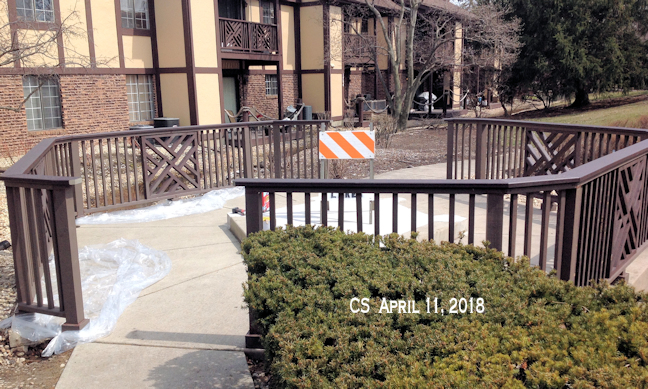
New fence - gazebo area, Spring 2018
Completed by Maintenance

New Bench - Gazebo Area
Completed by Maintenance, 2018
No sun sails because the obstructionist on the board and her followers refused to approve one, 
preferring a wooden pergola.  At this point I was done with their crap.


Additional Data Created via Reserve Studies and Expert Input

During my 8-year tenure on the board I created numerous spreadsheets and graphs for presentation to the board using Reserve Study, supplemental data and my own observations. They included 5-year, 10-year, 20-year and 30-year reserve expenditure projections. I also used some of this during annual meetings and presented it to the owners, who are our shareholders. Here's a graph which I created for the board and also presented to owners during the Annual Meeting held in September 2017. It presents the possible allocation of reserve spending for the next 5 years, and includes a little more than $127,000 for landscaping and tree replacements.  In fact, the boards since 2014 have allocated additional annual funding in recognition of landscaping problems including diseased and dying, or dead, trees and shrubbery.  The amounts are explained as follows.

The additional funding prior to the 2018 budget was before the die-out of the thousands of Viburnum shrubs on the property was identified and realized.  It is possible that additional replacement funds will be required.

In 2017-2018 I promoted the removal of dead, dying and diseased shrubs to be replaced with grass. This would maintain the appearance of the property while the board decided upon and allocated funds for a longer term replacement. 

This has not occurred. In 2018 a bid was obtained by our Landscaping Contractor but was not accepted because it did not follow the guidelines, which specifically asked for low care shrubbery and planting which could thrive without special watering, which would increase water consumption and in turn increase annual water expense because there is labor expense involved. At the time the bidder was promoting changes to the front entry landscaping. I replied, in the presence of our professional manager that "There are no funds currently available for this, and it is more important that the viburnum problem be addressed first. Apparently the boards of 2019-2021 that followed did not agree with that approach, and decided to work on the North entry landscaping while delaying the shrubbery problem.

Here's a chart I prepared and presented in 2017:

2017 Reserve Study Expenditure Chart 2017-2022
Does not include supplemental amounts added by boards and
is not current, as it does not include board decisions 2019-2021.

Boards have full discretion of how reserve funds are spent, and at what pace.  For example, an extra-ordinary amount of work was done in 2017-2018 to complete all stream repairs and complete the drainage projects throughout the grounds, in addition to ongoing garage floor replacements, driveways, street repairs and so on. As a consequence expenditures exceeded income to the reserves.  The boards of 2019-2021  decided not to replace dead shrubbery. It also decided not to do street repairs as dictated by condition surveys in 2016-2018.

My first charts to the board and owners

I used an incomplete reserve study ordered by the board of 2008-2009 as the basis for some deep dive financial planning. I constructed a series of spreadsheets, and from those, a series of charts.  Here are a few I created and which were presented to owners shortly after I was elected, September 2010. They addressed planning issues for some critical infrastructure.  They did not include landscaping or tree issues, because there was insufficient data available.  Within two years this was addressed. Furthermore, problems with drainage created by the new roofing project was just beginning to surface, with only about 20% of the roofs completed:


The Water Mains
Our association owns and maintains all of the water mains on the property. This is an odd, and expensive situation. To prepare to turn over the mains to the City of Wheaton, in 2012 I undertook a more aggressive maintenance program. It would be ridiculous to assume the city will take over mains which were not maintained. Of my own volition I began earnest discussions with the city engineer and other city officials. 

All of the mains which are beneath Salisbury Ct and cross beneath Lakecliffe Blvd were replaced during the street projects of 2014-2015.  I was the motive force for including the replacement of mains in the projects. There were a lot of concerns about the impact on the balances of the reserves (the Replacement Fund) and possible fee increases. But tightened financial controls accomplished what many owners and some board members insisted was not possible.  Reserve balances were maintained, all projects were addressed and annual fee increases during my tenure, from the period 2010 to 2018 averaged 1.50% per year. The prior board includes a 7.0% fee increase for the budget created in October 2010 because of a faulty reserve study, created under the oversight of the board of 2009-2010.  It took a lot of work on my part, another reserve study and an update to prove that such a fee increase was unnecessary with proper board oversight of the association

My approach was terribly confrontational to entrenched, incapable, or unprepared board members.  Amateurs are dangerous to the financial well-being of the owners is my mantra, and I have been proven to be correct.

For more about these projects, click on:  Link to Street Repairs and Projects


(C) N. Retzke 2021